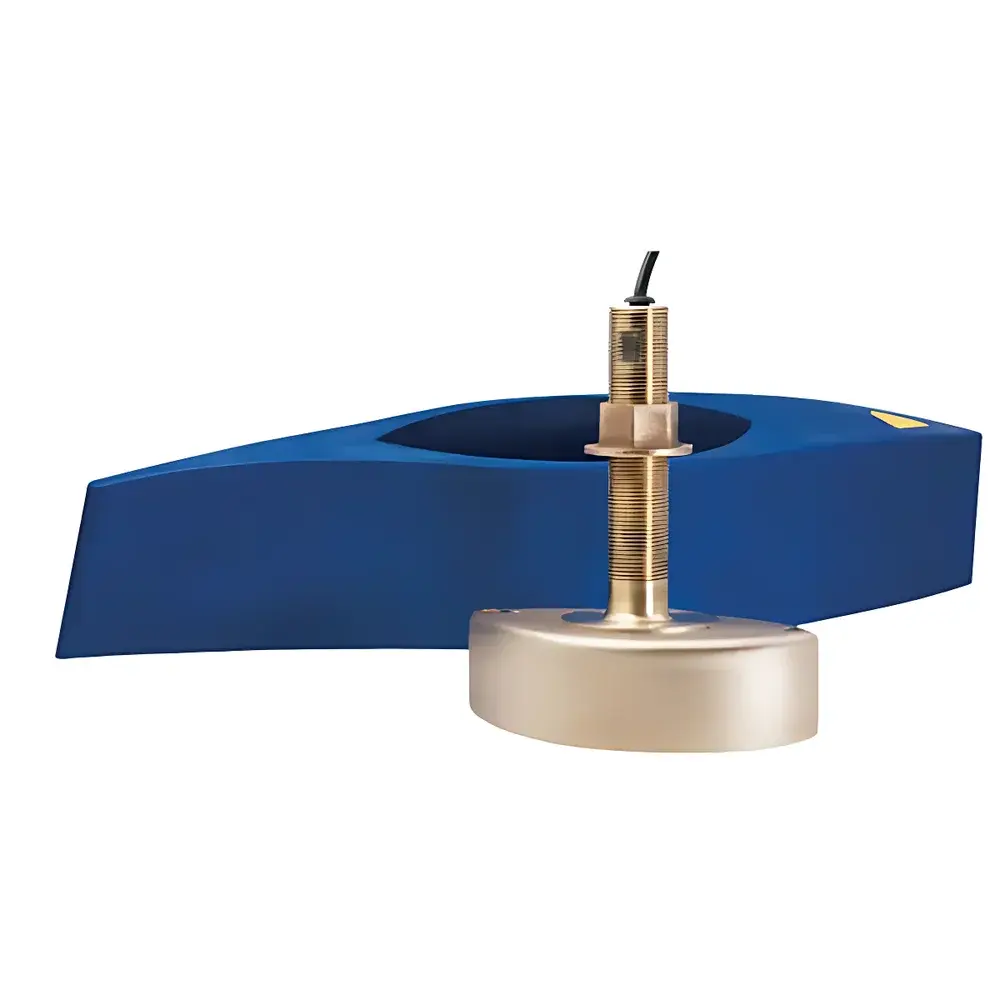
AirMar B258 Through-Hull Depth Sounder Transducer
| Brand | AIRMAR |
|---|---|
| Origin | USA |
| Model | B258 |
| Power Output | 1000 W |
| Operating Frequencies | 50 kHz / 200 kHz |
| Beam Width | 14° × 23° @ 50 kHz / 3° × 5° @ 200 kHz |
| Housing Material | Bronze |
| Mounting Type | Through-Hull |
| Cutout Diameter | 30 mm |
| Stub Length | 121 mm |
| Cable Length | 10 m |
| Integrated Temperature Sensor | Yes, ±0.2°C accuracy |
| Maximum Hull Tilt Angle | 26° (with fairing) |
| Lens Material | Epoxy/Polyurethane |
| Weight | 3.6 kg |
Overview
The AirMar B258 is a high-output, through-hull mounted depth sounder transducer engineered for reliable hydroacoustic performance in recreational and light commercial marine environments. It operates on dual-frequency sonar principles—utilizing both 50 kHz (long-range, deep-water penetration) and 200 kHz (high-resolution, shallow-water imaging)—to deliver consistent bottom detection, contour mapping, and fish-target discrimination. Its design adheres to fundamental acoustic transduction physics: piezoceramic elements convert electrical energy into mechanical vibrations at resonant frequencies, generating pressure waves that propagate through water; returning echoes are captured and converted back into electrical signals for digital processing. The B258’s bronze housing provides corrosion resistance and structural rigidity, while its elliptical acoustic lens geometry optimizes beam coverage across varying hull configurations. Designed for vessels up to 9 meters (30 feet), it supports real-time depth profiling with minimal signal attenuation, even under dynamic vessel motion or turbulent flow conditions.
Key Features
- Dual-frequency operation (50/200 kHz) enables adaptive depth ranging—from shallow inshore zones to offshore depths exceeding 300 meters (depending on water clarity and bottom composition)
- 1000 W peak power output ensures strong signal-to-noise ratio and improved target resolution in turbid or thermally stratified waters
- Patented XducerID® technology allows automatic transducer identification and configuration within compatible multifunction displays (MFDs), reducing setup time and eliminating manual parameter entry errors
- Integrated fast-response temperature sensor (±0.2°C accuracy) supports real-time sound velocity correction, enhancing depth measurement fidelity per ISO 17025 traceable methodologies
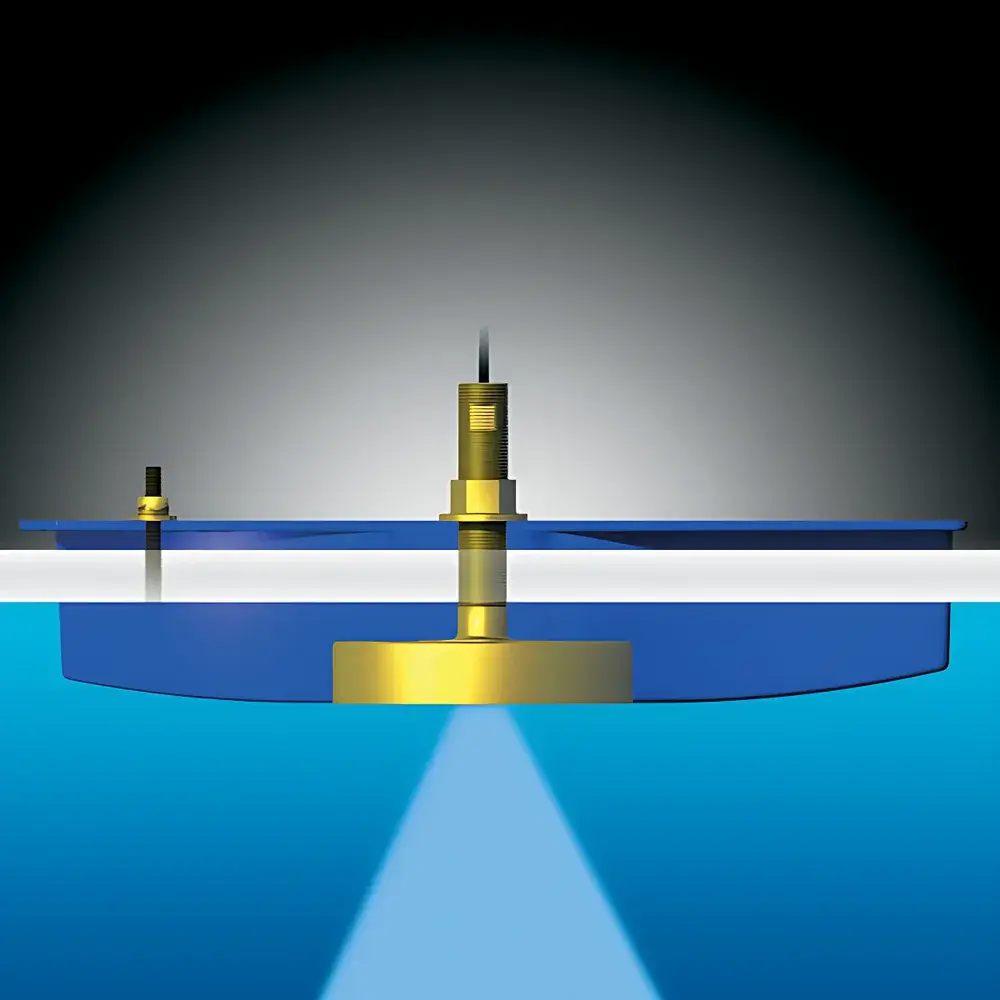
- Elliptical beam pattern (14° × 23° at 50 kHz; 3° × 5° at 200 kHz) delivers broader seabed coverage than conventional circular beams—particularly beneficial for detecting sloped or irregular terrain
- Streamlined bronze housing minimizes cavitation-induced noise and facilitates laminar water flow over the face, reducing air entrainment and improving echo return consistency
- Optional high-performance fairing kit enables custom contouring to match hull curvature, mitigating flow separation and optimizing acoustic coupling efficiency
Sample Compatibility & Compliance
The B258 is compatible with NMEA 2000-certified chartplotters and sonar processors from leading marine electronics manufacturers including Garmin, Raymarine, Simrad, and Furuno. Its through-hull installation method complies with ABYC TE-12 (Transducers) and ISO 8846 (Marine Electrical Systems – Safety Requirements). The epoxy/polyurethane acoustic window meets ASTM D412 tensile strength standards and exhibits UV stability per ISO 4892-2. All materials—including the bronze housing and ceramic elements—are selected for long-term immersion service in saltwater environments and conform to RoHS Directive 2011/65/EU. While not certified for Class I Div 1 hazardous locations, the transducer meets IP68 ingress protection requirements when properly installed with OEM-sealed through-hull fittings.
Software & Data Management
The B258 does not include embedded firmware or onboard data storage; instead, it functions as an analog/digital hybrid transducer interfacing via NMEA 2000 or proprietary analog outputs (e.g., CHIRP-ready pulse modulation). When integrated into a compliant MFD ecosystem, raw echo log data can be archived in industry-standard formats (e.g., .nmea, .gpx, or vendor-specific .sdcard logs) supporting post-processing in third-party hydrographic analysis tools. XducerID® metadata—such as frequency pair, beam angle, and serial-linked calibration coefficients—is transmitted over the NMEA 2000 bus, enabling automated gain compensation and ensuring repeatable measurement conditions across device swaps. For regulatory documentation, audit trails of transducer configuration changes are maintained within supported MFD firmware per GLP-aligned logging protocols.
Applications
- Recreational sportfishing vessels (center consoles, walkarounds, and bay boats up to 9 m LOA)
- Small commercial workboats engaged in coastal survey support, aquaculture monitoring, or dredge guidance
- Scientific auxiliary platforms requiring robust, low-maintenance depth referencing in estuarine and near-shore marine research
- Marine training simulators where realistic sonar response modeling is required for operator proficiency development
- Integration into autonomous surface vehicle (ASV) navigation stacks for bathymetric SLAM (Simultaneous Localization and Mapping) applications
FAQ
What hull materials are compatible with the B258 through-hull installation?
Fiberglass, aluminum, and steel hulls are fully supported; wood requires additional sealing considerations and is not recommended without professional marine surveyor validation.
Can the B258 be used with CHIRP sonar systems?
Yes—its broadband ceramic elements and 1000 W amplifier interface support wideband pulse compression when connected to CHIRP-capable MFDs.
Is temperature compensation mandatory for accurate depth readings?
While optional, real-time temperature input significantly improves sound velocity calculation per UNESCO algorithm, particularly in variable salinity or thermal gradient conditions.
Does the B258 require anti-fouling paint on the lens surface?
No—epoxy/polyurethane lens material is incompatible with copper-based antifoulants; use only silicone-based or foul-release coatings approved for transducer windows.
How does hull tilt affect beam alignment, and what is the maximum allowable angle?
Up to 26° hull deadrise is accommodated using the optional fairing; beyond this, beam skew increases measurement uncertainty and may necessitate custom mounting bracket fabrication.