
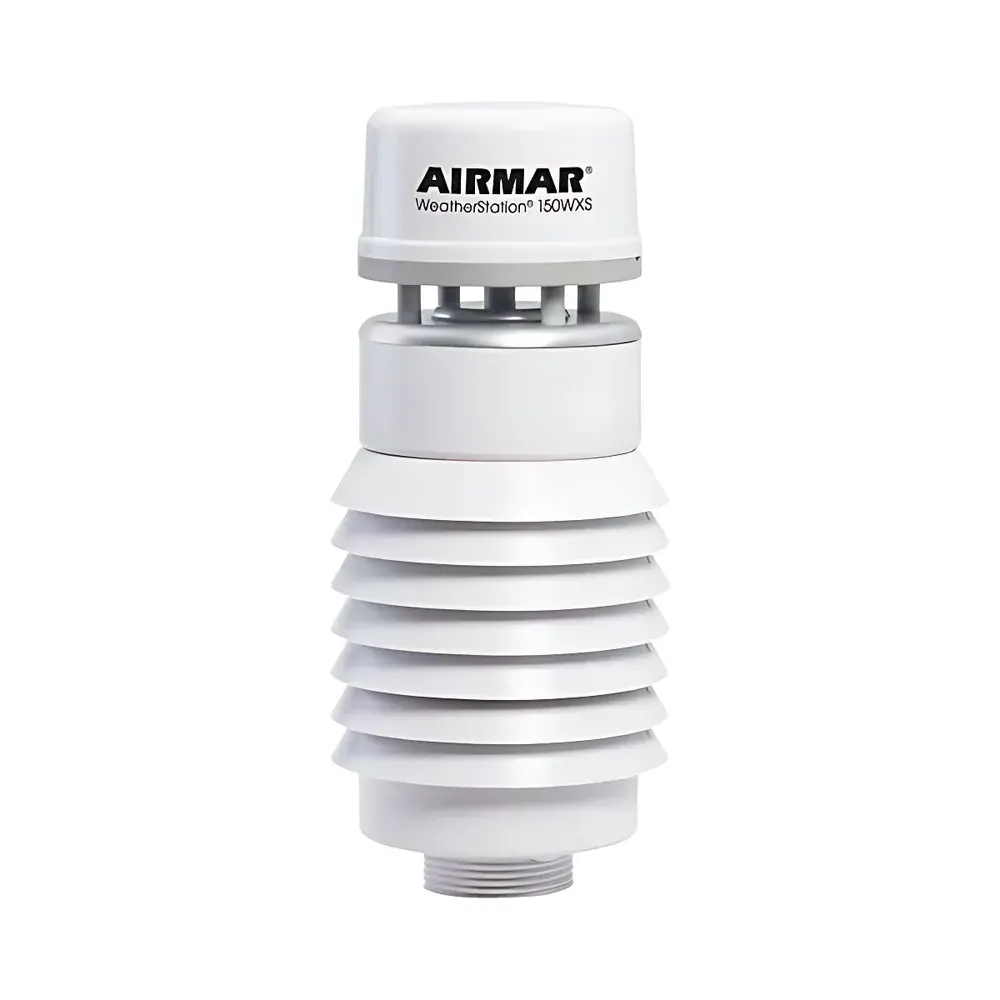
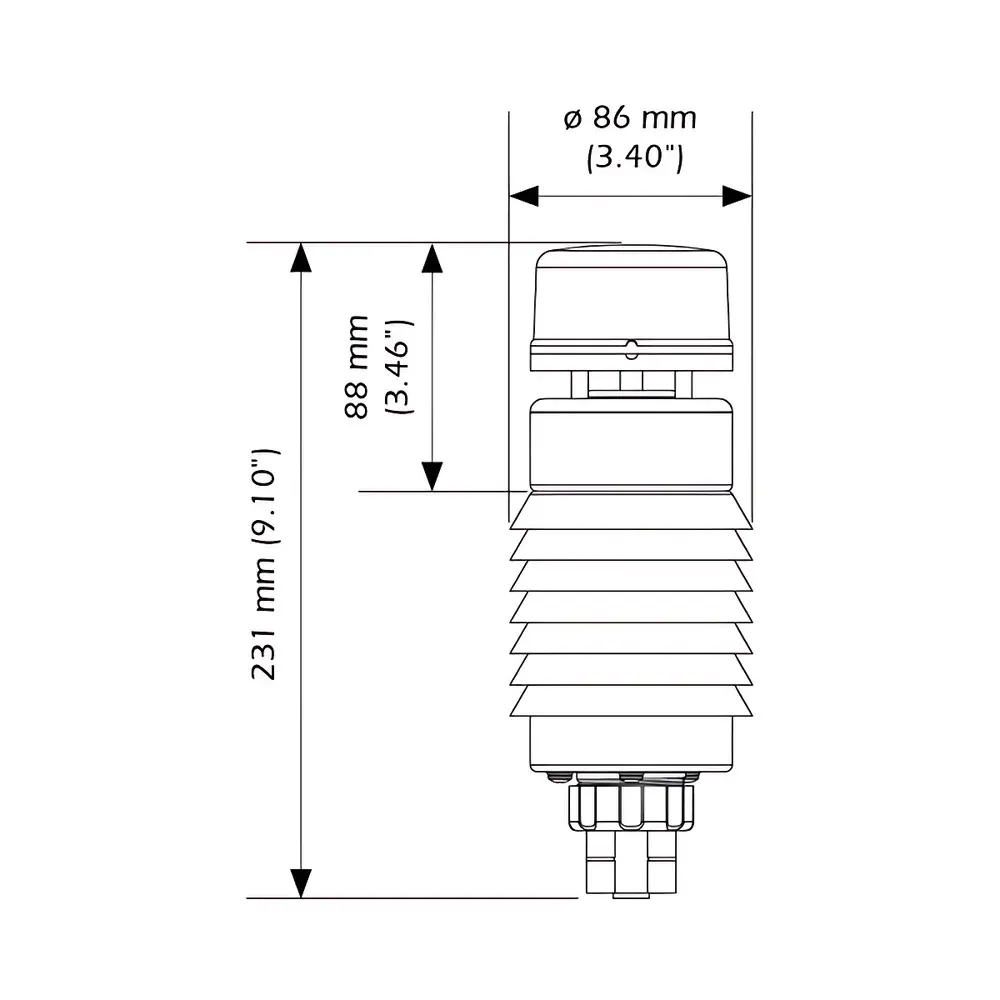
AirMar 150WXS Ultrasonic Weather Station
| Brand | AIRMAR |
|---|---|
| Origin | USA |
| Model | 150WXS |
| Instrument Type | Portable Weather Station |
| Output Interface | RS232 / RS422 |
| GPS Update Rate | 10 Hz |
| Compass Accuracy | <1° |
| Enclosure Rating | IP66 |
| Operating Temperature Range | -30°C to +70°C |
| Wind Measurement Principle | Ultrasonic Time-of-Flight |
| Temperature & Humidity Shield | Integrated Solar Radiation Shield |
| Data Output Frequency | Up to 4 Hz for meteorological parameters |
Overview
The AirMar 150WXS Ultrasonic Weather Station is a fully integrated, compact environmental sensor system engineered for high-reliability meteorological data acquisition in demanding outdoor and mobile applications. Unlike traditional cup-and-vane anemometers, the 150WXS employs ultrasonic time-of-flight technology to measure true apparent wind speed and direction without mechanical moving parts—eliminating wear, inertia lag, and directional dead zones. This principle relies on precise timing of ultrasonic pulse transmission and reception across orthogonal transducer pairs, enabling sub-second response to turbulent flow structures and accurate vector resolution even at low wind speeds (<0.1 m/s). Complementing wind sensing, the unit integrates calibrated digital sensors for air temperature, relative humidity, and barometric pressure—all housed within a NIST-traceable, naturally aspirated solar radiation shield that meets WMO Class B thermal shielding specifications. The built-in 10 Hz GPS engine provides synchronized positional metadata (latitude, longitude, altitude), course over ground (COG), speed over ground (SOG), and UTC timestamps—critical for spatially referenced environmental logging and mobile platform integration.
Key Features
- Ultrasonic Wind Sensing: Dual-axis transducer array delivers continuous wind vector output at up to 4 Hz with no moving parts, ensuring long-term stability and minimal maintenance across marine, agricultural, and construction deployments.
- Thermally Optimized Environmental Sensing: Integrated WMO-compliant solar radiation shield minimizes radiative heating errors, enabling ±0.3°C accuracy for air temperature and ±2% RH uncertainty for relative humidity under full sun exposure.
- High-Fidelity Pressure Transduction: Absolute barometric pressure sensor with temperature compensation, factory-calibrated to ±0.1 hPa accuracy over the full operating range (500–1100 hPa).
- Embedded Navigation Engine: 10 Hz GPS module compliant with ICAO Annex 10 standards, delivering position, velocity, and time (PVT) data with <2.5 m CEP horizontal accuracy and sub-millisecond timestamp resolution.
- Precision Heading Reference: Solid-state 2D electronic compass with <1° heading accuracy (RMS), compensated for local magnetic declination and tilt via integrated accelerometer fusion.
- Ruggedized Industrial Design: IP66-rated marine-grade enclosure with UV-stabilized polycarbonate housing, corrosion-resistant stainless-steel mounting hardware, and wide-temperature operation (-30°C to +70°C).
Sample Compatibility & Compliance
The 150WXS is designed for direct exposure to ambient atmospheric conditions and requires no sample conditioning or inlet filtration. It complies with IEC 60945 (marine electronic equipment), EN 61000-6-2/-6-4 (EMC immunity/emission), and MIL-STD-810G Method 509.6 (humidity resistance). Its pressure and temperature calibration traceability aligns with ISO/IEC 17025-accredited laboratory practices. While not certified for aviation-grade weather reporting, its measurement uncertainty profiles meet ASTM D5096 (standard practice for wind speed and direction instrumentation) and support GLP-compliant field data collection when deployed with validated data loggers.
Software & Data Management
The 150WXS outputs ASCII-formatted NMEA 0183 sentences (MWV, MWD, GGA, VTG, HDT) and proprietary binary protocols over RS232 or RS422 serial interfaces (configurable baud rates up to 115.2 kbps). No proprietary drivers are required; raw data streams integrate natively with industry-standard platforms including Campbell Scientific LoggerNet, LabVIEW DAQmx, Python-based PySerial pipelines, and cloud telemetry gateways (e.g., AWS IoT Core, Azure IoT Hub). Timestamped data supports post-processing for derived indices—including wind chill, heat index, dew point, and sea-level pressure correction—using embedded algorithms consistent with NOAA/NWS methodologies. Audit-ready logging is achievable when paired with time-synchronized hosts supporting RFC 5424 syslog or IEEE 1588 PTP v2 synchronization.
Applications
- Agricultural Precision Operations: Real-time microclimate monitoring on spray rigs and autonomous tractors to optimize pesticide application windows and minimize drift risk based on boundary-layer wind shear profiles.
- Construction Site Environmental Compliance: Continuous regulatory-grade monitoring of wind speed/direction for crane operation safety thresholds and dust suppression control systems.
- Mobile Atmospheric Profiling: Integration into unmanned aerial vehicles (UAVs), survey vessels, and emergency response vehicles for spatiotemporal mapping of near-surface meteorological gradients.
- Renewable Energy Support: Pre-construction wind resource assessment and turbine wake characterization in distributed wind farm feasibility studies.
- Educational & Research Field Stations: Low-footprint deployment for long-term ecological monitoring networks requiring minimal power (typical draw: 120 mA @ 12 VDC) and robust data continuity.
FAQ
Does the 150WXS require periodic recalibration?
No scheduled recalibration is mandated by AirMar; however, annual verification against traceable reference standards is recommended for GLP/GMP-aligned deployments.
Can the device operate independently without external power?
It requires a stable 9–32 VDC supply; internal battery backup is not provided—external power management must be implemented for unattended operation.
Is firmware upgrade capability supported?
Yes, field-upgradable via UART using AirMar’s official configuration utility (Windows/Linux compatible) and documented command set.
What mounting options are available?
Standard 1″ NPT male thread and dual ¼”-20 UNC tapped holes enable pole, mast, or rail mounting; optional vibration-damping isolators are available through authorized distributors.
How is GPS antenna performance affected by nearby metallic structures?
Mounting clearance of ≥15 cm from conductive surfaces is advised to maintain signal integrity; active GPS antennas with extended coaxial cables may be used in constrained installations.
Related Products







