
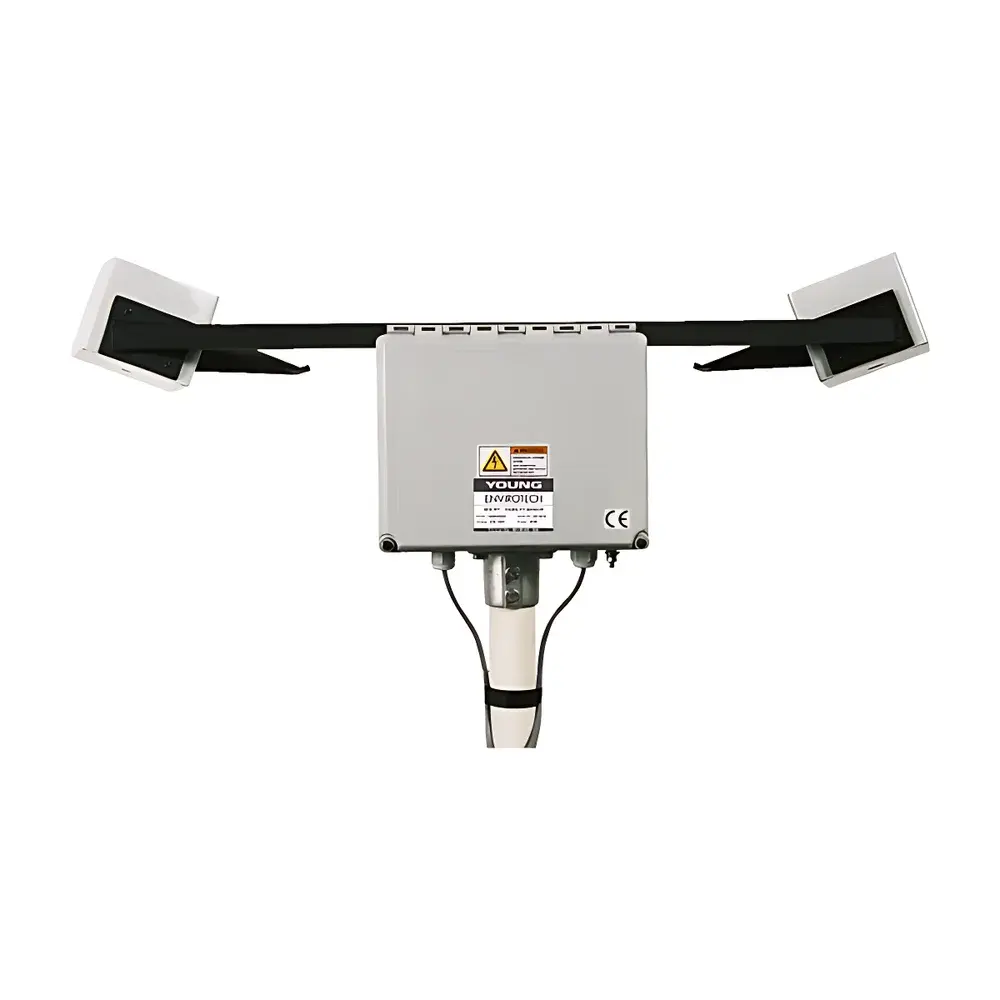

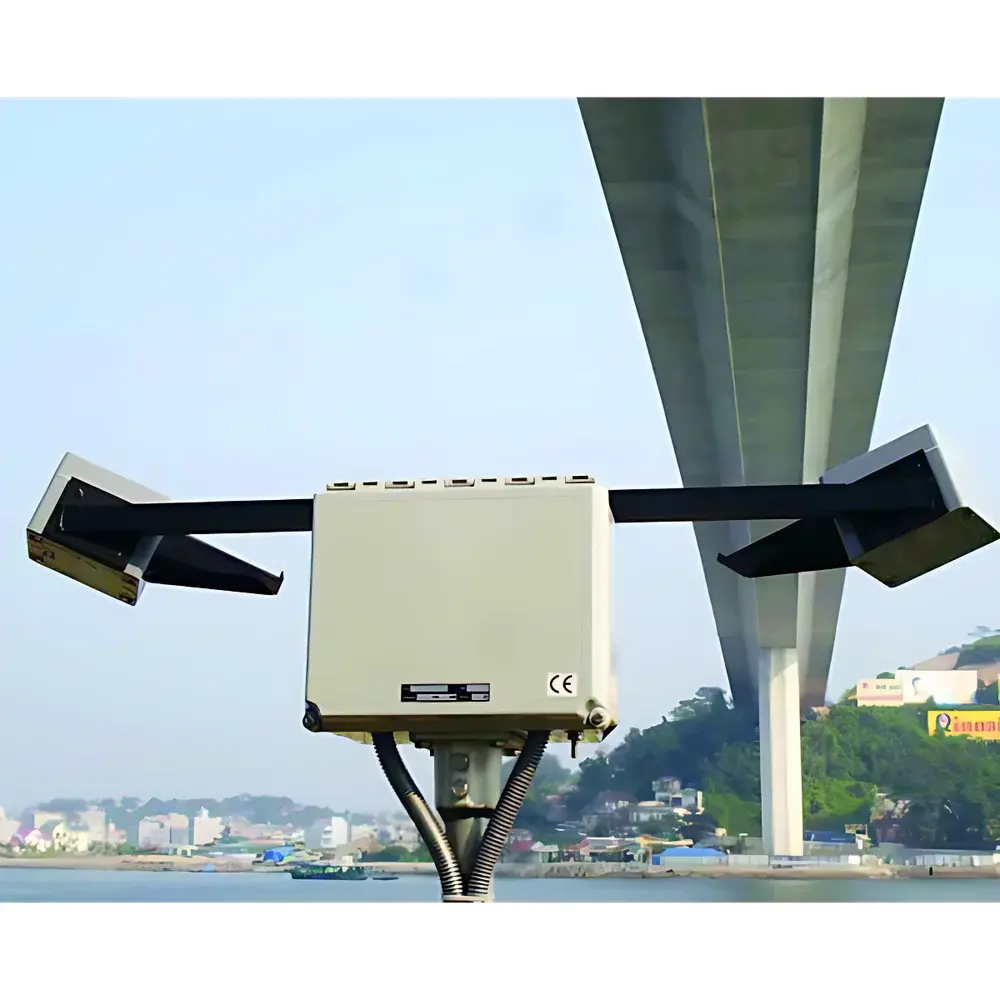
R.M. Young 73000 Sentry™ Forward Scatter Visibility Sensor
| Brand | R.M. Young |
|---|---|
| Origin | USA |
| Model | 73000 |
| Weight | 8 kg |
| Operating Temperature | -40 to +60 °C |
| Supply Voltage | 10–36 VDC |
| Measurement Range | 30 m – 16 km |
| Accuracy | ±10% RMSE |
| Time Constant | 60 s |
| Scattering Angle | 42° (nominal) |
| Output Options | 0–10 VDC |
| Relay Options | 2 control relays, 1 diagnostic relay |
| Power Consumption | 6 VA (nominal), 18 VA (with heated shroud) |
| Ingress Protection | IP66 (NEMA-4X) |
| Dimensions | 889 mm × 292 mm × 305 mm (W × H × D) |
| Mounting | 48 mm (1.9″) for 1.5″ IPS pipe (standard), optional 34 mm (1.3″) for 1″ IPS pipe |
| Housing Material | Anodized aluminum frame, UV-stabilized fiberglass enclosure |
| Compliance | EN 61326-1:2010, EMC Directive 2014/30/EU, RoHS Directive 2011/65/EU |
Overview
The R.M. Young 73000 Sentry™ Forward Scatter Visibility Sensor is an industrial-grade meteorological instrument engineered for continuous, high-reliability measurement of Meteorological Optical Range (MOR) in outdoor environments. It operates on the principle of forward scatter photometry: a collimated infrared light beam (typically 850 nm) is transmitted across a 30-meter baseline; airborne particulates—including fog droplets, rain, snow, dust, haze, and smoke—scatter light at a nominal angle of 42°, which is detected by a precisely aligned photodiode array. The intensity of scattered radiation correlates with aerosol concentration and particle size distribution, enabling robust MOR estimation from 30 meters to 16 kilometers. Designed in accordance with operational requirements validated by the U.S. National Weather Service (NWS) and Federal Aviation Administration (FAA), the sensor employs a downward-looking optical geometry to minimize window contamination, ice accumulation, and snow bridging—critical advantages over horizontal-path or backward-scatter configurations in unattended, all-weather deployments.
Key Features
- Integrated internal cabling architecture eliminates external junction boxes and reduces vulnerability to moisture ingress, rodent damage, and mechanical strain.
- Anodized aluminum structural frame and UV-stabilized fiberglass housing ensure long-term dimensional stability and resistance to solar degradation, salt fog, and thermal cycling.
- Heated optical window with continuous anti-condensation operation maintains optical clarity under high-humidity and sub-zero conditions.
- Optional thermostatically controlled heated shroud (model 73004D) extends operational envelope into extreme cold or high-snowfall regions.
- Comprehensive electromagnetic immunity: all power and signal lines incorporate multi-stage surge suppression and EMI filtering per IEC 61000-4 standards.
- IP66 (NEMA-4X) rated enclosure guarantees protection against powerful water jets and total dust ingress—validated for permanent outdoor mounting without auxiliary enclosures.
- Standard 1.5″ IPS pipe-mounting flange (48 mm OD) enables rapid deployment on towers, masts, or traffic poles; optional 1″ IPS adapter (34 mm OD) available for legacy infrastructure compatibility.
Sample Compatibility & Compliance
The 73000 Sentry™ is designed for ambient atmospheric sampling only—not for controlled laboratory chambers or ducted airflow systems. Its forward-scatter geometry provides representative MOR values for aviation weather reporting (METAR/SPECI), highway visibility monitoring (ITS applications), airport runway visual range (RVR) support, and environmental compliance tracking. The sensor meets EN 61326-1:2010 for electromagnetic compatibility in industrial environments and complies with EU directives 2014/30/EU (EMC) and 2011/65/EU (RoHS). While not certified to FAA TSO-C136 or ICAO Annex 3 directly, its design heritage aligns with NWS ASOS/AWOS system specifications and supports integration into systems requiring traceable calibration per ISO/IEC 17025-accredited procedures.
Software & Data Management
The 73000 outputs analog and digital signals natively—requiring no proprietary firmware or driver installation. Standard output options include 0–10 VDC, 0–5 VDC, isolated and non-isolated 4–20 mA loops, and configurable serial interfaces (RS232, RS422, RS485) supporting ASCII or Modbus RTU protocols. Two programmable control relays support local alarm triggering (e.g., low-visibility thresholds), while a dedicated diagnostic relay reports heater status, signal saturation, or communication faults. Calibration data is stored internally and accessible via serial command; field recalibration uses the factory-provided 73062 calibration fixture—completed in under 30 minutes without disassembly or optical realignment. All configuration parameters are retained through power cycles, and no battery-backed memory is required.
Applications
- Airport surface visibility monitoring for Low Visibility Procedures (LVP) and Runway Visual Range (RVR) estimation.
- Highway Intelligent Transportation Systems (ITS) for dynamic speed advisory, lane closure, and variable message sign activation.
- National weather service networks (e.g., ASOS, AWOS, RAWS) requiring long-term unattended operation.
- Environmental monitoring stations tracking regional haze, wildfire smoke dispersion, and PM2.5/PM10 proxy trends.
- Railway signaling systems where fog-induced signal masking poses safety risks.
- Wind farm site assessment for turbine de-icing and maintenance scheduling based on persistent low-visibility events.
FAQ
What is the recommended calibration interval?
Annual calibration is recommended for operational continuity; however, field verification using the 73062 calibration fixture may be performed quarterly in high-pollution or coastal environments.
Can the sensor operate during heavy rainfall or snowfall?
Yes—the downward-looking geometry, heated window, and IP66-rated housing enable reliable performance during precipitation events. Snow accumulation on the upper housing is shed naturally due to the sloped profile and thermal gradient.
Is the 73000 compatible with SCADA or cloud-based data platforms?
Yes—via RS485 Modbus RTU or 4–20 mA analog output, it integrates seamlessly with industry-standard PLCs, RTUs, and IIoT gateways supporting MQTT or HTTP(S) telemetry ingestion.
Does the unit require grounding beyond standard electrical code practices?
Yes—a dedicated low-impedance earth ground (<5 Ω) is required for surge protection effectiveness and noise rejection in high-lightning-risk zones.
What documentation is provided for regulatory audits?
Factory calibration certificate (traceable to NIST), CE Declaration of Conformity, EMC test report summary, and RoHS compliance statement are included with each unit. Full test reports are available upon request for GLP/GMP-aligned deployments.
Related Products







