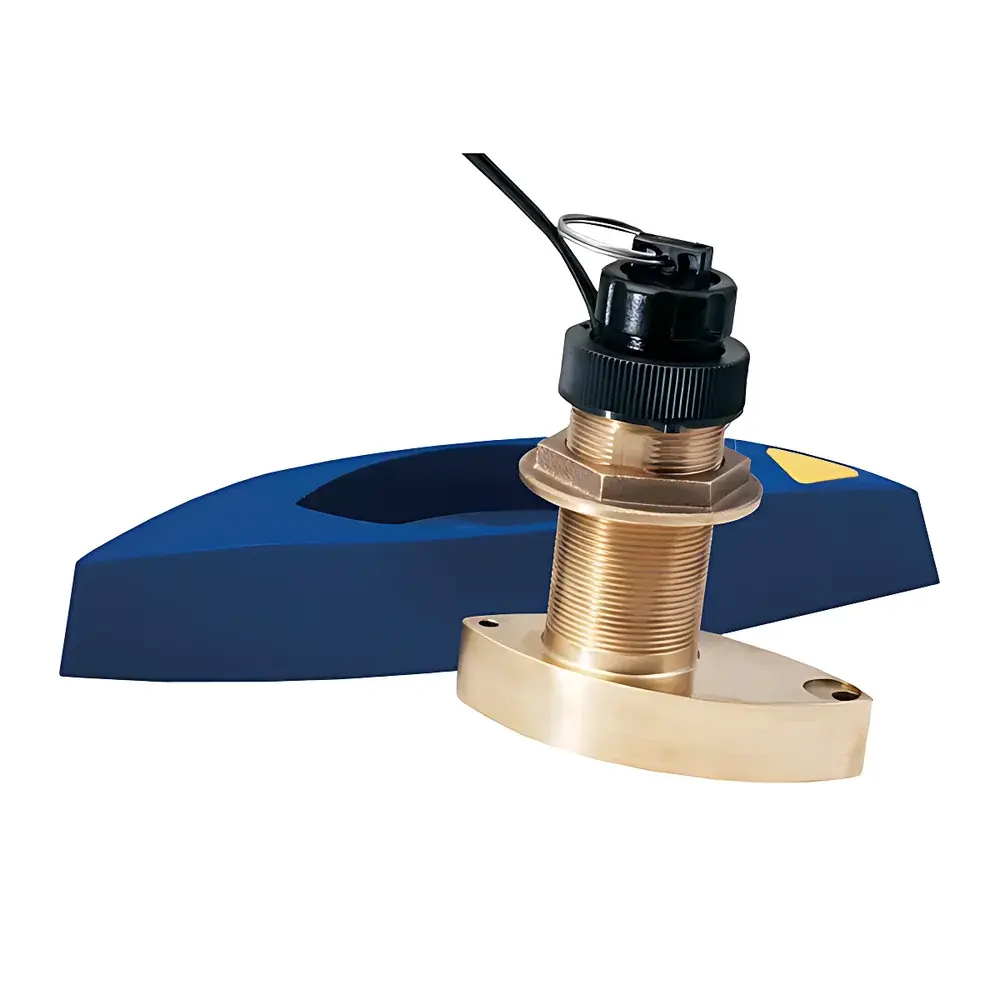
Airmar B744V TriDucer Through-Hull Depth, Speed & Temperature Transducer
| Brand | Airmar |
|---|---|
| Origin | USA |
| Model | B744V |
| Frequency Bands | 50 kHz / 200 kHz |
| Beamwidth | 45° @ 50 kHz |
| Transmit Power | 600 W |
| Maximum Depth Range | 235–353 m (50 kHz), 118–206 m (200 kHz) |
| Hull Penetration Diameter | 51 mm |
| Fixed Shaft Length | 121 mm |
| Cable Length | 10 m |
| Housing Material | Bronze |
| Transducer Window | Polyurethane |
| Operating Speed Range | 1–45 knots |
| Maximum Hull Tilt Angle | 24° (with fairing) |
| Integrated Temperature Sensor | Yes |
| Integrated Paddlewheel Speed Sensor | Yes |
| Weight | 2.5 kg |
| Compatible Hull Size | Up to 9 m (30 ft) |
Overview
The Airmar B744V TriDucer is an engineered-through-hull transducer designed for marine navigation and fisheries applications requiring concurrent, high-fidelity acquisition of depth, water speed, and temperature data. Utilizing dual-frequency piezoelectric ceramic elements operating at 50 kHz and 200 kHz, the B744V employs pulse-echo sonar principles to deliver accurate bottom detection and echo resolution across shallow to mid-depth coastal and lacustrine environments. Its integrated paddlewheel speed sensor—mounted laterally on the transducer body—minimizes flow disturbance while maintaining accuracy under cross-current conditions. The temperature sensor is embedded within the housing to ensure thermal equilibrium with ambient seawater or freshwater. Unlike multi-component installations, the B744V consolidates three critical vessel performance parameters into a single through-hull penetration, reducing hull integrity risk and simplifying system integration.
Key Features
- Triple-sensor integration: Simultaneous depth (sonar), speed (paddlewheel), and temperature (thermistor) measurement in one compact through-hull unit.
- Dual-frequency operation: 50 kHz for long-range bathymetric profiling (up to 353 m) and 200 kHz for high-resolution near-bottom imaging (down to ~1 m vertical resolution).
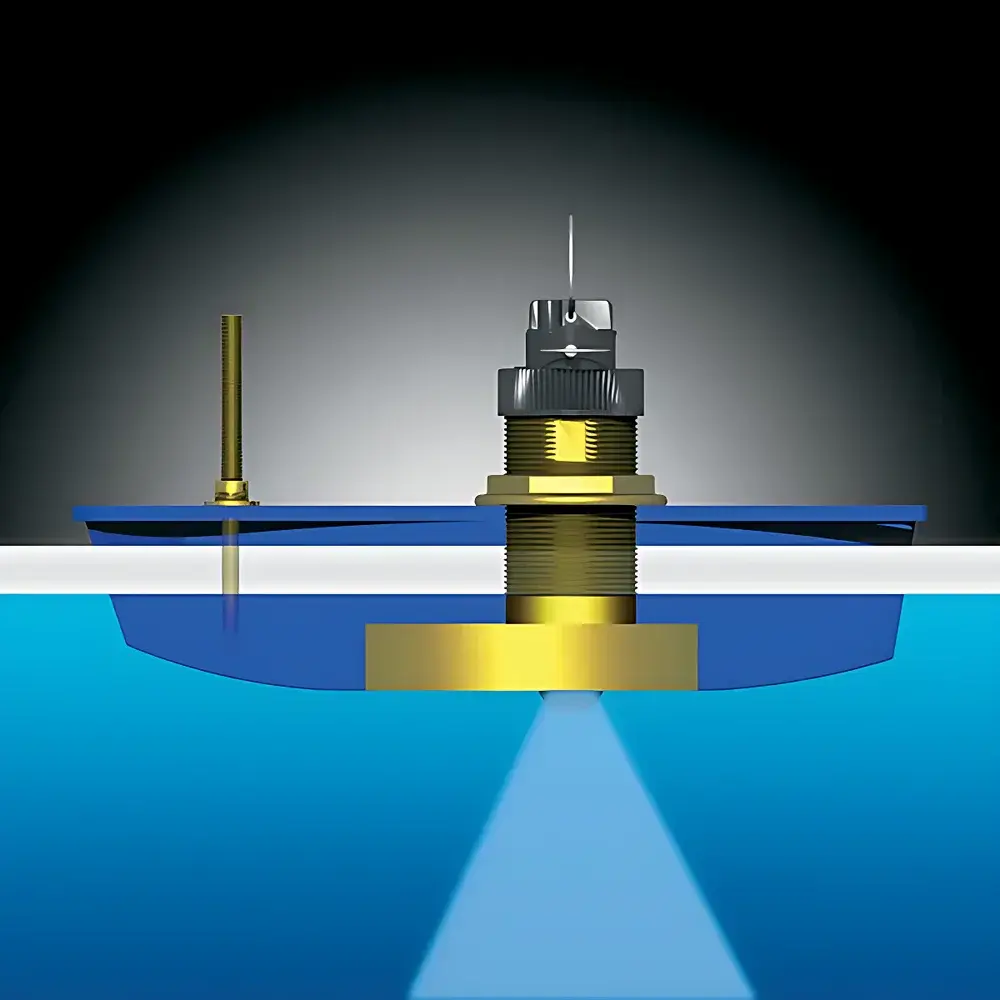
- Patented self-sealing valve mechanism: Enables safe removal of the internal transducer insert during maintenance without flooding the hull interior.
- Optimized hydrodynamic fairing compatibility: Designed to mate precisely with Airmar’s high-performance plastic fairings, reducing turbulence-induced noise and extending reliable operation up to 45 knots (52 mph).
- Lateral paddlewheel geometry: Blade orientation minimizes lateral slippage error in oblique flow, improving speed accuracy in crabbing or beam seas.
- Copper alloy housing with polyurethane acoustic window: Provides corrosion resistance in saltwater environments and optimal acoustic impedance matching for signal transmission.
- Fixed-shaft configuration: 121 mm shaft length ensures stable mounting in standard fiberglass or aluminum hulls; extended-length B744VL variant accommodates thicker or highly angled hull sections (up to 24° tilt).
Sample Compatibility & Compliance
The B744V is compatible with all major 600 W CHIRP-ready fishfinders and multifunction displays—including Furuno, Garmin, Lowrance, and Raymarine platforms—via standardized NMEA 0183 and NMEA 2000 interfaces. Its mechanical design conforms to ISO 8846 (Marine Electrical Systems – Safety Requirements) and ABYC E-11 (Electrical Systems Standards). The bronze housing meets ASTM B150/B150M specifications for naval brass alloys, while the polyurethane window complies with MIL-DTL-23713G for underwater acoustic transparency and abrasion resistance. Installation adheres to NMMA Certification guidelines for through-hull penetrations, including minimum hull thickness (≥6 mm fiberglass or ≥4 mm aluminum) and structural reinforcement recommendations. No proprietary firmware or vendor lock-in is required; raw analog sonar signals and digital NMEA outputs remain fully accessible for third-party data logging or custom visualization systems.
Software & Data Management
The B744V delivers native NMEA 0183 sentences (DPT, VLW, MWV, MTW) and NMEA 2000 PGNs (127250 Water Depth, 127251 Speed Water Referenced, 130311 Environmental Parameters) without protocol translation. When connected to compliant MFDs, real-time depth contours, speed-over-ground correction factors, and thermal stratification overlays are rendered automatically. For scientific deployment, the transducer supports time-synchronized data capture via external GPS timestamps (PGN 129029) and enables post-mission alignment with GIS platforms using standard GPX or CSV exports. Audit-trail-capable chartplotters (e.g., Garmin quatix or Raymarine Lighthouse OS v6+) log installation metadata—including hull angle calibration offsets and fairing type—ensuring traceability per GLP-aligned field data collection protocols.
Applications
- Coastal and inland commercial fishing: Real-time bottom discrimination for trawling, gillnetting, and pot setting in depths from 5 m to 300 m.
- Recreational and tournament angling: Identification of thermoclines, suspended bait schools, and hard/soft bottom transitions in lakes and estuaries.
- Hydrographic survey support: Preliminary bathymetric mapping where high-precision RTK-GNSS integration is supplemented by consistent speed-through-water input for Doppler correction.
- Vessel performance monitoring: Long-term trending of hull fouling effects via comparative speed-through-water vs. speed-over-ground analysis.
- Aquaculture site assessment: Bottom composition evaluation (sand/mud/rock) and seasonal temperature profiling for cage placement optimization.
FAQ
Does the B744V require a separate speed sensor or temperature probe?
No. All three sensing elements—depth (dual-frequency sonar), speed (mechanical paddlewheel), and temperature (embedded thermistor)—are integrated into a single sealed housing.
Can the B744V be installed on a metal hull?
Yes, provided the hull section is non-magnetic (e.g., aluminum) and electrically isolated from the transducer housing using the supplied insulating gasket kit. Stainless steel or ferrous hulls are not recommended due to acoustic attenuation and grounding interference.
Is the 10-meter cable shielded and rated for marine wet locations?
Yes. The cable assembly meets UL 1277 (Marine Instrumentation Cable) and IEC 60529 IP68 specifications for continuous submersion and UV resistance.
How does the self-sealing valve function during maintenance?
Upon unscrewing the outer retaining ring, an internal elastomeric sleeve compresses radially against the hull bore, forming a watertight seal before the transducer insert is extracted.
What is the minimum recommended hull thickness for through-hull installation?
6 mm for fiberglass, 4 mm for aluminum. Thinner hulls require structural backing plates per ABYC E-11 Section 4.6.2.