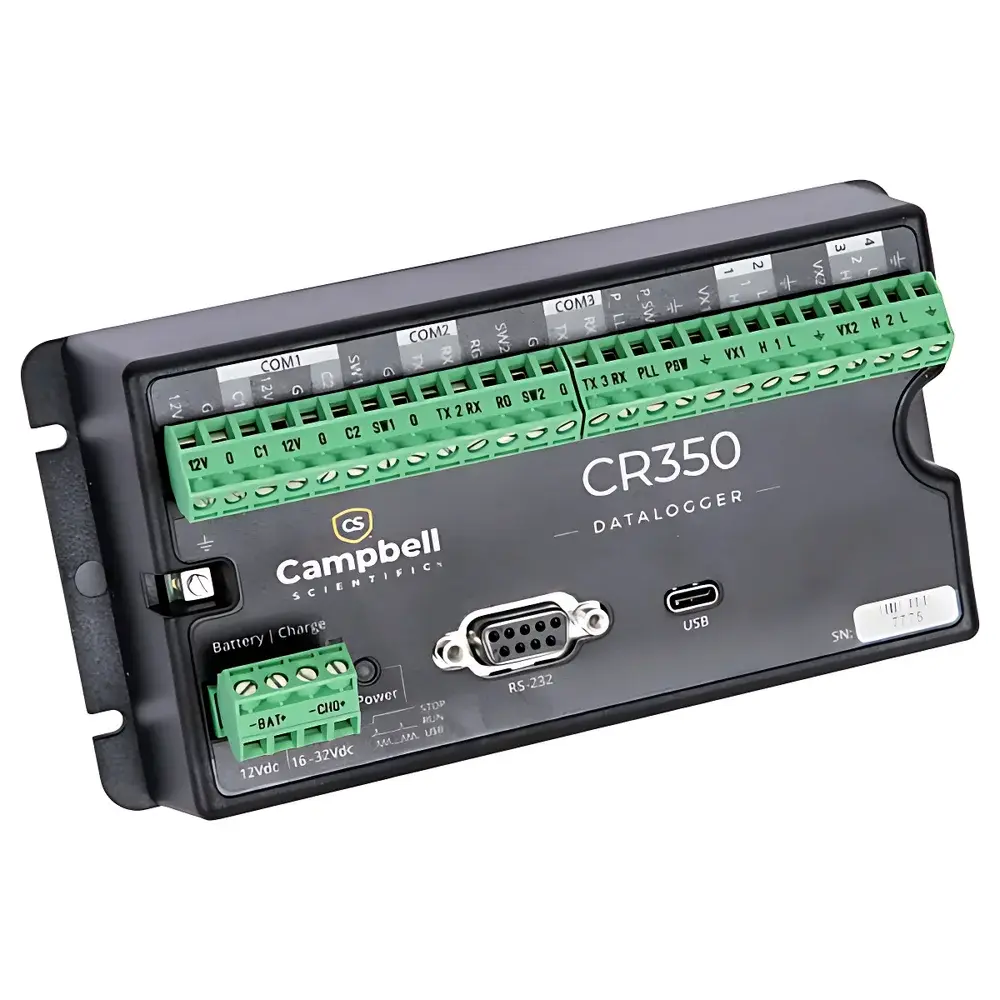
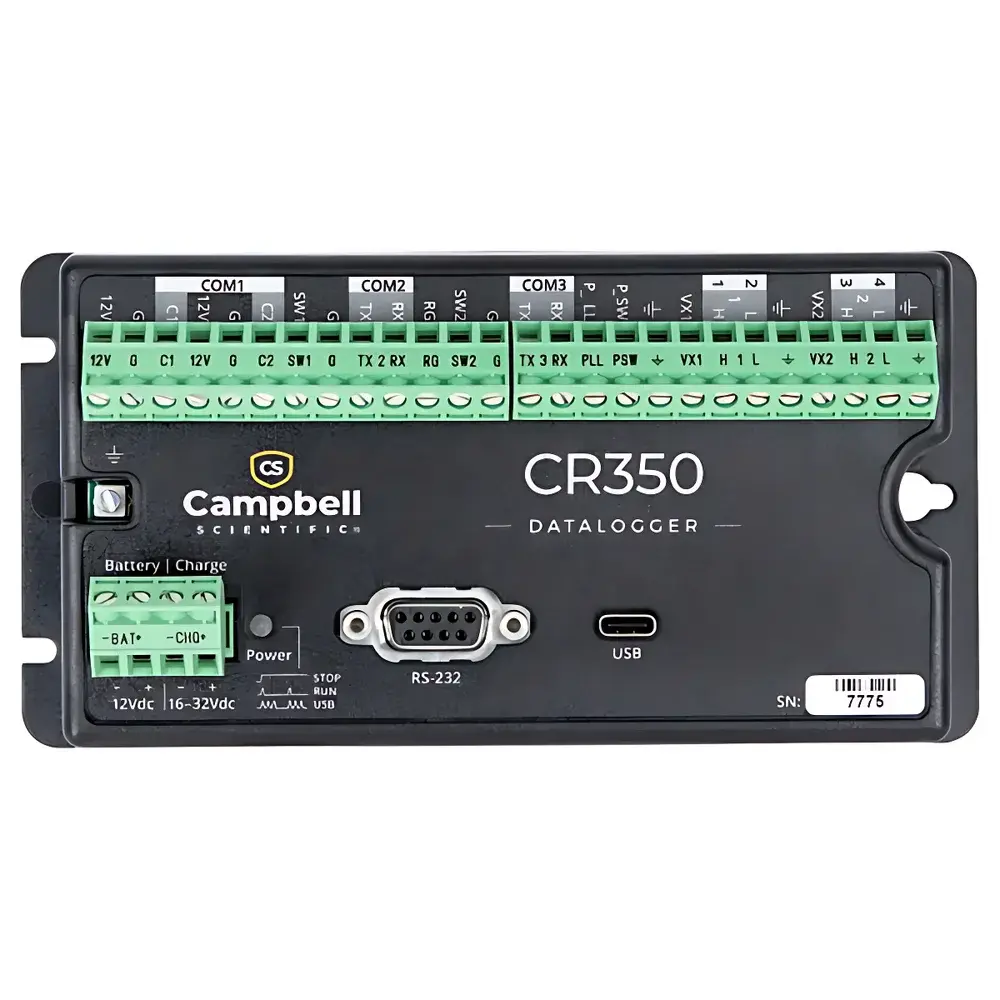
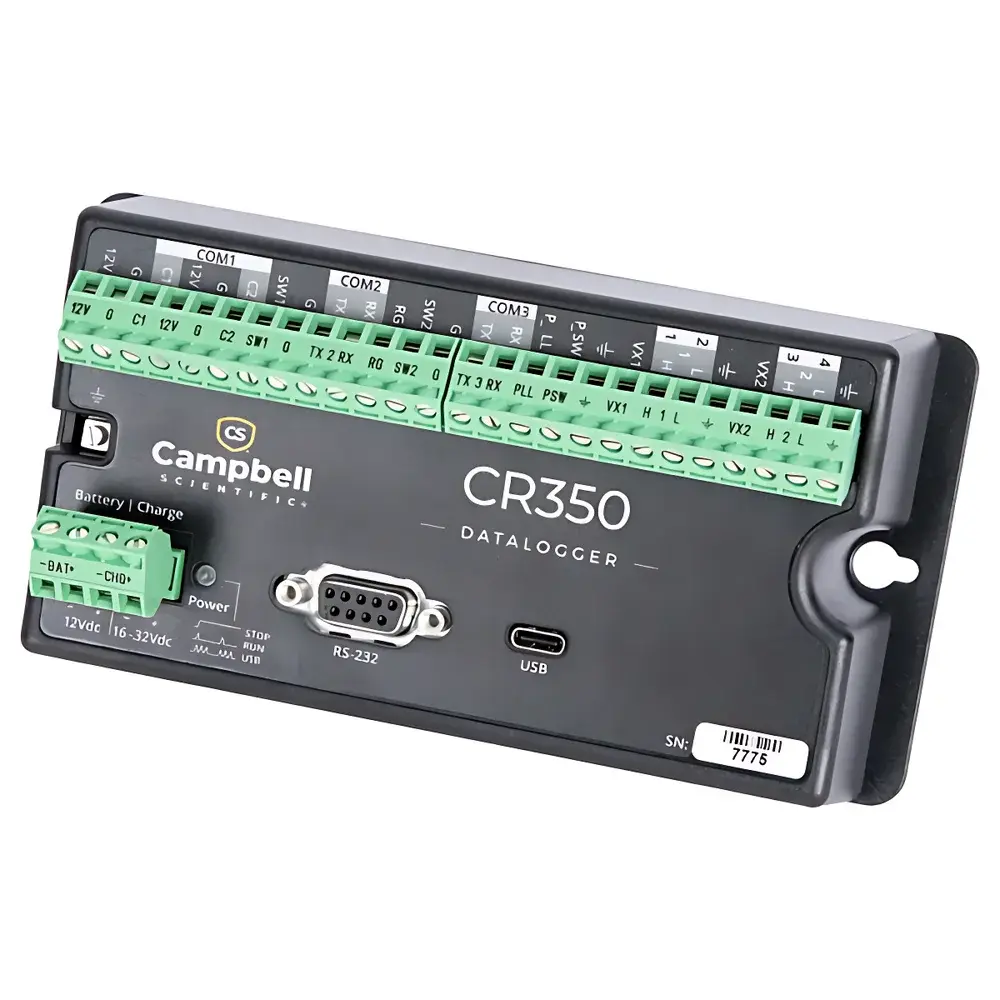
Campbell Scientific CR350 Data Acquisition Unit
| Brand | CAMPBELL |
|---|---|
| Origin | USA |
| Model | CR350 |
| Operating Temperature | -40 to +70 °C (standard, non-condensing) |
| Max Scan Rate | 10 Hz |
| Enclosure Material | High-impact polycarbonate (Recycling Code 7) |
| Analog Inputs | 4 single-ended or 2 differential (software-configurable) |
| Pulse Counters | 8 (P_SW, P_LL, C1, C2, SE1–SE4) |
| Excitation Terminals | 2 (VX1, VX2) |
| Communication Interfaces | USB Type-C 2.0, RS-232, RS-485 |
| 12 V Switched Power Outputs | 2 |
| Digital I/O | 7 (C1, C2, P_SW, SE1–SE4 |
| Input Range | -100 to +2500 mV |
| Analog Voltage Accuracy | ±(0.04% of reading + offset) at 0–40 °C |
| ADC Resolution | 24-bit |
| Power Supply Input (CHG) | 16–32 Vdc (max 1.1 A for charger/solar input) |
| Real-Time Clock Accuracy | ±1 min/month |
| Supported IP Protocols | Ethernet, PPP, RNDIS, ICMP/Ping, Auto-IP (APIPA), IPv4, IPv6, UDP, TCP, TLS v1.2, DNS, DHCP, SLAAC, NTP, Telnet, HTTP(S), FTP(S), SMTP/TLS, POP3/TLS, MQTT(S) |
| Communication Protocols | PakBus, PakBus Encryption, Modbus RTU/ASCII/TCP, DNP3, SDI-12 |
| CPU & Program Memory | 50 MB serial flash |
| Data Storage | 50 MB serial flash |
| Idle Current Draw | 0.5 mA (@ 12 Vdc) |
| Active Current Draw | 8 mA (@ 12 Vdc, processor always on) |
| Dimensions | 16.3 × 8.4 × 5.6 cm (6.4 × 3.3 × 2.2 in.) |
| Weight | 288–306 g (0.64–0.68 lb), depending on comms options |
Overview
The Campbell Scientific CR350 Data Acquisition Unit is a compact, ultra-low-power environmental and industrial data logger engineered for long-term, unattended field deployment. Designed around a deterministic real-time operating system and a robust 32-bit ARM Cortex-M4 processor, the CR350 performs synchronized measurement, control logic execution, and protocol-based data transmission with high reproducibility across temperature extremes. Its architecture follows the proven Campbell Scientific measurement philosophy—emphasizing signal integrity, galvanic isolation, and built-in transient protection—making it suitable for hydrological monitoring, micrometeorological networks, soil moisture profiling, and distributed industrial sensor systems where reliability under harsh conditions is non-negotiable. Unlike PC-based DAQ systems, the CR350 operates autonomously: it executes user-defined measurement sequences (via CRBasic programming), manages power states intelligently, and maintains time-synchronized datasets even during intermittent connectivity.
Key Features
- Ultra-low power consumption: 0.5 mA quiescent current enables multi-year operation on sealed lead-acid or lithium-thionyl chloride batteries, especially when paired with solar charging via its integrated 12 V battery regulator.
- Dual independent serial interfaces (RS-232/RS-485) support simultaneous communication with legacy sensors, telemetry radios (e.g., RF401, CELL2XX), and SCADA gateways—eliminating the need for external protocol converters.
- USB Type-C 2.0 interface provides high-speed configuration, firmware updates, and local data retrieval without requiring additional adapters or drivers.
- Eight pulse-counting terminals—including dedicated low-level (P_LL) and switch-closure (P_SW) inputs—enable precise accumulation of flow meter pulses, tipping-bucket rain gauge actuations, or event-triggered counters with debouncing and edge detection.
- Four analog input channels configurable as either single-ended or differential inputs, each with programmable gain, filtering, and excitation control—optimized for bridge circuits, thermistors, and low-level mV-output transducers.
- Seven multifunction digital I/O ports support diverse roles: digital input (with Schmitt-trigger conditioning), open-collector output, PWM generation for actuator control, and hardware-timed serial communication (e.g., SDI-12, Modbus RTU).
- Native support for TLS 1.2, MQTT(S), HTTP(S), and FTP(S) ensures secure, standards-compliant data delivery to cloud platforms (e.g., AWS IoT Core, Azure IoT Hub) or enterprise SCADA systems without middleware.
- Built-in PakBus networking stack allows seamless integration into existing Campbell Scientific sensor arrays—enabling peer-to-peer routing, data aggregation, and remote reprogramming over radio, cellular, or Ethernet backbones.
Sample Compatibility & Compliance
The CR350 interfaces directly with a broad spectrum of analog, digital, and smart sensors—including thermocouples (via external signal conditioners), RTDs, potentiometric displacement transducers, vibrating-wire piezometers, ultrasonic anemometers, and SDI-12 soil water content probes. Its analog input design complies with IEEE 1057 and IEC 61000-4-5 for surge immunity (±4 kV line-to-ground), while ESD protection meets IEC 61000-4-2 Level 4 (±15 kV air, ±8 kV contact). For regulated environments, the CR350 supports audit-trail-capable data logging when deployed with Campbell’s LoggerNet software configured for GLP/GMP workflows. Though not FDA 21 CFR Part 11-certified out-of-the-box, its deterministic timestamping, write-once memory allocation, and password-protected program editing provide foundational elements for validation in environmental monitoring applications aligned with ISO 17025 and ASTM D5092.
Software & Data Management
Configuration, programming, and data retrieval are managed through Campbell Scientific’s industry-standard LoggerNet software (Windows only), which provides full CRBasic editor integration, network topology visualization, automated data harvesting, and export to CSV, XML, or database formats (ODBC). The CR350 stores data in binary format with embedded metadata (sensor IDs, units, calibration coefficients), ensuring traceability across instrument lifecycles. On-device storage (50 MB serial flash) supports ring-buffer or file-based archival strategies; optional microSD card expansion (via third-party carrier board) extends capacity for high-frequency sampling. Remote management is enabled via Telnet, HTTP(S), or secure MQTT—allowing firmware updates, script uploads, and diagnostic queries without physical access. All communications can be encrypted using TLS 1.2 or PakBus Encryption, satisfying data-in-transit requirements for sensitive environmental or infrastructure monitoring programs.
Applications
- Remote watershed monitoring: Integration of pressure transducers, conductivity sensors, and stage gauges for real-time flood forecasting and regulatory reporting.
- Microclimate observation networks: Simultaneous acquisition from net radiometers, pyranometers, soil heat flux plates, and CO₂/H₂O analyzers in eddy covariance towers.
- Industrial process oversight: Monitoring of tank levels, pump status, valve positions, and ambient conditions in water treatment plants or renewable energy substations.
- Educational field labs: Low-cost, rugged platform for student-led environmental science projects involving sensor calibration, statistical analysis, and IoT data publishing.
- Infrastructure health monitoring: Strain, tilt, and vibration measurements from civil structures using MEMS accelerometers and fiber-optic interrogators interfaced via analog or SDI-12.
FAQ
Can the CR350 serve as a PakBus router in large sensor networks?
No. Campbell Scientific explicitly advises against deploying the CR350 as a PakBus router in networks exceeding 50 devices due to memory and throughput constraints. For scalable telemetry architectures, the CR1000X or CR6 is recommended.
Does the CR350 support Modbus TCP natively?
Yes—the CR350 implements Modbus TCP as both a client and server, enabling direct integration with PLCs, HMIs, and building automation systems without protocol translation hardware.
What is the maximum sustainable scan rate for analog measurements?
The CR350 achieves up to 10 Hz aggregate scan rate across all enabled measurements, but individual channel timing depends on sensor settling time, filter settings, and excitation duration. For high-precision DC measurements, typical scan intervals range from 1 second to 1 minute.
Is SDI-12 communication supported on all serial ports?
SDI-12 is supported exclusively on the RS-232 port (COM1); the RS-485 port (COM2) is reserved for Modbus, DNP3, or custom ASCII protocols.
How is time synchronization maintained in off-grid deployments?
The internal RTC maintains ±1 minute/month accuracy. When connected to Ethernet or cellular, the CR350 automatically synchronizes to NTP servers; for radio-only sites, time can be propagated via PakBus time broadcast from a master datalogger.