
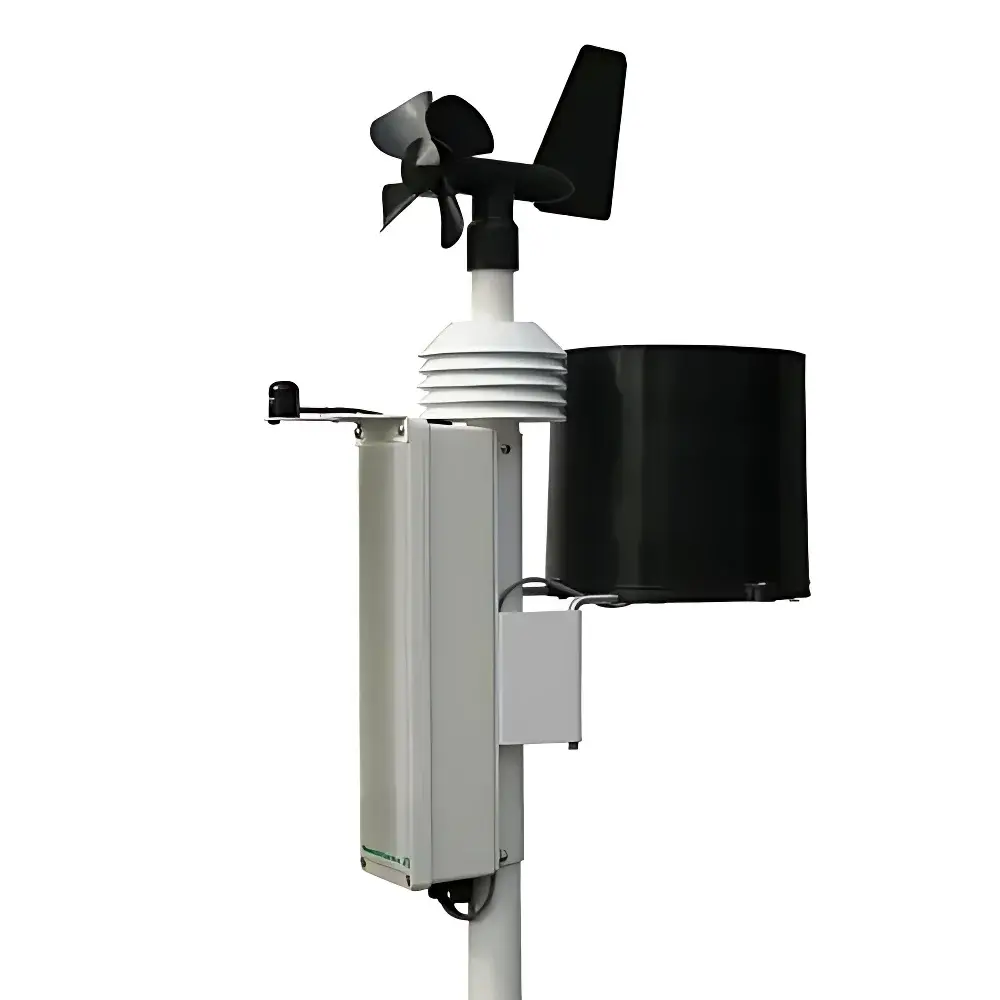
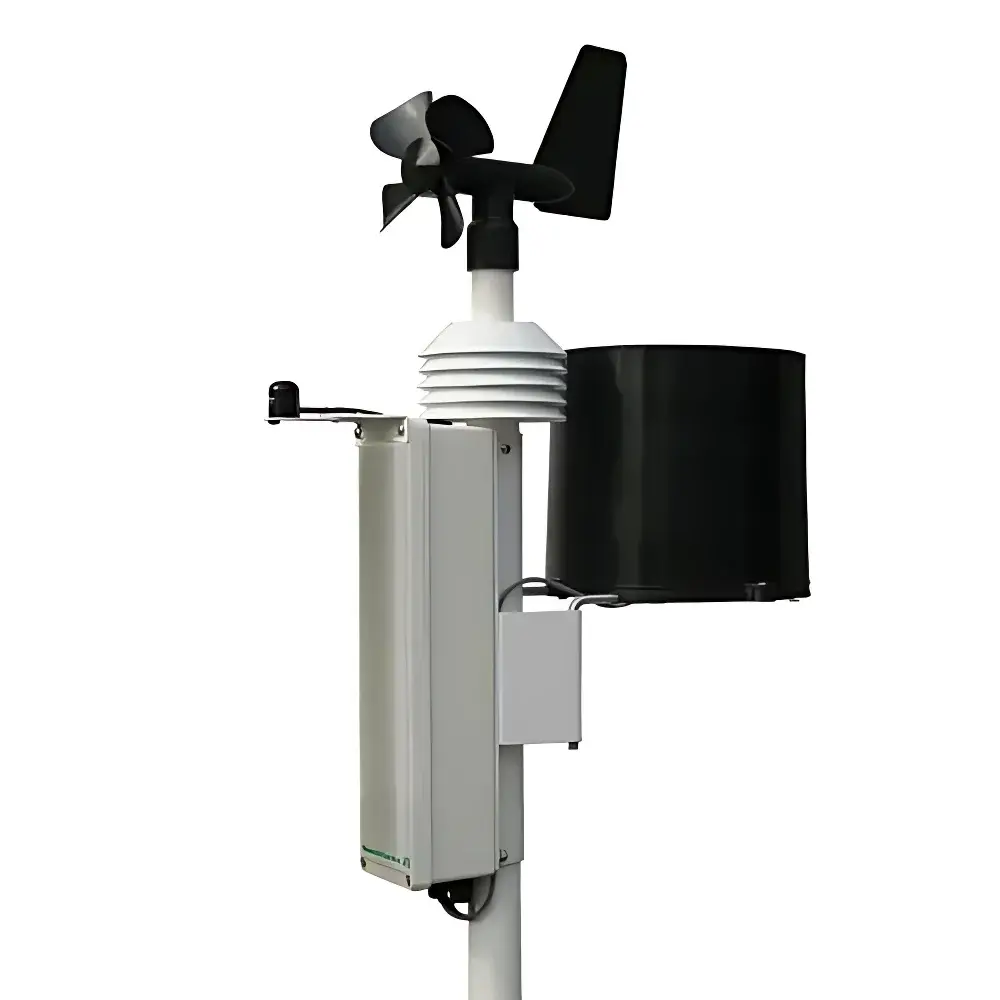
RainWise PVmet 330 Photovoltaic Weather Station
| Brand | RainWise |
|---|---|
| Origin | USA |
| Model | PVmet 330 |
| Sensor Types | Global Solar Irradiance, PV Module Backsheet Temperature (up to 2), Air Temperature, Relative Humidity, Barometric Pressure, Wind Speed & Direction, Precipitation |
| Communication | RS-485 Modbus RTU (standard), Optional Modbus TCP over Ethernet |
| Compliance | SunSpec Certified |
| Operating Temperature | -40 °C to +60 °C |
| Power Supply | 10–30 VDC, 50 mA |
| Enclosure Materials | PVC, ABS, Anodized Aluminum, Stainless Steel, Polycarbonate (LEXAN®/Makrolon® 2658) |
| Weight | 9.07 kg |
| Dimensions (L×W×H) | 91.44 × 50.8 × 33.02 cm |
Overview
The RainWise PVmet 330 Photovoltaic Weather Station is an integrated, SunSpec-certified environmental monitoring system engineered specifically for utility-scale and commercial photovoltaic (PV) power plants. It adheres to IEC 61724-1:2021 (Photovoltaic system performance — Monitoring guidelines) and supports essential performance ratio (PR) and yield calculations required under international grid interconnection standards. Unlike generic weather stations, the PVmet 330 implements a purpose-built sensor suite calibrated for solar energy applications: its thermopile-based pyranometer delivers spectral response aligned with silicon PV modules, while dual backsheet temperature sensors enable differential thermal analysis across module strings. The system operates on a robust 2-wire RS-485 Modbus RTU architecture—designed for noise immunity in electrically noisy substation and inverter yard environments—and features field-configurable baud rates (default 9600 bps) and 120 Ω termination support for daisy-chained deployments up to 1,200 meters.
Key Features
- SunSpec-certified Modbus register map ensures seamless integration with SCADA, inverters, and third-party data acquisition systems (e.g., Siemens Desigo, Schneider EcoStruxure, or custom PLCs)
- Global horizontal irradiance (GHI) sensor with ±5% accuracy, 1 W/m² resolution, and cosine error compensation optimized for low-angle incidence (±1% at 45°, ±5% at 75°)
- Dual PV backsheet temperature inputs (standard: 1 channel; expandable to 2) using Class A PT1000 RTD probes with ±0.3 °C accuracy and 270 s thermal time constant for representative module thermal mass modeling
- Integrated aspirated air temperature and relative humidity sensor (±0.3 °C / ±5% RH) housed in a radiation-shielded, passive vented enclosure meeting ISO 7726 ergonomics criteria
- Ultrasonic wind sensor with 0–67 m/s range, ±0.45 m/s or ±5% accuracy, and true 360° azimuth resolution (22.5° steps, ±11.25° absolute error)
- Barometric pressure transducer (552–1084 hPa, ±1.7 hPa) referenced to sea level for air mass correction in PV simulation models (e.g., PVsyst, SAM)
- Tipping-bucket rain gauge (0–762 mm/hr, ±2% @ 25.4 mm/hr) with stainless-steel funnel and anti-clogging design validated per ASTM D2456
- IP65-rated polycarbonate and anodized aluminum housing; RoHS-compliant, lead-free construction per EU Directive 2011/65/EU
Sample Compatibility & Compliance
The PVmet 330 is compatible with all crystalline silicon (c-Si), thin-film (CdTe, CIGS), and bifacial PV technologies. Its sensor geometry and mounting configuration comply with IEC 61724-1 Annex B for site assessment instrumentation layout—including recommended shadow-free separation distances from array edges and tilt alignment tolerances. All analog signal conditioning circuits meet EN 61000-6-2 (immunity) and EN 61000-6-4 (emissions) requirements for industrial environments. Data logging integrity satisfies GLP-aligned traceability protocols when paired with Modbus-enabled dataloggers supporting timestamped register reads and cyclic redundancy check (CRC) validation. Firmware revision history and calibration certificate metadata are accessible via standard Modbus function code 0x03 (Read Holding Registers).
Software & Data Management
No proprietary software is required: the PVmet 330 communicates exclusively via open Modbus protocol—eliminating vendor lock-in and enabling direct ingestion into industry-standard platforms including OSIsoft PI System, Ignition SCADA, and Python-based monitoring stacks (e.g., InfluxDB + Grafana). Register mapping follows SunSpec Model 103 (Irradiance), Model 111 (Weather), and Model 112 (Module Temperature), ensuring interoperability with inverters certified to IEEE 1547-2018 Annex H. Optional Ethernet gateway modules support Modbus TCP bridging with TLS 1.2 encryption for secure cloud telemetry. Audit trails—including parameter changes, firmware updates, and communication timeouts—are retained in non-volatile memory and retrievable via Modbus address block 40001–40100.
Applications
- Performance monitoring and degradation analysis of ground-mount, rooftop, and floating PV plants
- Real-time input for irradiance-corrected inverter reactive power control (Q(U) and Q(P) curves per UL 1741 SB)
- Validation of satellite-derived solar resource datasets (e.g., NSRDB, Solargis) against ground-truth measurements
- Supporting commissioning reports for IEC 62446-1 compliance and bankability assessments
- Feeding meteorological inputs to energy forecasting models (e.g., NREL’s SolarAnywhere API integration)
- Long-term soiling rate quantification when deployed alongside reference cells or soiling stations
FAQ
Is the PVmet 330 compatible with third-party SCADA systems?
Yes—it uses standard Modbus RTU over RS-485 with SunSpec-defined register maps, enabling plug-and-play integration with any SCADA platform supporting Modbus master functionality.
Can the backsheet temperature sensor be upgraded to two channels post-installation?
Yes—the hardware supports dual inputs; activation requires firmware update and configuration via Modbus write commands to holding registers 40020–40021.
What is the recommended mounting height for optimal GHI measurement?
Per IEC 61724-1, install the pyranometer at least 1.5 m above the nearest PV row plane and outside the shading envelope of all structures, with unobstructed 180° southern hemisphere view (in Northern Hemisphere sites).
Does the station include NIST-traceable calibration certificates?
Each sensor ships with individual factory calibration reports referencing NIST-traceable standards; full recalibration services are available through RainWise’s ISO/IEC 17025-accredited lab.
How is lightning protection implemented?
The unit includes internal transient voltage suppression (TVS) diodes on all analog and communication lines, and must be installed with external Type II SPDs (per IEC 61643-11) on power and RS-485 runs in high-lightning-probability regions.
Related Products







