
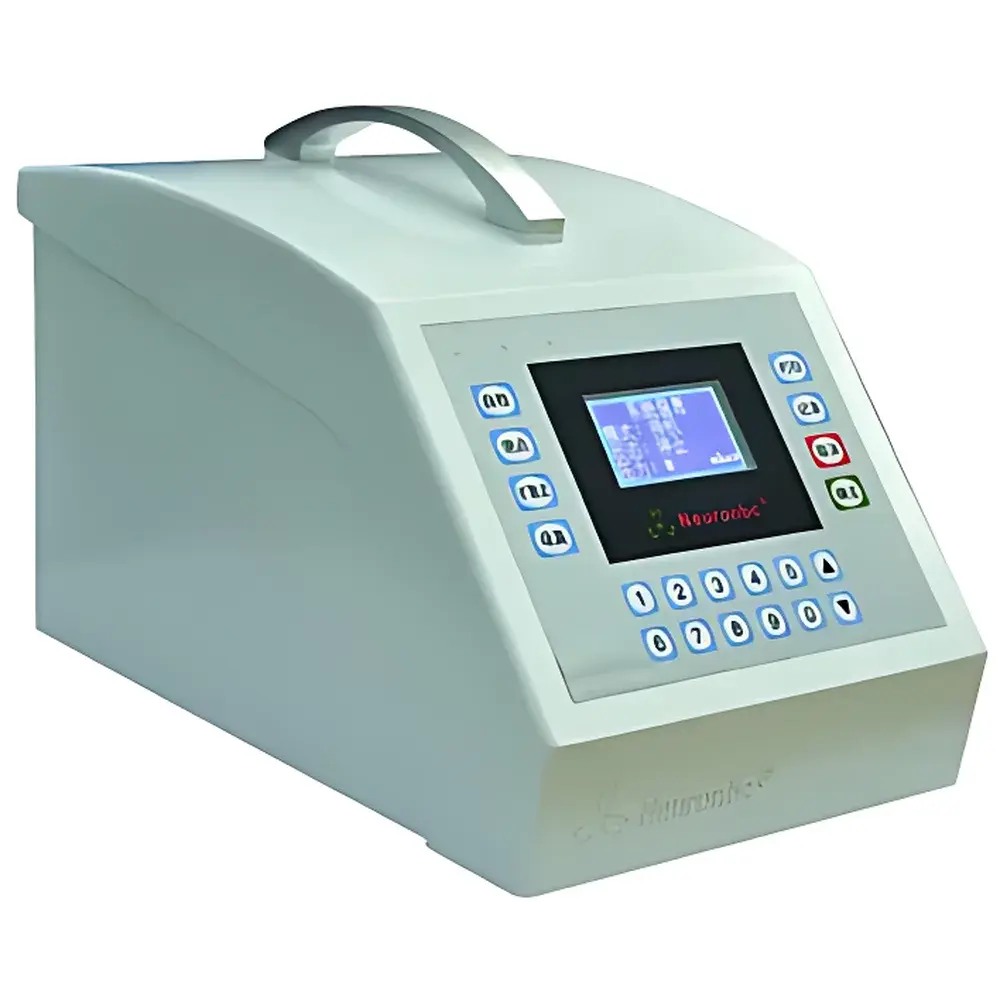
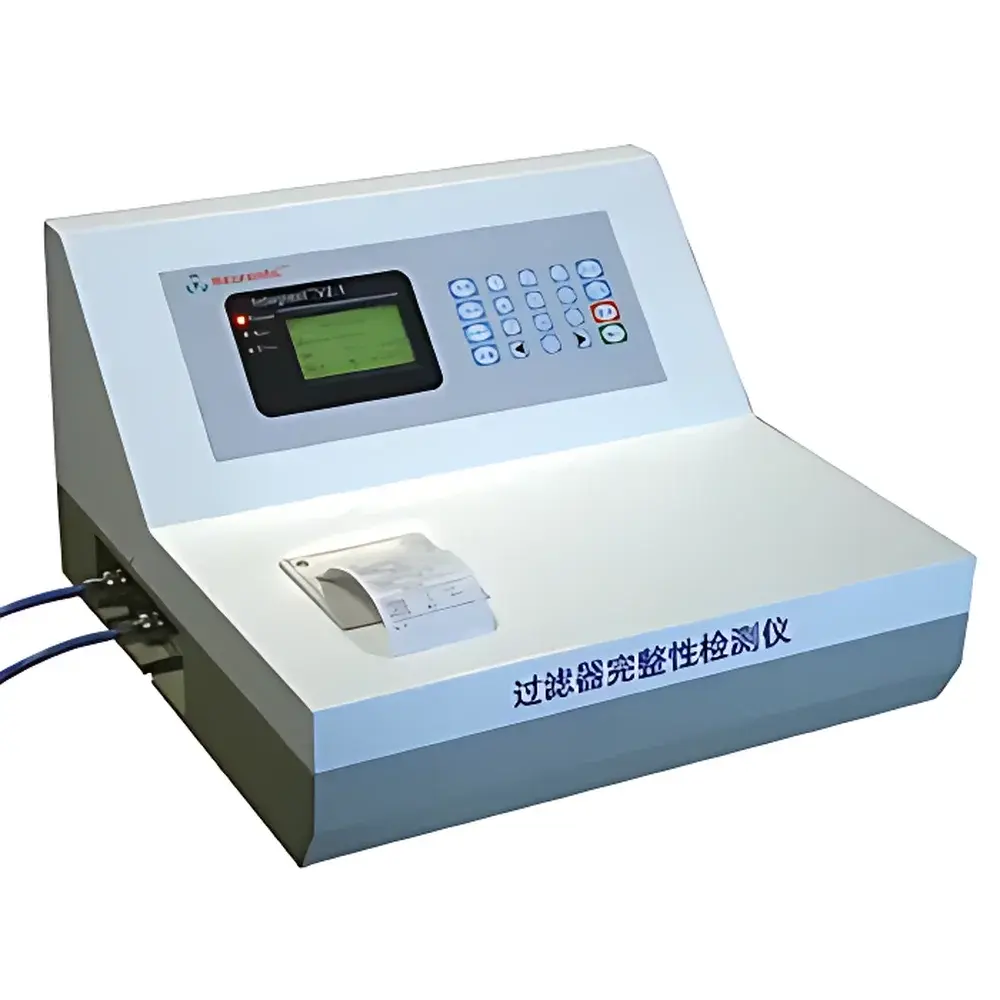
NeuronBC Integtest™ V1.2 Automated Filter Integrity Tester
| Brand | NeuronBC |
|---|---|
| Origin | Beijing, China |
| Model | V1.2 |
| Power Supply | 100–240 VAC, 50 Hz, 120 W |
| Operating Pressure Range | 100–8000 mbar (115 psi) |
| Bubble Point Accuracy | ±75 mbar |
| Diffusion Flow Accuracy | ±4% |
| Bubble Point Range | 590–6900 mbar |
| Diffusion Flow Range | 1–180 mL/min |
| Display | 3.2″ monochrome LCD |
| Data Storage | 20 test records |
| Dimensions (L×W×H) | 400 × 240 × 270 mm (main unit) + 220 mm (height with printer) |
| Weight | 7.5 kg |
| Environmental Operating Conditions | 5–40 °C, 10–80% RH |
| Compliance | FDA, USP <1207>, ISO 13408-2, Annex 1 (2022), and Chinese Pharmacopoeia (ChP) 2020 Edition |
Overview
The NeuronBC Integtest™ V1.2 Automated Filter Integrity Tester is a precision-engineered instrument designed for quantitative, regulatory-compliant integrity verification of hydrophobic and hydrophilic membrane filters used in pharmaceutical, biotechnology, and medical device manufacturing. It operates on established capillary flow principles—specifically the bubble point, diffusion (forward) flow, and pressure hold (decay) test methods—to determine whether a filter meets its specified pore size rating and structural integrity prior to or after use. The instrument conforms to internationally recognized standards including USP , ISO 13408-2, EU GMP Annex 1 (2022), and the Chinese Pharmacopoeia (ChP) 2020 Edition, making it suitable for validation documentation under FDA 21 CFR Part 11 and EU Annex 11 requirements when paired with appropriate software controls and audit trail configuration.
Key Features
- Fully automated microprocessor-controlled operation with integrated self-diagnostic routines for system leak detection, pressure sensor calibration verification, and user error alerts.
- Multi-method testing capability: programmable bubble point scanning, rapid single-point bubble point determination, diffusion flow measurement (semi-automated with upstream volume input), and pressure hold (decay) testing.
- Non-invasive online testing mode—enables integrity verification without compromising downstream sterility or requiring filter disassembly.
- Real-time thermal printing of test reports with timestamp, operator ID (manual entry), test method, parameters, pass/fail status, and raw data traces.
- Configurable upstream volume input for accurate diffusion flow normalization—critical for multi-cartridge or large-surface-area filter assemblies.
- Robust mechanical architecture with dual-height modular housing accommodating both compact benchtop deployment and integration into isolator or RABS environments (Grade B cleanroom compatible).
Sample Compatibility & Compliance
The Integtest™ V1.2 supports a broad range of filter geometries and configurations, including disc membranes (Φ25 mm to Φ300 mm), standard cylindrical cartridges (2.5″ to 40″ length, 1–15 elements), capsule filters, mini-cartridges, and vent filters used in tank air breathers and compressed gas lines. It is validated for symmetric and asymmetric membranes—including polyethersulfone (PES), polyvinylidene fluoride (PVDF), nylon, cellulose acetate, and polytetrafluoroethylene (PTFE)—and accommodates both hydrophilic and hydrophobic filter media. All test protocols align with regulatory expectations for pre-use post-sterilization (PUPSIT) and post-use integrity testing as defined in FDA Guidance for Industry (2022), EMA CHMP Reflection Paper (2018), and ICH Q5A(R2). Instrument design facilitates IQ/OQ/PQ execution and supports GLP/GMP documentation workflows.
Software & Data Management
While the V1.2 operates as a standalone unit with embedded firmware, its data output structure is compatible with laboratory information management systems (LIMS) and electronic batch record (EBR) platforms via RS-232 serial interface (optional USB-to-serial adapter). Each printed report includes traceable metadata: date/time stamp, operator identifier, filter identification, test method, applied pressure profile, measured values, and pass/fail conclusion per predefined acceptance criteria. Internal memory retains up to 20 complete test histories with full parameter sets. For full 21 CFR Part 11 compliance—including electronic signatures, audit trails, and role-based access control—integration with validated third-party data acquisition software is recommended. Firmware updates are delivered via secure USB flash drive with version-controlled release notes and change logs.
Applications
- Integrity verification of sterilizing-grade liquid filters in API, final fill, and buffer preparation lines.
- Validation of hydrophobic air/gas filters in bioreactor sparging, tank venting, and HVAC supply ducts.
- Testing of capsule filters installed in sampling ports, media transfer lines, and sterile connectors.
- Post-sterilization integrity confirmation for steam-in-place (SIP) and autoclaved filter assemblies.
- Supporting risk-based filter lifecycle management in accordance with ISO 13408-2 Annex C and PDA Technical Report No. 40.
FAQ
Does the Integtest™ V1.2 support 21 CFR Part 11 compliance out-of-the-box?
No—the base unit provides audit-ready printed reports and internal storage but lacks electronic signature capability, role-based permissions, or immutable audit trails. Full Part 11 compliance requires external software integration and procedural controls.
Can it test multi-cartridge housings with mixed filter types?
Yes—provided all filters share the same nominal pore rating and wetting fluid; upstream volume must be accurately entered for diffusion flow normalization.
Is calibration traceable to national standards?
Yes—factory calibration uses NIST-traceable pressure transducers; users receive a calibration certificate valid for three years, with optional annual recalibration services.
What wetting fluids are supported?
The instrument is agnostic to fluid choice; common options include 100% isopropyl alcohol (IPA), 60% IPA/water, or purified water—selection depends on membrane chemistry and process compatibility.
Does it meet EU Annex 1 (2022) requirements for PUPSIT?
Yes—the pressure hold and diffusion flow methods satisfy Annex 1 §6.42–6.44 for pre-use integrity testing, provided validation protocols include worst-case challenge conditions and documented rationale for method selection.




