
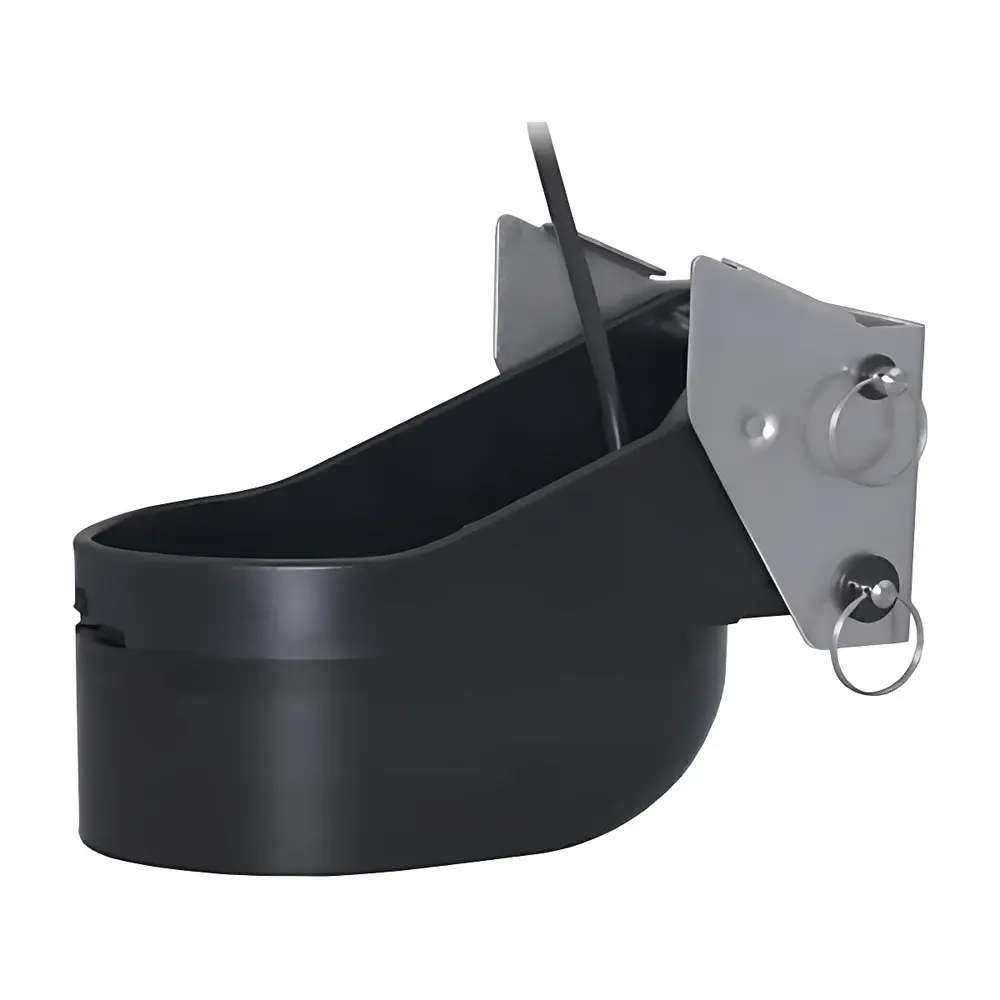
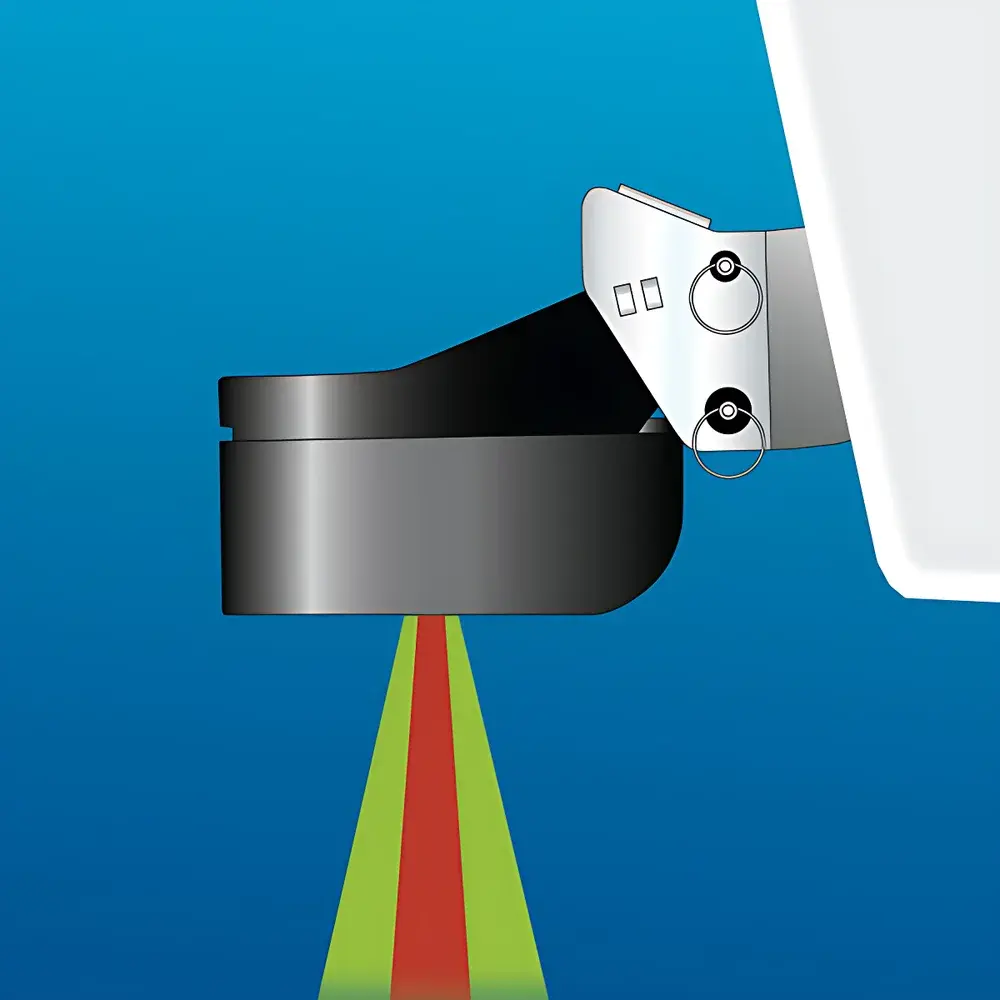
AIRMAR TM275LHW Dual-Frequency CHIRP Transom-Mount Depth Sounder
| Brand | AIRMAR |
|---|---|
| Origin | USA |
| Model | TM275LHW |
| Power Output | 1000 W |
| Operating Frequency Bands | Low Band 42–65 kHz (beam width 25°–16°), High Wideband 150–250 kHz (constant 25° beam width) |
| Max Depth Range | 914 m (low band), 152 m (high wideband) |
| Beam Mounting Angle Adjustment | 3°–21° |
| Housing Material | SEALCAST™ seamless polyurethane encapsulation |
| Mounting Type | Transom-mount stainless steel bracket |
| Sensor Weight | 4 kg |
| Compatible Hull Types | All hull materials (fiberglass, aluminum, wood, composites) |
| Hull Length Requirement | ≥10 m |
| Temperature Sensor | Integrated fast-response thermistor |
| Total Frequency Span | 123 kHz |
Overview
The AIRMAR TM275LHW is a dual-frequency CHIRP transom-mount echosounder engineered for precision depth profiling and real-time water temperature measurement in demanding marine environments. Utilizing swept-frequency (CHIRP) pulse compression technology, it transmits continuous frequency-modulated signals across two distinct bands—low-band (42–65 kHz) and high wideband (150–250 kHz)—enabling simultaneous optimization of deep-water penetration and shallow-water resolution. Unlike fixed-frequency transducers, CHIRP processing delivers superior signal-to-noise ratio, enhanced target separation, and improved bottom discrimination without sacrificing range. The TM275LHW’s constant 25° beam width across its entire high-band spectrum ensures consistent lateral coverage—approximately double that of conventional narrow-beam 200 kHz transducers—while maintaining sharp target definition and accurate fish arch rendering. Its low-band capability supports reliable operation to 914 meters, making it suitable for offshore continental shelf surveys, deep fjord navigation, and pelagic fishing operations where vertical resolution and signal integrity at depth are critical.
Key Features
- Dual-band CHIRP architecture with independent low-band (42–65 kHz) and high-wideband (150–250 kHz) transmission paths
- Constant 25° beam width across full high-band range—optimized for broad-area scanning and high-fidelity fish arch formation
- Adjustable transom mounting bracket (3°–21° tilt) for optimal acoustic coupling on planing, semi-displacement, and displacement hulls ≥10 m LOA
- Integrated fast-response NTC thermistor for concurrent water temperature acquisition with depth data
- SEALCAST™ seamless polyurethane encapsulation—fully submersible, corrosion-resistant, and acoustically transparent for long-term reliability in saltwater
- Stainless steel transom bracket with non-slip grip surface and vibration-dampening isolation
- Xducer ID® digital identification protocol—enables automatic configuration and firmware validation within compatible multifunction displays (MFDs)
- 1 kW peak acoustic output power with optimized impedance matching for efficient energy transfer into water column
Sample Compatibility & Compliance
The TM275LHW is certified for installation on vessels with fiberglass, aluminum, wood, or composite hulls, provided minimum hull length is 10 meters and transom thickness meets standard marine structural requirements (≥25 mm). It complies with FCC Part 15 Subpart B (Class B digital device emissions) and IEC 60945 maritime equipment safety standards. While not classified as a Class A medical or laboratory instrument, its analog and digital signal outputs adhere to NMEA 2000 (IEC 61162-3) and NMEA 0183 v4.10 protocols—ensuring interoperability with chartplotters, sonar processors, and vessel monitoring systems deployed under GLP-aligned marine data logging workflows. No regulatory certification under FDA 21 CFR Part 11 applies, as the device does not generate auditable electronic records for clinical or pharmaceutical use.
Software & Data Management
The TM275LHW operates as a sensor-level peripheral and requires integration with a host display system supporting CHIRP processing (e.g., Garmin GPSMAP, Raymarine Axiom, Furuno TZtouch). Raw echo data is transmitted via NMEA 2000 using proprietary PGNs for depth, temperature, and signal quality metrics. Firmware updates are performed through the host MFD’s update interface using AIRMAR-provided .bin files; all versions include checksum verification and rollback protection. Xducer ID® enables plug-and-play recognition—eliminating manual parameter entry—and logs transducer serial number, calibration date, and operational hours into the host system’s audit trail. Data export is limited to user-initiated screen captures or third-party NMEA loggers; no onboard storage or cloud synchronization is implemented.
Applications
- Recreational and commercial offshore sportfishing—especially targeting pelagic species (tuna, marlin, swordfish) where deep-water target detection and thermal layer mapping are essential
- Coastal hydrographic surveying for small-vessel chart updates and hazard identification in areas up to 914 m depth
- Yacht and superyacht navigation support in poorly charted fjords, archipelagos, and continental slope zones
- Scientific auxiliary use in limnological or oceanographic campaigns requiring synchronized depth/temperature profiles from moving platforms
- Marine education and training platforms where CHIRP principles, beam geometry effects, and acoustic propagation modeling are taught
FAQ
Does the TM275LHW require a dedicated CHIRP processor or is it compatible with standard sounder displays?
It requires a CHIRP-capable MFD with firmware supporting dual-band CHIRP interpretation (e.g., Garmin BlueChart g3 Vision, Raymarine LightHouse OS v20+). Legacy non-CHIRP units cannot decode its swept-frequency output.
Can the TM275LHW be installed on an aluminum-hulled vessel?
Yes—its transom-mount design eliminates hull material dependency. The stainless steel bracket isolates the transducer from galvanic corrosion risks associated with direct hull bonding.
What is the significance of the constant 25° beam width in the high-wideband mode?
It ensures uniform spatial sampling across the entire 150–250 kHz range, eliminating beam-width distortion common in stepped-frequency transducers—critical for consistent fish target sizing and bottom contour fidelity.
Is the integrated temperature sensor calibrated to traceable standards?
The thermistor is factory-calibrated against NIST-traceable references per AIRMAR internal QA procedure QM-TR-004; calibration certificate is available upon request for marine survey applications.
How does the TM275LHW handle air entrainment or cavitation at high speeds?
Its low-profile hydrodynamic housing and recessed face minimize turbulence-induced noise; performance remains stable up to 35 knots on properly aligned installations.
Related Products







