
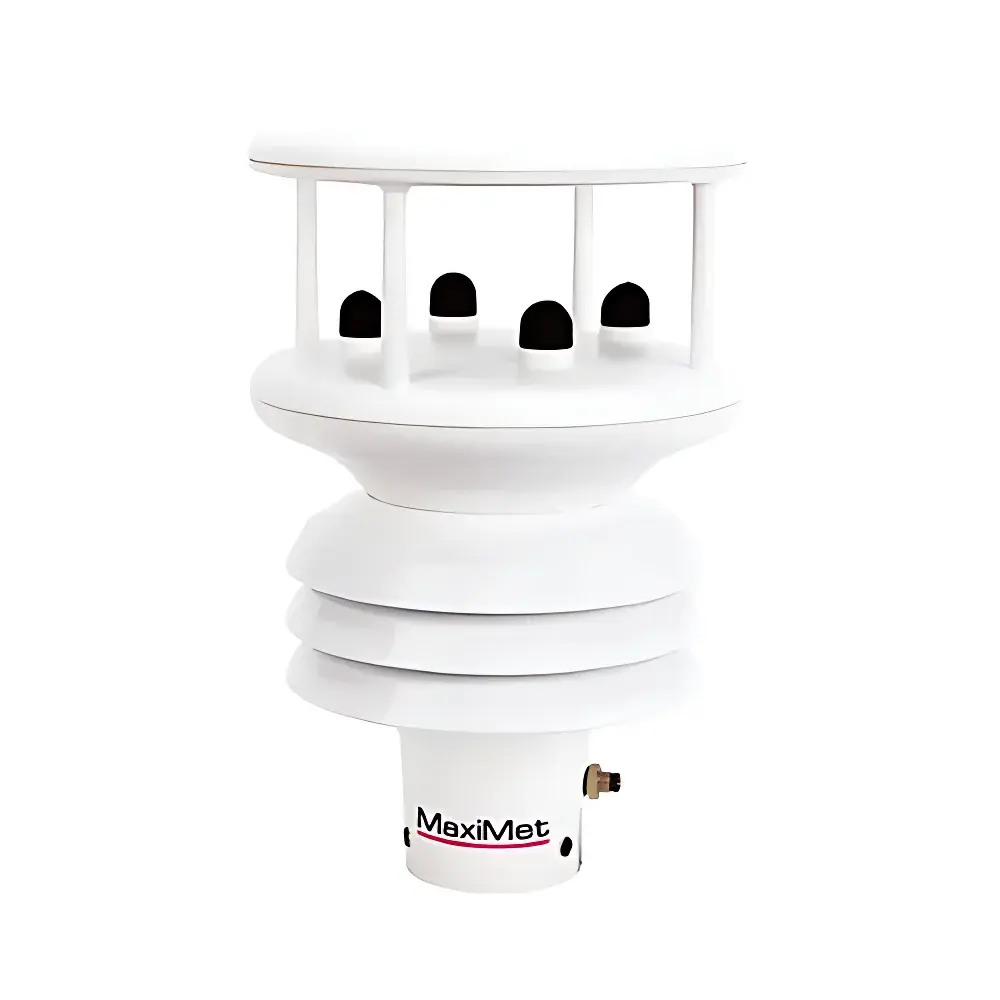
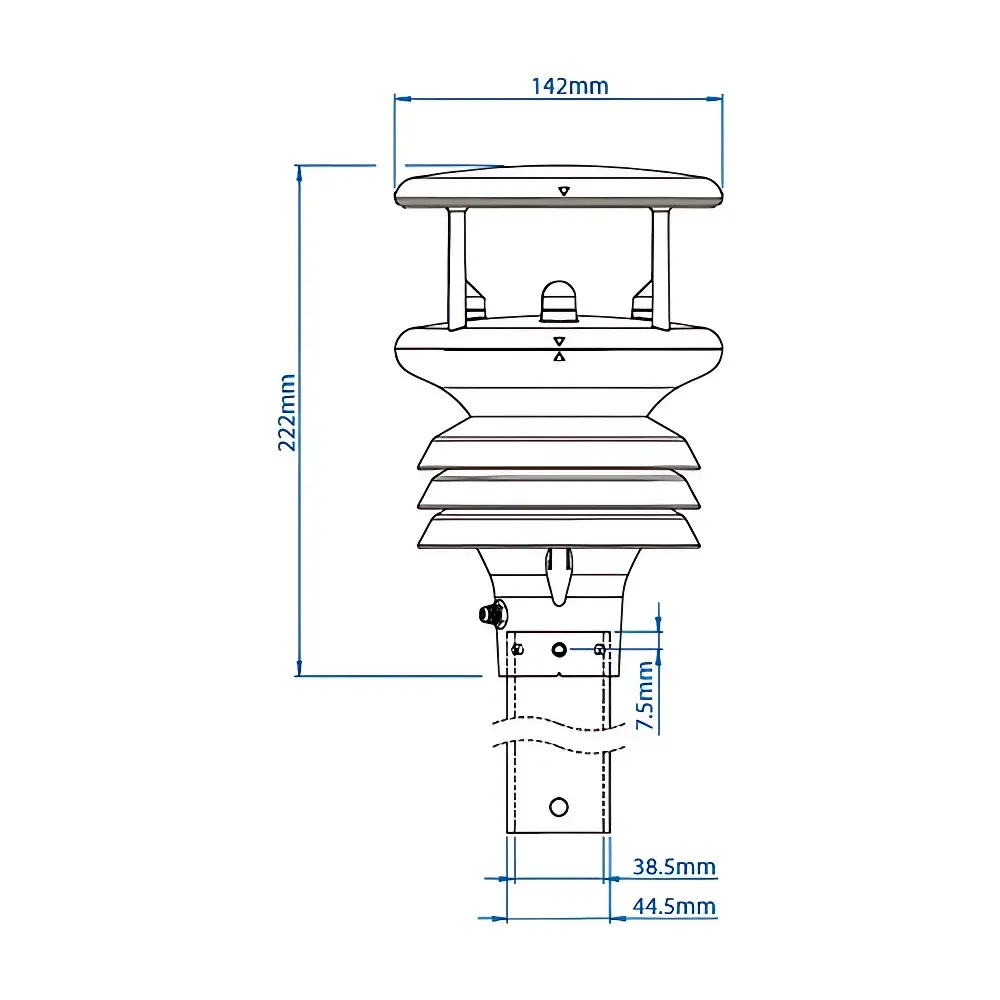
Gill GMX550 Compact Weather Station
| Brand | Gill |
|---|---|
| Origin | United Kingdom |
| Model | GMX550 |
| Instrument Type | Portable Weather Station |
| Compliance | CE, RoHS, IP66 Enclosure |
| Output Interfaces | RS-232/422/485 (ASCII), SDI-12, NMEA 0183, Modbus RTU, Analog (optional) |
| Power Supply | 6–30 VDC |
| Operating Temperature | −40 °C to +70 °C |
| Wind Measurement Principle | Ultrasonic Time-of-Flight |
| Temperature/Humidity Sensing | Capacitive Polymer Sensor with Natural Ventilation Radiation Shield |
| Barometric Sensor | Piezoresistive MEMS Transducer |
| Rain Input | Pulse-compatible tipping-bucket rain gauge interface (0.2 mm or 0.01 in per tip) |
| GPS Interface | Optional external GPS module (NMEA output, provides true wind, geolocation, sunrise/sunset, solar position) |
Overview
The Gill GMX550 Compact Weather Station is a fully integrated, maintenance-free environmental monitoring system engineered for long-term reliability and metrological consistency in unattended outdoor deployments. Designed and manufactured in the UK by Gill Instruments—a leader in precision atmospheric sensing—the GMX550 implements a multi-sensor fusion architecture grounded in internationally recognized measurement principles. Air temperature and relative humidity are acquired via a high-stability capacitive polymer sensor housed within a triple-layer, naturally ventilated, UV-stabilized radiation shield—eliminating fan-induced power demand and mechanical failure risk while ensuring compliance with WMO guidance on passive aspiration. Atmospheric pressure is measured using a temperature-compensated piezoresistive MEMS transducer referenced to mean sea level (MSL) and corrected for local elevation. Wind speed and direction are determined through ultrasonic time-of-flight technology across two orthogonal acoustic paths, enabling true 3D vector resolution without moving parts or bearing wear. The system supports optional external GPS integration to compute true wind vectors (corrected for platform motion), georeferenced timestamps, solar geometry parameters (sun azimuth/elevation, civil/nautical/astronomical twilight, apparent solar noon), and precise altitude-derived barometric corrections.
Key Features
- Fanless, naturally aspirated temperature and humidity sensing—meets WMO Class II exposure requirements for passive ventilation
- Ultrasonic wind sensor with built-in electronic compass for apparent wind vector derivation and magnetic declination compensation
- Modular rain input interface compatible with industry-standard tipping-bucket gauges (0.2 mm or 0.01 in resolution)
- Multi-protocol digital outputs: ASCII over RS-232/422/485, SDI-12, NMEA 0183 (for GPS-enabled configurations), and Modbus RTU for SCADA integration
- Optional analog voltage/current outputs (0–5 V, 0–10 V, 4–20 mA) for legacy PLC or DAQ systems
- Ruggedized IP66-rated enclosure with marine-grade stainless-steel mounting hardware and UV-resistant polycarbonate housing
- Wide operating range (−40 °C to +70 °C) validated per IEC 60068-2 environmental stress testing standards
Sample Compatibility & Compliance
The GMX550 is certified to CE and RoHS directives and conforms to EN 61326-1 (EMC) and EN 61000-6-2/6-3. Its sensor architecture aligns with WMO No. 8 “Guide to Meteorological Instruments and Methods of Observation” for temperature/humidity shielding, wind measurement uncertainty budgets, and precipitation gauge siting recommendations. While not intrinsically safe, the station meets IECEx/ATEX Zone 2 requirements when deployed with appropriate barrier systems. Data integrity supports GLP-compliant logging when paired with Gill’s MetLink software, which maintains full audit trails, user access control, and timestamped configuration change logs—facilitating FDA 21 CFR Part 11 readiness in regulated environmental monitoring applications.
Software & Data Management
Gill’s MetLink software (Windows-based, free download) enables real-time visualization, configuration, firmware updates, and automated data export to CSV, Excel, or SQL databases. Raw ASCII/NMEA streams are parseable by third-party platforms including Campbell Scientific LoggerNet, CR1000X scripting, and Python-based telemetry pipelines (e.g., PySerial + Pandas). The station supports scheduled data polling, alarm thresholds (e.g., wind gust >25 m/s), and configurable transmission intervals (1 s to 24 h). All internal measurements—including dew point, wet-bulb temperature, air density, wind chill, and heat index—are computed onboard using ITS-90 and Goff-Gratch formulations, minimizing post-processing latency.
Applications
- Transportation infrastructure: Road weather information systems (RWIS), airport surface condition monitoring, rail corridor microclimate assessment
- Renewable energy: Solar irradiance proxy modeling (via solar position + cloud cover inference), wind farm site validation, turbine control input
- Agricultural decision support: Evapotranspiration (ET₀) calculation, frost warning, irrigation scheduling, pesticide drift risk modeling
- Coastal and marine operations: Harbor safety, tidal current correlation, offshore platform environmental compliance reporting
- Urban climate studies: Heat island mapping, green roof performance evaluation, building energy load forecasting
- Educational meteorology labs: Curriculum-aligned datasets for atmospheric physics, climatology, and sensor calibration pedagogy
FAQ
Does the GMX550 require periodic recalibration?
No routine field recalibration is required. Gill performs factory calibration traceable to NPL (UK National Physical Laboratory) standards; drift specifications are ≤0.1 °C/year for temperature and ≤0.5 %RH/year for humidity under typical conditions.
Can the station operate independently without external power?
Yes—it supports low-power sleep modes and can be deployed with solar-charged battery systems (e.g., 12 V 7 Ah SLA with charge controller) for multi-year autonomous operation.
Is MODBUS communication compatible with industrial PLCs?
Yes—MODBUS RTU over RS-485 is implemented per Modbus Organization v1.1b specification, supporting function codes 03 (read holding registers) and 06 (preset single register) with configurable slave ID and baud rate.
What rain gauge models are verified for use with the GMX550?
Gill validates compatibility with Oregon Scientific, Rainwise, and TBW tipping-bucket gauges meeting pulse output standards (open-collector or opto-isolated, 5–24 V logic); full list available in Application Note AN-GMX550-RG.
How is true wind calculated when GPS is connected?
True wind velocity is derived from apparent wind vector subtraction of platform velocity (GPS ground speed + heading), corrected for magnetic variation and inertial effects using embedded AHRS algorithms.
Related Products







