
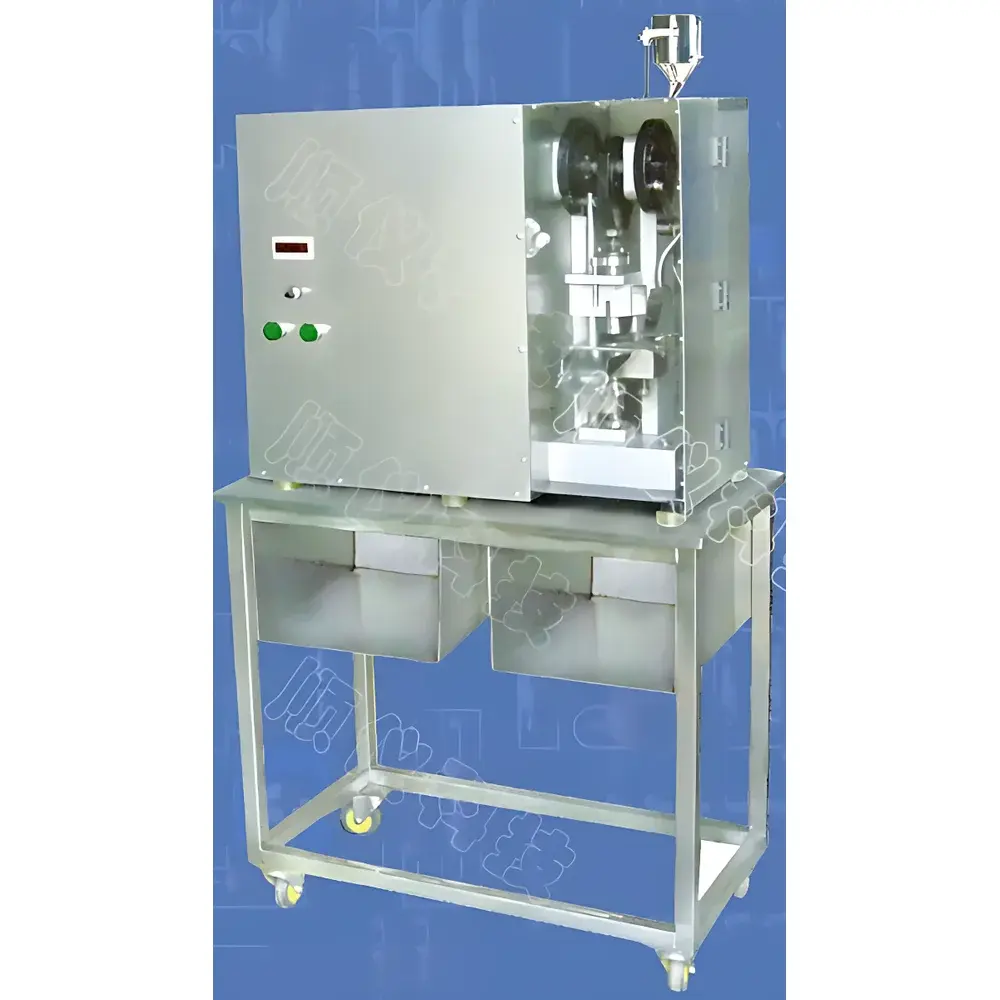
YP-1400 Laboratory Single-Station Tablet Press
| Origin | Shanghai, China |
|---|---|
| Manufacturer Type | Authorized Distributor |
| Origin Category | Domestic (China) |
| Model | YP-1400 |
| Pricing | Upon Request |
| Tablet Diameter Range | 3–20 mm |
| Compression Speed | 10–140 tablets/min |
| Maximum Compression Force | 4000 kgf |
| Motor Power | 1.2 kW |
| Voltage/Frequency | 220–240 V AC, 50/60 Hz |
| Dimensions (L×W×H) | 650 × 400 × 650 mm |
| Net Weight | 150 kg |
| Frame Material | 304 Stainless Steel |
| Contact Parts Material | 316 Stainless Steel |
| Control Mode | Fully Automatic, Stepless Speed Regulation |
| Optional Accessories | Custom-shaped punches, Hopper extension, Manual jog & reverse function |
Overview
The YP-1400 Laboratory Single-Station Tablet Press is an engineered solution for precise, repeatable tablet formulation development and small-batch production in regulated R&D and quality control environments. Designed on the principle of mechanical eccentric cam-driven compression, it applies controlled axial force to powder-filled dies via interchangeable upper and lower punches, enabling deterministic compaction under defined dwell time, pressure, and ejection parameters. Unlike industrial rotary presses, this single-station architecture eliminates cross-contamination risk between formulations and supports rapid changeover—critical for early-phase pharmaceutical development, nutraceutical prototyping, and academic materials science research. Its compact footprint and self-contained electrical drive system allow deployment on standard laboratory benches without external utilities or structural reinforcement.
Key Features
- Fully automatic operation with stepless speed regulation (10–140 tablets per minute), ensuring consistent dwell time across variable throughput requirements.
- Interchangeable punch sets accommodating tablet diameters from 3 mm to 20 mm—including custom non-circular geometries (e.g., oval, triangular, scored)—enabling formulation testing across diverse dosage forms.
- Dual-grade stainless steel construction: 304 SS for structural frame and housing; 316 SS for all product-contact surfaces (dies, punches, hopper, feed shoe), meeting ISO 8573-1 purity class 3 and USP material compatibility requirements.
- Integrated jog-and-reverse function allows precise manual positioning during tooling setup, punch alignment verification, or recovery from powder bridging—enhancing experimental continuity and reducing downtime.
- Modular design supports optional accessories: gravity-fed or vibratory hoppers for improved flow consistency, casters for mobility, and digital force calibration kits traceable to NIST standards.
- Compliance-ready mechanical architecture: smooth surfaces, zero crevices, fully drainable base pan, and tooling retention mechanisms aligned with Annex 1 (EU GMP) and FDA’s Process Validation Guidance for equipment qualification.
Sample Compatibility & Compliance
The YP-1400 accommodates a broad spectrum of powder blends, including direct-compression excipients (microcrystalline cellulose, lactose monohydrate), active pharmaceutical ingredients (APIs) with varying compressibility profiles, herbal extracts, and mineral-based nutraceuticals. Its adjustable fill depth (via lower punch position) and programmable compression force enable empirical determination of critical quality attributes—such as tensile strength, friability, and disintegration time—per USP , , and . All wetted components are electropolished to Ra ≤ 0.4 µm, facilitating cleaning validation per ASTM E3009 and supporting GLP/GMP audit readiness. Documentation packages include Factory Acceptance Test (FAT) reports, material certificates (EN 10204 3.1), and IQ/OQ protocol templates.
Software & Data Management
While the base YP-1400 operates via embedded PLC with tactile HMI, optional Ethernet-enabled controllers support integration into laboratory information management systems (LIMS) and electronic batch record (EBR) platforms. Real-time logging includes compression force (kgf), turret position (°), cycle count, and motor current draw—exportable as CSV or PDF for 21 CFR Part 11–compliant audit trails. Optional data acquisition modules provide timestamped force-displacement curves for Heckel analysis and compaction modeling, aligning with ICH Q5C stability assessment frameworks.
Applications
- Pre-formulation screening of binder efficacy and lubricant sensitivity
- GMP-compliant clinical trial material (CTM) manufacturing (Phase I–II)
- Regulatory filing batches requiring full traceability and process documentation
- Taste-masking evaluation using film-coated or layered tablets
- Academic research on powder rheology–compressibility correlations
- Contract development organizations (CDOs) performing tech transfer to commercial-scale rotary presses
FAQ
Is the YP-1400 suitable for sterile manufacturing?
No—it is designed for non-sterile R&D and pilot-scale production. Sterile processing requires isolator-integrated press systems compliant with ISO 14644-1 Class 5.
Can I validate the compression force accuracy?
Yes. The hydraulic load cell is calibrated to ±0.5% FS and supplied with a UKAS-accredited certificate. Optional annual recalibration services are available.
Does it meet FDA 21 CFR Part 11 requirements?
The base unit does not include electronic signature capability; however, the optional Ethernet controller with password-protected user roles, audit trail generation, and electronic signature support satisfies Part 11 Annex A criteria.
What maintenance intervals are recommended?
Lubrication of cam followers and guide rods every 200 operating hours; die cavity inspection and punch tip wear measurement every 500 tablets; full calibration verification annually or after major component replacement.
Can I use it for effervescent or high-moisture formulations?
Yes—with appropriate tooling coatings (e.g., chromium nitride) and environmental controls (dehumidified room air <40% RH) to mitigate sticking and capping. Pre-compression dwell time adjustment is recommended for low-density blends.






