
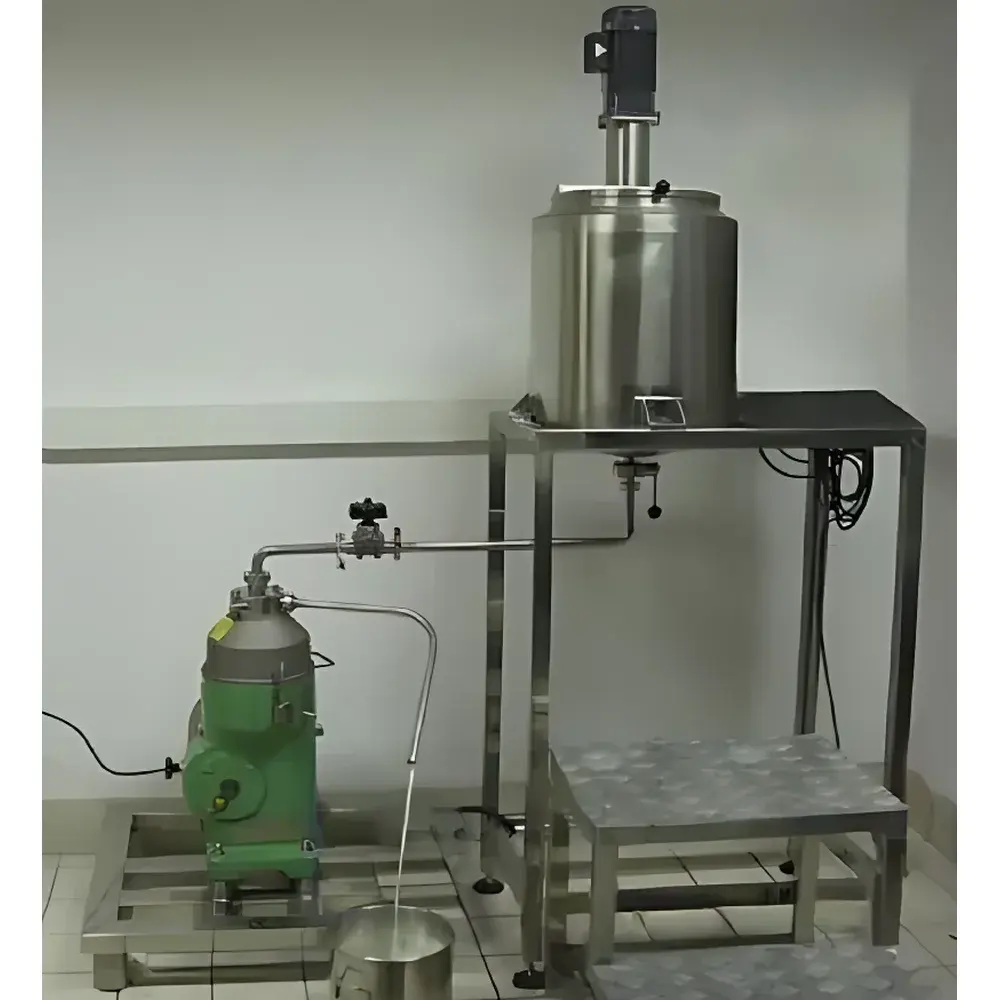
SE03.0V Disc Stack Centrifuge – Industrial-Scale Continuous Laboratory Centrifuge
| Origin | Italy |
|---|---|
| Type | Floor-standing Disc Stack Centrifuge |
| Model | SE03.0V |
| Max Speed | 11,000 rpm |
| Max RCF | 11,000 × g |
| Capacity | 50–1,000 L/h (batch minimum: 10 L) |
| Dimensions (W×D×H) | 670 × 455 × 880 mm |
| Power Supply | 3-phase / 380 V / 50 Hz / 1.5 kW |
| Motor Protection | IP55, Class F Insulation with Thermal Overload Protection |
| Drum Material | High-strength stainless steel (AISI 431 for spindle, precision-machined 304 stainless steel discs) |
| Casing & Frame | AISI 304 stainless steel |
| Separation Efficiency | ≤0.05% residual fat in skim milk |
| Separation Modes | Liquid–Liquid–Solid (three-phase) and Liquid–Solid (two-phase) |
| Feed/Discharge | Sanitary-grade 304 stainless steel piping with pressure gauge and micro-controlled discharge valve |
Overview
The SE03.0V Disc Stack Centrifuge is a fully integrated, continuous-flow laboratory-scale centrifuge engineered for high-fidelity process simulation of industrial separation workflows. Unlike conventional batch centrifuges, it operates on the principle of high-speed sedimentation within a rotating conical disc stack — leveraging enhanced surface area and controlled residence time to achieve precise, scalable phase separation. Its design replicates key operational parameters of full-scale dairy, biopharmaceutical, and fine chemical processing lines, making it suitable for both formulation development and pilot-scale validation under GMP-aligned conditions. The unit delivers consistent separation performance across liquid–liquid–solid (e.g., cream–skim–casein), liquid–solid (e.g., yeast harvesting, cell debris removal), and clarified liquid applications — with demonstrated efficacy in skim milk standardization (≤0.05% fat), fruit juice clarification, biodiesel purification, and microbial biomass recovery.
Key Features
- Continuous-feed operation with adjustable throughput (50–1,000 L/h), enabling direct scalability from lab bench to pilot plant without re-optimization.
- High-precision disc stack assembly manufactured from AISI 304 stainless steel with micron-level parallelism tolerance, ensuring uniform flow distribution and minimal channel clogging.
- Rotating drum system balanced to ISO 1940 Grade G2.5, minimizing mechanical vibration and acoustic emission (<72 dB(A) at 1 m distance).
- Self-contained architecture: includes integrated 50 L feed tank, clarified effluent collection vessel, sanitary-grade inlet/outlet manifolds, and real-time pressure monitoring.
- Modular stainless steel frame (AISI 304) with independent leveling feet — installation requires no anchoring, concrete foundation, or structural reinforcement.
- IEC-compliant drive system featuring an IP55-rated, Class F insulated motor with thermal cut-off protection and belt-driven transmission for low-maintenance torque transfer.
Sample Compatibility & Compliance
The SE03.0V accommodates a broad range of aqueous and low-viscosity non-aqueous suspensions and emulsions, including raw milk, whey, fermentation broths, plant extracts, and solvent-based reaction mixtures. It supports both two-phase (liquid–solid or immiscible liquid–liquid) and three-phase (e.g., oil–water–solids) separations with validated reproducibility across viscosity ranges up to 200 cP. All wetted surfaces comply with FDA 21 CFR 178.3570 and EC 1935/2004 food-contact material regulations. The system meets ISO 22000 prerequisite program requirements for hygiene design and is compatible with GLP/GMP documentation workflows, including audit-ready log generation for speed, temperature, feed rate, and operating duration.
Software & Data Management
While the base configuration operates via analog control panel with calibrated dials for feed rate, bowl speed, and backpressure regulation, optional digital integration enables RS-485 Modbus RTU communication with SCADA or LIMS platforms. Process data — including cumulative runtime, total processed volume, and motor load trends — can be logged at 1-second intervals for traceability. Optional firmware supports 21 CFR Part 11–compliant electronic signatures, user-access levels, and immutable audit trails when paired with validated third-party data acquisition software.
Applications
- Dairy processing: Skim milk standardization, whey protein concentration, butterfat recovery.
- Beverage industry: Clarification of apple, orange, and grape juices; removal of pectin and starch haze.
- Biopharmaceuticals: Harvesting of mammalian or microbial cells, lysate clarification, plasmid DNA purification intermediates.
- Industrial biotechnology: Recovery of enzymes, organic acids, and bioactive metabolites from fermentation supernatants.
- Fuel & lubricant refining: Purification of biodiesel, removal of glycerol and catalyst residues.
- Chemical synthesis: Solid catalyst recovery, solvent recycling, and phase separation in multi-step reactions.
FAQ
What is the minimum batch volume required for method development?
The system supports discrete batch operation down to 10 L per run, allowing robust parameter screening prior to continuous-mode transition.
Can the disc stack be sterilized in place (SIP)?
Yes — the entire fluid path is designed for steam sterilization at 121°C for 30 minutes; all seals are EPDM or silicone rated for repeated SIP cycles.
Is validation support available for IQ/OQ protocols?
Factory-provided documentation includes FAT reports, material certificates (EN 10204 3.1), and dimensional drawings; on-site OQ execution is supported by certified field engineers.
How is solid discharge managed during continuous operation?
The unit operates in semi-continuous mode: solids accumulate in the bowl and are discharged manually after programmable intervals; automated sludge ejection is available as an upgrade.
What maintenance intervals are recommended for long-term reliability?
Bearing inspection every 2,000 operating hours; disc stack cleaning after each product change; full drivetrain lubrication annually — all procedures detailed in the bilingual (EN/IT) service manual.



