
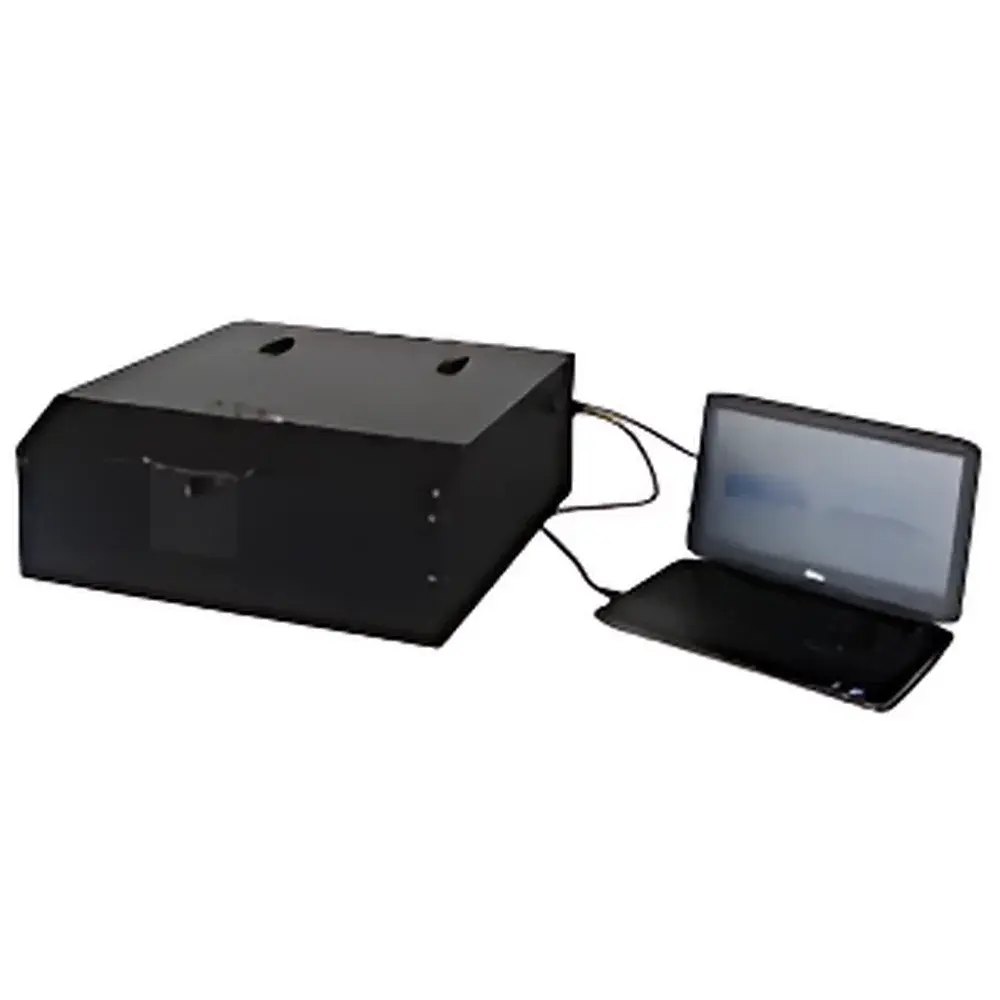
Batop Benchtop Terahertz Time-Domain Spectrometer (THz-TDS)
| Brand | Batop |
|---|---|
| Origin | Germany |
| Model | TDS1008 / TDS1010 / TDS1015 |
| Laser Wavelength | 800 nm / 1040 nm / 1560 nm |
| Spectral Range | 0.05–3.5 THz / 0.05–2.5 THz / 0.05–2.0 THz |
| Dynamic Range | >60 dB / >60 dB / >50 dB |
| Scan Range | 500 ps (2 GHz frequency resolution) |
| THz Beam Diameter | 22 mm (collimated) / 1–3 mm (focused) |
| Sample Aperture | 55 × 55 mm (collimated) / 5 × 5 mm (focused) |
| Power Supply | 100–240 V, 50–60 Hz |
| Dimensions | 600 × 600 × 250 mm³ |
| Weight | 50 kg |
Overview
The Batop Benchtop Terahertz Time-Domain Spectrometer (THz-TDS) is a compact, turnkey system engineered for high-fidelity time-resolved spectroscopic analysis in the 0.05–3.5 THz range. Based on ultrafast photoconductive sampling, the instrument employs femtosecond laser excitation of low-temperature-grown GaAs or InGaAs-based photoconductive antennas to generate and coherently detect broadband THz pulses. The system operates on the principle of electro-optic or photoconductive sampling with optical delay line scanning, enabling direct measurement of the electric field waveform of THz transients in both amplitude and phase. This coherent detection architecture provides intrinsic advantages over intensity-only methods—including access to complex dielectric functions, precise thickness determination via time-of-flight analysis, and high signal-to-noise ratio without spectral averaging artifacts. Designed for laboratory integration rather than industrial floor deployment, the benchtop form factor maintains metrological rigor while minimizing footprint and infrastructure requirements.
Key Features
- Fully integrated platform including mode-locked femtosecond laser, THz emitter/detector photoconductive antennas, motorized optical delay line, lock-in amplifier, and hermetically sealed sample chamber
- Three configurable laser options: 800 nm (Ti:Sapphire), 1040 nm (Yb-fiber), and 1560 nm (Er-fiber), each optimized for specific semiconductor antenna materials and atmospheric transmission windows
- Collimated THz beam (22 mm diameter) for uniform large-area transmission measurements; optional focusing optics enable spot sizes down to 1–3 mm for spatially resolved analysis
- 500 ps maximum scan window supports frequency resolution of ≤2 GHz—sufficient to resolve phonon resonances, intermolecular vibrations, and carrier relaxation dynamics
- Dynamic range exceeding 60 dB (TDS1008/TDS1010) ensures reliable quantification of weak absorption features in polymers, pharmaceuticals, and semiconductors
- Robust mechanical design with vibration-damped optical table base and temperature-stabilized electronics for long-term measurement reproducibility
Sample Compatibility & Compliance
The system accommodates solid, liquid, and thin-film samples within defined geometries: up to 55 × 55 mm for collimated-beam transmission and 5 × 5 mm for focused-beam configurations. The sealed sample chamber permits controlled environmental operation (dry nitrogen purge or vacuum compatibility upon request), mitigating water vapor absorption that dominates THz attenuation above 0.5 THz. All hardware and firmware comply with CE marking directives for electromagnetic compatibility (EMC) and low-voltage equipment. Data acquisition protocols support audit-ready operation under GLP and GMP frameworks when paired with validated software workflows. While not pre-certified to FDA 21 CFR Part 11, the system’s deterministic data logging architecture—including timestamped raw field traces, metadata tagging, and unalterable binary storage—facilitates qualification for regulated environments.
Software & Data Management
Control and analysis are executed via proprietary Batop THz Analysis Suite, delivered pre-installed on an included Windows-based laptop. The software enables real-time waveform visualization, Fourier transformation, complex refractive index extraction (n, κ), absorption coefficient calculation, and multilayer fitting using transfer-matrix formalism. Export formats include HDF5, MATLAB .mat, CSV, and industry-standard JCAMP-DX for spectral interoperability. Raw time-domain datasets retain full 16-bit resolution and are stored with embedded instrument configuration logs. Batch processing scripts support automated measurement sequences across multiple samples, with configurable pass/fail thresholds for QA/QC screening. Optional Python API allows integration into custom data pipelines compliant with FAIR (Findable, Accessible, Interoperable, Reusable) principles.
Applications
- Pharmaceutical solid-state characterization: polymorph identification, hydrate/anhydrate differentiation, and tablet coating uniformity assessment
- Security and non-destructive testing: concealed material identification in mail screening, composite delamination mapping, and ceramic defect localization
- Semiconductor metrology: carrier lifetime measurement in photoexcited wafers, doping concentration profiling, and epitaxial layer thickness validation
- Materials science: low-energy excitations in superconductors, magnons in antiferromagnets, and hydrogen-bonding dynamics in biomolecules
- Academic research: ultrafast carrier transport studies, nonlinear THz spectroscopy, and pump-probe investigations of photoinduced phase transitions
FAQ
Is the system compatible with reflection-mode measurements?
Yes—optional fiber-coupled reflection modules are available for surface-normal or angled incidence configurations, enabling non-contact thickness metrology of opaque substrates and layered coatings.
Can I upgrade from TDS1008 to TDS1010 post-purchase?
Hardware upgrades between laser platforms require replacement of the laser source, emitter/detector antennas, and associated optics; such modifications are supported through Batop’s service program but necessitate factory recalibration.
What sample environment options are offered beyond the standard chamber?
Cryogenic stages (4–300 K), variable-temperature holders, and gas-cell adapters for in-situ reaction monitoring are available as OEM accessories with documented thermal and optical alignment specifications.
Does the system meet ISO/IEC 17025 calibration traceability requirements?
While the instrument itself is not a certified reference standard, NIST-traceable THz calibration standards (e.g., silicon wafers with certified thickness) and third-party verification services are accessible through Batop’s metrology partners.






