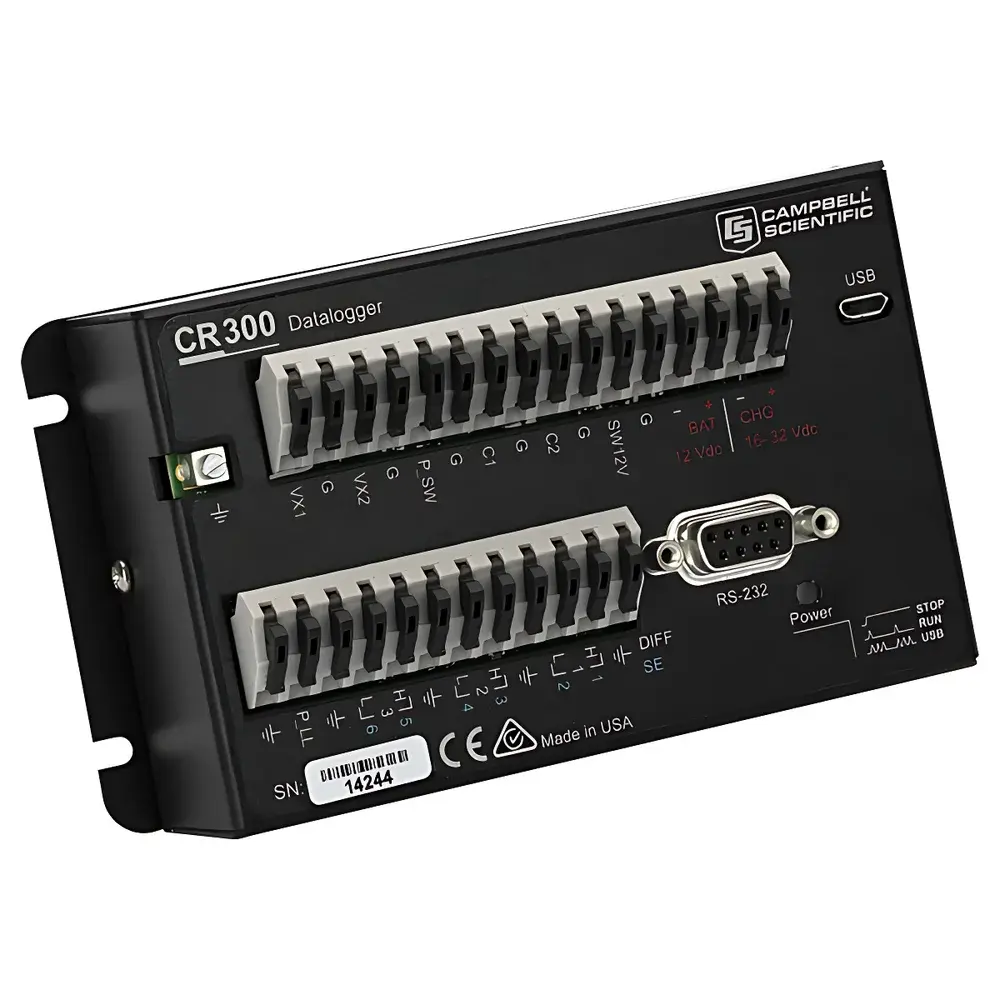
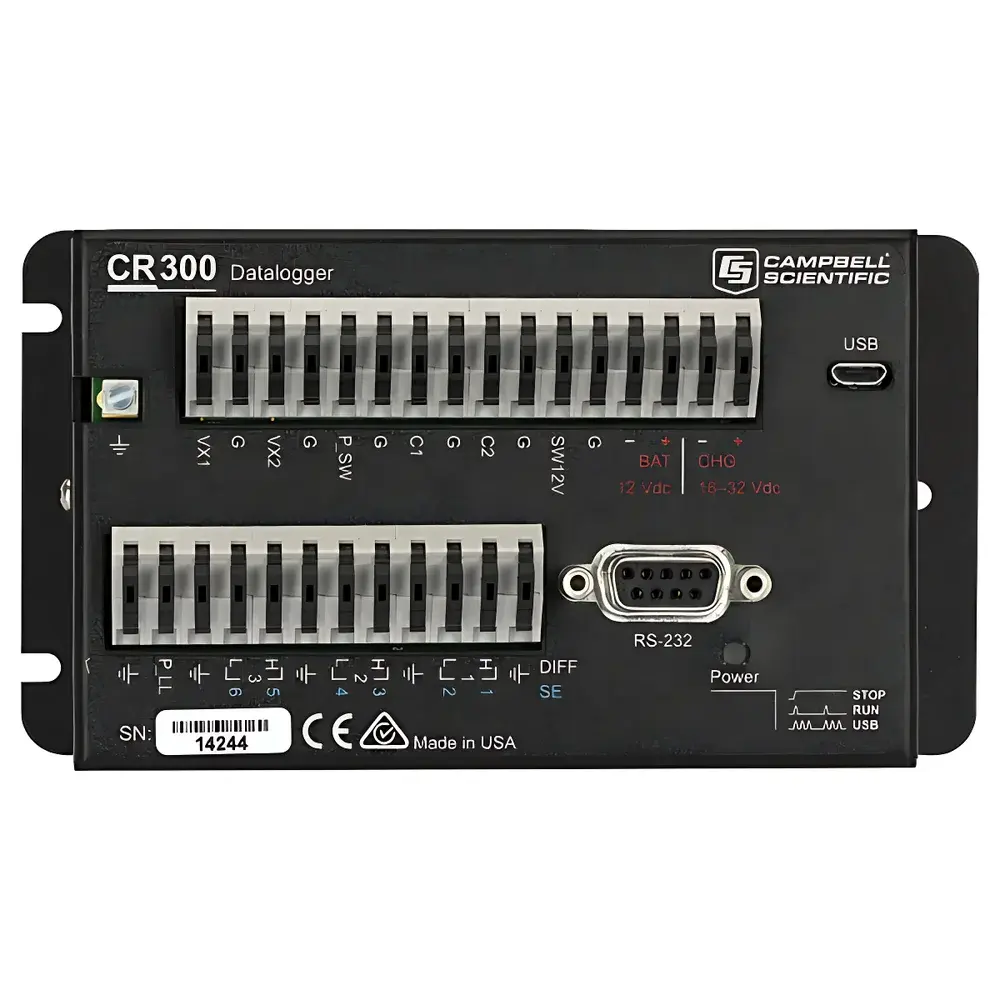
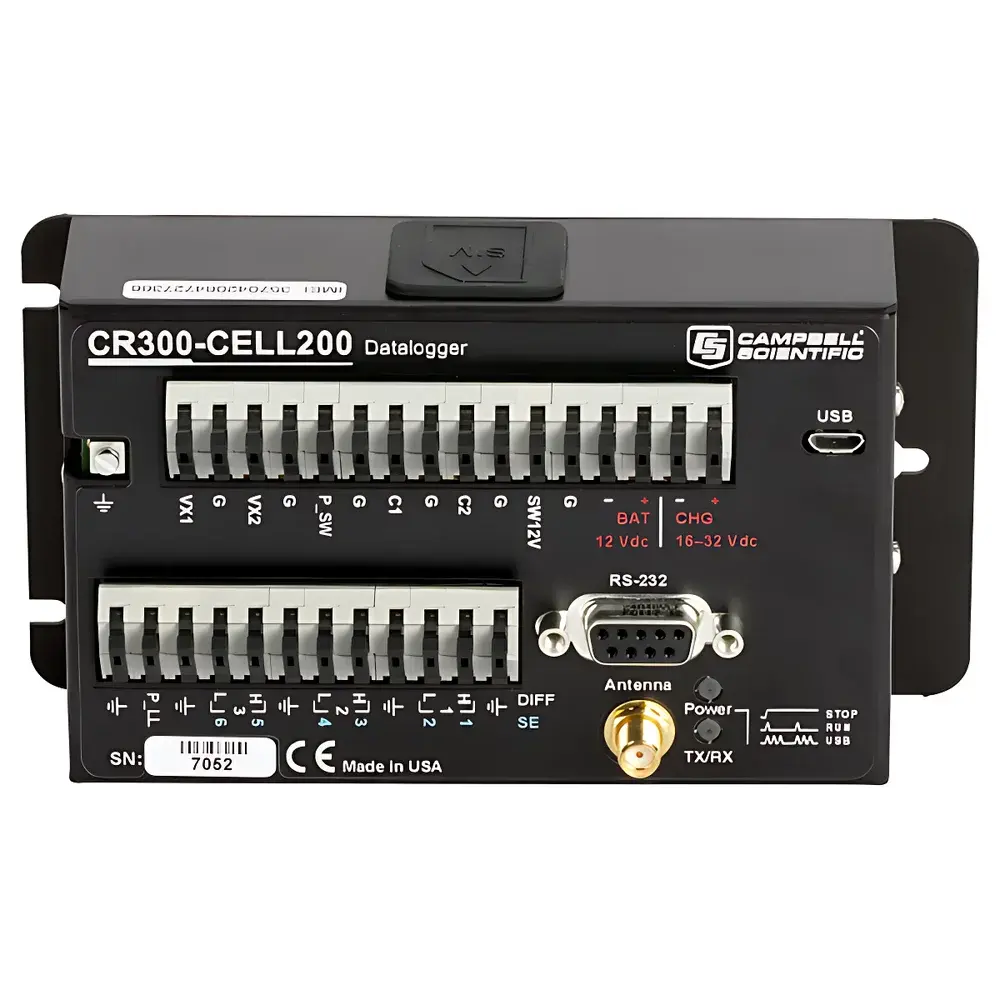
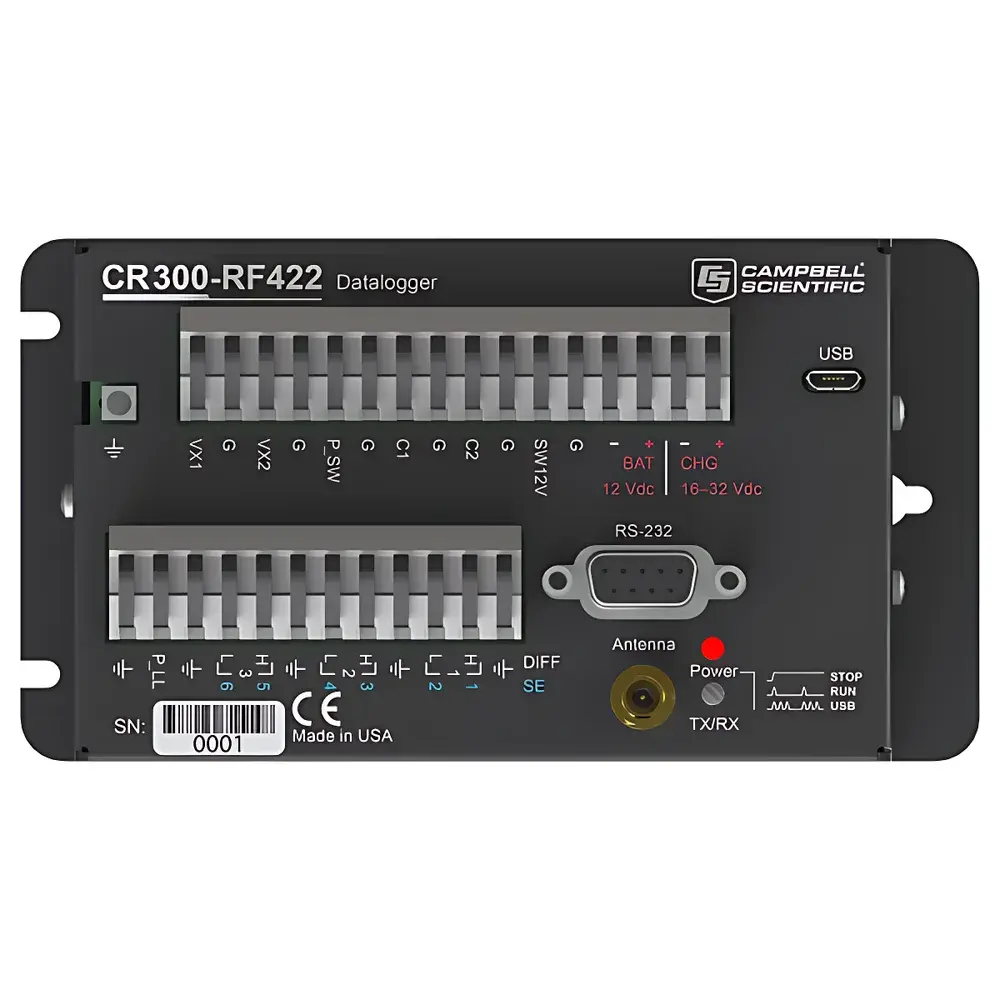
Campbell Scientific CR300 Data Acquisition Unit
| Brand | Campbell Scientific |
|---|---|
| Origin | USA |
| Model | CR300 |
| Operating Temperature | -40 to +70 °C (standard, non-condensing) |
| Analog Inputs | 6 single-ended or 3 differential (software-configurable) |
| ADC Resolution | 24-bit |
| Analog Voltage Accuracy | ±(0.04% of reading + offset) at 0–40 °C |
| Pulse Counters | 8 (P_SW, P_LL, C1, C2, SE1–SE4) |
| Excitation Outputs | 2 (VX1, VX2) |
| Digital I/O | 7 configurable terminals (C1, C2, P_SW, SE1–SE4 |
| Communication Interfaces | USB Micro-B, RS-232, Ethernet (10/100BASE-T), PPP, RNDIS |
| Supported Protocols | PakBus, Modbus RTU/TCP, DNP3, SDI-12, TCP/IP, UDP, TLS v1.2, HTTP(S), FTP(S), SMTP/TLS, POP3/TLS, NTP, DHCP, DNS, ICMP, IPv4/IPv6 |
| Real-Time Clock Accuracy | ±1 minute per month (battery-backed) |
| Power Supply | 16–32 Vdc (CHG input) |
| Idle Current Draw | 1.5 mA @ 12 Vdc |
| Active Current Draw | 5 mA @ 12 Vdc (1 Hz scan, 1 analog measurement) |
| Enclosure Material | Powder-coated aluminum |
| Dimensions | 13.97 × 7.62 × 4.56 cm (5.5 × 3.0 × 1.8 in.) |
| Weight | 242–250 g (0.53–0.55 lb) |
| Onboard Memory | 80 MB flash (program/storage), 30 MB dedicated data storage |
| Programming Language | CRBasic (onboard BASIC-like language) |
Overview
The Campbell Scientific CR300 Data Acquisition Unit is an embedded, low-power environmental and industrial monitoring system engineered for long-term, unattended operation in remote and resource-constrained field deployments. Built upon Campbell Scientific’s proven data logger architecture, the CR300 implements high-fidelity analog signal acquisition using a 24-bit sigma-delta analog-to-digital converter (ADC), enabling precise resolution of small-signal variations common in hydrological, meteorological, soil science, and industrial process sensors. Its design follows deterministic real-time sampling principles—each measurement cycle is executed at user-defined intervals with microsecond-level timing consistency, synchronized to an onboard temperature-compensated real-time clock (RTC) backed by a replaceable lithium battery. The device operates across a wide ambient temperature range (-40 to +70 °C) without condensation, making it suitable for deployment in arctic tundra, desert microclimates, and industrial enclosures alike. Unlike PC-based DAQ systems, the CR300 functions as an autonomous edge node: it acquires sensor data, executes on-device processing via CRBasic firmware, stores time-stamped records locally, and transmits structured datasets over heterogeneous networks—including cellular modems, satellite links, LoRaWAN gateways, or wired Ethernet—using industry-standard protocols.
Key Features
- 24-bit sigma-delta ADC with programmable gain and low-noise front-end filtering for high-resolution analog measurements (±(0.04% reading + offset) accuracy at 0–40 °C)
- Flexible analog input configuration: up to six single-ended or three differential inputs, each independently software-selectable
- Dual programmable voltage excitation outputs (VX1, VX2) supporting constant-voltage or switched excitation for bridge, thermistor, and RTD sensors
- Eight pulse-counting channels compatible with tipping-bucket rain gauges, turbine flow meters, and event-triggered digital signals
- Seven multifunction digital I/O terminals supporting TTL/CMOS logic levels, PWM output, external interrupt (except SE4), and serial communication (e.g., SDI-12, RS-232)
- Native support for PakBus—the Campbell Scientific peer-to-peer networking protocol—enabling meshed, self-healing sensor networks with automatic routing and data aggregation
- Full TCP/IP stack including IPv4/IPv6, TLS 1.2 encryption, HTTPS, FTPS, and SMTP/TLS for secure, audit-ready data transmission compliant with ISO/IEC 27001-aligned infrastructure requirements
- Onboard CRBasic interpreter with 80 MB flash memory for program storage and 30 MB dedicated data memory—capable of storing >1 million timestamped records without external media
- USB Micro-B interface for direct configuration, firmware updates, and local data retrieval without network dependency
- Low-power architecture: 1.5 mA average quiescent current (@12 Vdc) extends battery life in solar-charged systems to multi-year intervals under typical hydro-meteorological scan rates
Sample Compatibility & Compliance
The CR300 interfaces with a broad spectrum of analog and digital sensors used in environmental and industrial applications—including thermistors, thermocouples (with appropriate signal conditioning), pressure transducers, load cells, water level sensors (e.g., bubbler, ultrasonic, radar), anemometers, pyranometers, soil moisture reflectometers (TDR/FDR), and gas concentration analyzers. It natively supports SDI-12, Modbus RTU/TCP, and DNP3—protocols widely adopted in USGS, NOAA, EPA, and ISO 14001-certified facilities. All firmware and communication stacks are designed to meet electromagnetic compatibility (EMC) requirements per IEC 61326-1 and environmental protection standards per IP65-rated enclosure performance (when installed with appropriate conduit fittings). While not FDA 21 CFR Part 11 certified out-of-the-box, its deterministic logging behavior, immutable time-stamping, and optional TLS-secured data export enable validation pathways for GLP/GMP environments when deployed with documented configuration control and change management procedures.
Software & Data Management
Configuration, programming, and data retrieval are performed using Campbell Scientific’s PC-based LoggerNet software (v4.5+), which provides graphical wiring diagrams, automated sensor setup wizards, and batch deployment tools for fleet management. CRBasic programs—compiled and uploaded to the CR300—are human-readable, version-controllable scripts that define scan intervals, measurement sequences, linearization equations, statistical calculations (e.g., min/max/average per interval), and conditional control logic (e.g., pump activation based on tank level thresholds). Data files are stored in binary or ASCII formats (TOA5, CSV) with embedded metadata headers conforming to USDA ARS and FAO WOCAT reporting conventions. Embedded web server functionality enables remote access via standard browsers for real-time status checks, live sensor value inspection, and manual command execution—without requiring proprietary client software. All network transactions support TLS 1.2 handshaking and certificate pinning, satisfying cybersecurity requirements for critical infrastructure monitoring per NIST SP 800-53 Rev. 5 controls RA-5 and SC-8.
Applications
- Remote watershed monitoring: continuous logging of stream stage, precipitation, soil moisture, and groundwater levels for flood forecasting and drought assessment
- Microclimate networks in precision agriculture: spatially distributed air temperature, relative humidity, leaf wetness, and photosynthetically active radiation (PAR) collection
- Industrial asset health monitoring: vibration analysis, tank level trending, and HVAC system performance verification using analog 4–20 mA loop integration
- Academic field research: long-duration ecological studies requiring autonomous, low-maintenance data capture in off-grid locations
- Smart city infrastructure: integration with traffic counters, noise sensors, and air quality monitors using Modbus and HTTP(S) APIs
- Regulatory compliance reporting: generation of auditable datasets aligned with EPA Method 1664, ASTM D3921, and ISO 5667-14 water quality monitoring frameworks
FAQ
Can the CR300 operate independently without a continuous power source?
Yes. With a properly sized solar panel and deep-cycle battery, the CR300 achieves multi-year autonomy due to its sub-2 mA idle current draw and efficient power management firmware.
Does the CR300 support encrypted data transmission to cloud platforms?
Yes. It implements TLS 1.2 with server-authenticated handshakes and supports HTTPS, FTPS, and SMTP/TLS—enabling secure ingestion into AWS IoT Core, Azure IoT Hub, or custom RESTful endpoints.
Is CRBasic programming required for basic data logging?
No. LoggerNet’s Quick Setup Wizard allows point-and-click configuration of common sensors without writing code; CRBasic is optional for advanced processing or control logic.
How is time synchronization maintained during extended network outages?
The onboard RTC uses a temperature-compensated crystal oscillator with ±1 minute/month drift, backed by a non-rechargeable lithium battery rated for 10+ years—ensuring traceable timestamps even after weeks of connectivity loss.
Can the CR300 be integrated into existing SCADA systems?
Yes. Native Modbus TCP/RTU and DNP3 support enables direct integration with Ignition, Siemens Desigo, Schneider EcoStruxure, and other ICS platforms without middleware translation layers.