
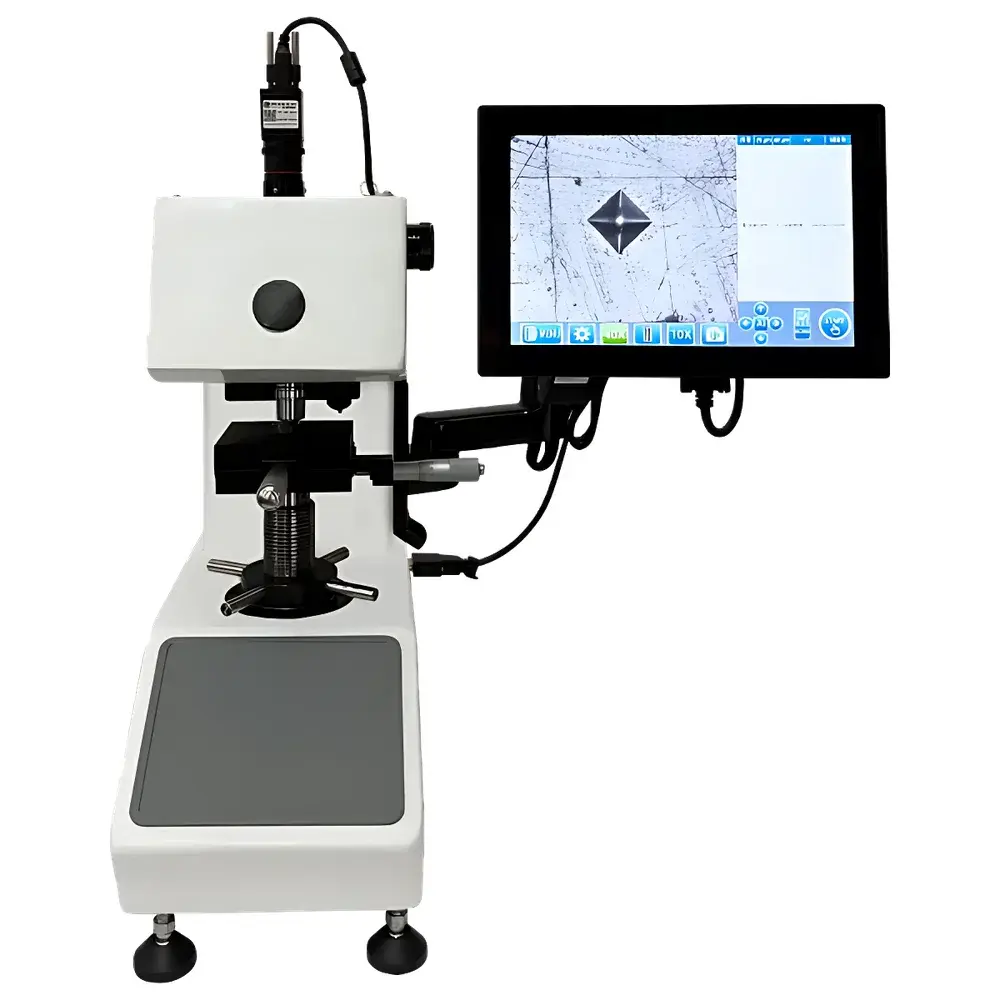
YANRUN MVS-1000AE Vision Microhardness Tester
| Brand | YANRUN |
|---|---|
| Origin | Shanghai, China |
| Manufacturer Type | Manufacturer |
| Product Category | Domestic |
| Model | MVS-1000AE Vision Microhardness Tester |
| Instrument Type | Microhardness Tester |
| Hardness Measurement Range | 8–3000 HV |
| Test Force Levels | 8 (0.098–9.807 N / 10–1000 gf) |
| Hardness Scales | HV0.01, HV0.025, HV0.05, HV0.1, HV0.2, HV0.3, HV0.5, HV1 |
| Objective Lenses | 10× (observation), 40× (measurement) |
| Total Magnification | ~160× (observation), ~640× (measurement) |
| Minimum Measurable Length | 0.03 µm |
| Dwell Time | 0–99 s (1 s increments) |
| Maximum Specimen Height | 70 mm |
| Distance from Indenter Center to Chamber Wall | 110 mm |
| X-Y Stage Travel | 25 × 25 mm |
| Stage Size | 100 × 100 mm |
| Dimensions (L×W×H) | 440 × 320 × 460 mm |
| Net Weight | 26.0 kg |
| Compliance | GB/T 4340 |
Overview
The YANRUN MVS-1000AE Vision Microhardness Tester is a fully automated, image-based microindentation system engineered for high-precision hardness evaluation of metallic, ceramic, polymeric, and thin-film materials at microstructural scales. It operates on the principle of Vickers indentation—applying a precisely controlled diamond pyramid indenter (136° apex angle) to the sample surface under calibrated loads, followed by digital imaging and geometric analysis of the resulting residual impression. The instrument integrates a coaxial optical path with dual-magnification objectives (10× for navigation, 40× for measurement), enabling accurate detection of diagonal lengths down to 0.03 µm resolution. Designed for compliance with ISO 6507-1 and ASTM E384 standards—and fully aligned with GB/T 4340 in its mechanical and procedural architecture—the MVS-1000AE delivers traceable, repeatable results across an extended hardness range (8–3000 HV), making it suitable for R&D laboratories, quality control departments, and failure analysis centers where minimal sample disruption and metrological integrity are critical.
Key Features
- Fully automated indentation cycle: motorized load application, dwell, and unloading—programmable per test sequence with dwell time adjustable from 1 to 99 seconds in 1-second increments.
- Dual-objective optical system: 10× objective for rapid specimen positioning and defect screening; 40× objective optimized for high-resolution indentation imaging and sub-micron diagonal measurement.
- Eight-step test force selection: spanning 0.098 N (10 gf) to 9.807 N (1000 gf), supporting standardized Vickers scales HV0.01 through HV1, as well as Knoop (HK) testing via interchangeable diamond indenters.
- High-stability mechanical platform: precision trapezoidal lead screw Z-axis lift mechanism and gear-driven load application ensure consistent force delivery and long-term repeatability.
- Integrated X-Y motorized stage: 100 × 100 mm stage with 25 × 25 mm travel range, enabling multi-point hardness mapping and cross-sectional profiling of coatings or heat-affected zones.
- Minimal surface damage: low-force capability (down to 10 gf) permits non-destructive evaluation of delicate substrates—including semiconductor wafers, optical coatings, dental alloys, and jewelry components—without compromising structural integrity.
Sample Compatibility & Compliance
The MVS-1000AE accommodates specimens up to 70 mm in height and 110 mm from indenter center to chamber interior wall, facilitating testing of irregularly shaped parts and mounted cross-sections. Its design supports standard metallographic sample preparation protocols (grinding, polishing, etching) and is compatible with epoxy-mounted, vacuum-impregnated, or conductive-coated specimens. All operational parameters—including force calibration, dwell timing, stage positioning, and image capture—are logged with timestamps and user identifiers, satisfying audit requirements for GLP and GMP environments. While not pre-certified to FDA 21 CFR Part 11, the system’s software architecture allows configuration of electronic signatures, audit trails, and role-based access control when deployed with validated IT infrastructure.
Software & Data Management
The proprietary YANRUN Materials Analysis & Measurement Software provides intuitive GUI-driven operation, real-time image acquisition, and automated diagonal detection using edge-enhanced thresholding algorithms. Each test record stores raw images, coordinate metadata, force/dwell settings, and calculated hardness values (HV/HK) with uncertainty estimation based on ISO 6507-2 methodology. Export options include CSV, PDF reports (with customizable templates), and XML for LIMS integration. Batch processing enables statistical analysis (mean, SD, Cpk), hardness depth profiling, and comparative overlay of multiple datasets—supporting material qualification per ASTM E92, ISO 14577, and internal QC specifications.
Applications
- Thin-film and coating hardness validation (e.g., TiN, DLC, PVD/CVD layers on aerospace or biomedical implants).
- Heat treatment verification of case-hardened steels, carburized gears, and nitrided tooling.
- Mechanical property mapping of weld joints, solder interconnects, and additive-manufactured microstructures.
- Quality assurance of microelectronics packaging materials, MEMS devices, and brittle ceramics (Al₂O₃, SiC, ZrO₂).
- Research-grade indentation studies in metallurgy, tribology, and nanomechanics—particularly where correlation with SEM/EBSD data is required.
FAQ
Does the MVS-1000AE support Knoop hardness testing?
Yes—by installing a standard Knoop diamond indenter (172.5° included angle), the system can perform HK measurements under identical optical and software workflows.
Is calibration traceable to national standards?
Force calibration is performed using NIST-traceable deadweight standards; optical magnification is verified with certified stage micrometers per ISO 6507-2 Annex B.
Can the system be integrated into an existing laboratory network?
The software supports TCP/IP communication, OPC UA-ready data export, and configurable database connectors (ODBC/JDBC) for enterprise-level data aggregation.
What maintenance is required for long-term accuracy?
Annual verification of force transducer linearity, objective magnification fidelity, and stage positional repeatability is recommended—full service documentation and OEM-certified technician support are available globally.
Is remote operation supported?
Yes—via secure RDP or VNC sessions, provided local network security policies permit authenticated access to the host PC running the measurement software.
Related Products



