ST-20 Miniature UHT Sterilization System with Integrated Aseptic Filling Module
| Origin | Shanghai, China |
|---|---|
| Manufacturer Type | Authorized Distributor |
| Origin Category | Domestic (China) |
| Model | ST-20 |
| Pricing | Upon Request |
| Standard Throughput | 20 L/h (adjustable 5–40 L/h) |
| Minimum Batch Volume | 3–5 L |
| Max Sterilization Temperature | 150 °C |
| Holding Time Options | 5 s / 15 s / 30 s (at 20 L/h) |
| Fill Temperature Range | 20–90 °C |
| SIP Capability | Yes |
| CIP Flow Rate | 400 L/h |
| Max Operating Pressure | 10 bar |
| Power Supply | 3-phase, 380 V, 10 kW |
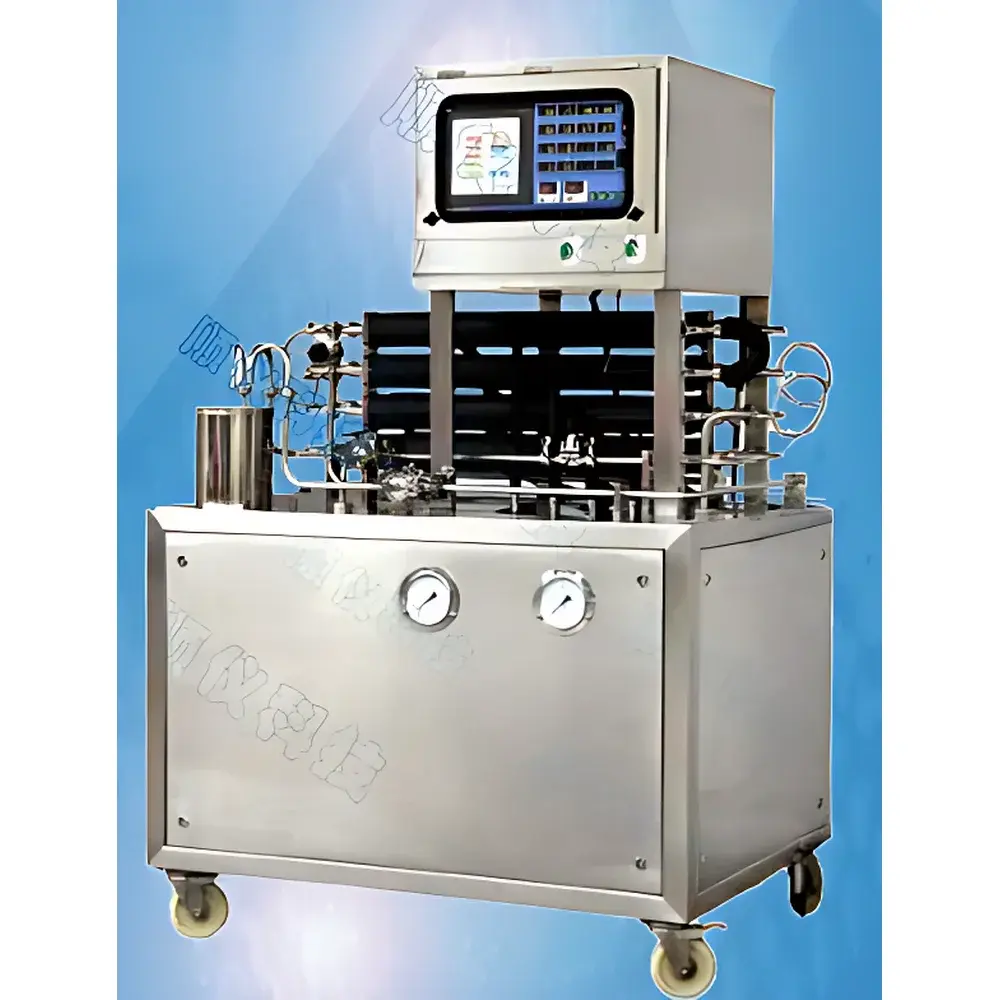
| Dimensions (UHT Unit) | 1600 H × 1200 L × 950 W mm |
| Aseptic Filling Module (CT-20) | HEPA Filtration Efficiency ≥99.999% @ 0.3 µm |
| Cleanroom Class | ISO Class 5 (Fed. Std. 209E Class 100) |
| CT-20 Dimensions | 2100 H × 850 L × 660 W mm |
| CT-20 Power | Single-phase, 220–240 V, 50 Hz, 0.25 kW |
Overview
The ST-20 Miniature UHT Sterilization System is a bench-scale, fully integrated thermal processing platform engineered for precise simulation of industrial ultra-high temperature (UHT) processing conditions in laboratory and pilot-scale R&D environments. Based on indirect heating via plate or tubular heat exchanger architecture—commonly employing steam-heated hot water or direct steam injection—the system delivers controlled, reproducible thermal treatment across defined time–temperature profiles (e.g., 137 °C for 4–6 s or 150 °C for ≤5 s). Its core function is to enable formulation validation, shelf-life prediction, microbial lethality assessment (F0 or B* calculations), and process scalability analysis for low-acid and acidified beverages, dairy analogs, plant-based fluids, and functional nutrition products. Unlike generic lab pasteurizers, the ST-20 replicates critical unit operations—including preheating, homogenization (optional), sterilization, cooling, and aseptic filling—in sequence and under programmable, closed-system hygienic conditions.
Key Features
- Compact footprint (≤3 m² total floor space) with modular, mobile design for flexible lab integration
- PID-controlled thermal management with ±0.5 °C accuracy across all process zones (preheat, hold, cooling)
- Full automation via PLC-based HMI interface; parameters configurable locally or remotely via Ethernet-connected PC software
- Real-time acquisition and logging of temperature, pressure, flow rate, and holding time with timestamped audit trails
- Onboard hot water generator for SIP (Steam-in-Place); validated CIP capability at 400 L/h with integrated chemical dosing ports
- Optional inline homogenizer (upstream or downstream of sterilization zone) supporting pressures up to 10 bar
- Integrated aseptic filling module (CT-20) featuring ISO Class 5 laminar airflow (HEPA-filtered, 99.999% @ 0.3 µm), validated for sterile container filling under GMP-aligned environmental controls
Sample Compatibility & Compliance
The ST-20 accommodates Newtonian and non-Newtonian liquid matrices including milk, soy beverage, fruit nectars, protein-fortified drinks, and viscous nutritional emulsions (up to ~500 mPa·s). It supports both continuous and batch-mode operation with minimum test volumes of 3–5 L—ideal for high-value formulations where material conservation is critical. The system conforms to key hygienic design principles outlined in EHEDG Doc. 8 and 3-A Sanitary Standards 01-05. All wetted surfaces are electropolished AISI 316L stainless steel with orbital weld certification. Data integrity complies with FDA 21 CFR Part 11 requirements when operated with validated software; electronic records include user authentication, change history, and immutable timestamps. Process validation documentation (IQ/OQ/PQ templates) and F0 calculation reports are exportable in PDF/CSV formats for regulatory submission.
Software & Data Management
Control and monitoring are executed through a Windows-based SCADA application compliant with IEC 62443 cybersecurity guidelines. The software provides dynamic trend visualization of all real-time process variables, automated generation of calibration logs, and configurable alarm thresholds with email/SMS notification (via optional gateway). Experimental data—including thermocouple traces, flow profiles, and pressure differentials—is stored in encrypted SQLite databases with daily auto-backup to network drives. Export functions support ASTM E2500-compliant report generation, GLP audit-ready CSV exports, and direct integration with LIMS platforms via OPC UA protocol. All firmware updates undergo version-controlled release testing per ISO/IEC 17025 traceability protocols.
Applications
- Rapid screening of thermal stability for novel stabilizers, emulsifiers, and pH-sensitive actives
- Determination of D-value and z-value kinetics for target microorganisms (e.g., Geobacillus stearothermophilus, Bacillus coagulans)
- Accelerated shelf-life studies under controlled storage conditions post-UHT treatment
- Validation of commercial aseptic packaging compatibility (e.g., cartons, pouches, PET bottles)
- Process mapping for scale-up to 1,000–10,000 L/h production lines using dimensionless number correlation (Re, Pr, Fo)
- Training platform for food science curricula and GMP operator certification programs
FAQ
Can the ST-20 be used for low-acid canned food process development?
Yes—when configured with validated thermocouple insertion points and integrated data loggers, it supports thermal process calculations required by USDA-FSIS and FDA for low-acid food applications.
Is third-party validation support available for 21 CFR Part 11 compliance?
Yes—qualified validation partners provide IQ/OQ/PQ execution, electronic signature implementation, and periodic requalification services aligned with Annex 11 and ALCOA+ principles.
What maintenance intervals are recommended for the homogenizer and heat exchanger modules?
Preventive maintenance is scheduled every 500 operational hours for gasket inspection, every 2,000 hours for plate pack recalibration, and annually for full SIP/CIP cycle verification per ASME BPE standards.
Does the CT-20 aseptic chamber meet EU Annex 1 requirements for sterile product handling?
The CT-20 achieves ISO Class 5 air quality and supports media fill simulations; however, full Annex 1 compliance requires site-specific qualification (smoke studies, particle counting, microbial challenge testing) performed during commissioning.
Can the system be retrofitted with a UV-C in-line sterilizer for cold-fill applications?
No—the ST-20 architecture is thermally optimized for UHT processing; UV-C integration would require redesign of flow path geometry and validation against ISO 15714, and is not supported under current CE/UL certification.