
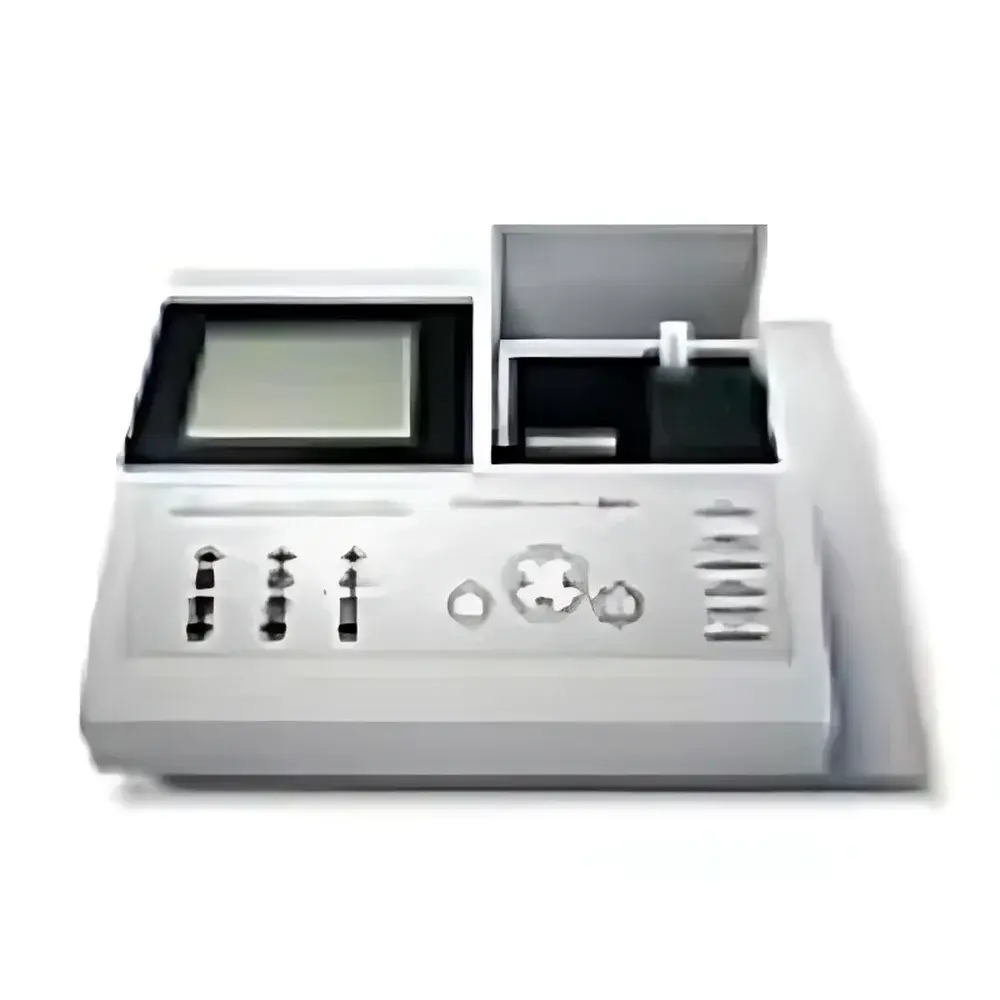
Millipore Spectroquant® Pharo 300 UV-Vis Multifunctional Water Quality Analyzer
| Brand | Millipore |
|---|---|
| Origin | Germany |
| Model | Pharo 300 |
| Wavelength Range | 190–1100 nm |
| Light Source | Xenon flashlamp |
| Optical System | Stabilized single-beam |
| Spectral Bandwidth | 4 nm |
| Wavelength Resolution | 1 nm |
| Wavelength Accuracy | ±1 nm |
| Absorbance Range | ±3.3 A |
| Absorbance Resolution | 0.001 A |
| Absorbance Accuracy | ±0.003 A (A < 0.600 A) |
| Scan Increment | 1 nm |
| Cuvette Types | 16 mm round |
| Barcode Recognition | Full support for Spectroquant® pre-filled tubes and reagent sets |
| AQA Levels | AQA 1 (wavelength verification), AQA 2 (system performance verification), AQA 3 (matrix interference screening) |
| Data Storage | 1000 measurement results |
| Interfaces | 1× USB-A, 1× USB-B, 1× RS-232 |
| Display | Backlit graphical LCD |
| Languages | English, German, Spanish, French, Italian, Simplified Chinese |
| IP Rating | IP31 |
| Operating Temperature | +10 °C to +35 °C |
| Dimensions | 404 × 197 × 314 mm (L × H × W) |
| Weight | ~3.7 kg (without battery) |
Overview
The Millipore Spectroquant® Pharo 300 UV-Vis Multifunctional Water Quality Analyzer is a laboratory-grade spectrophotometer engineered for precision, regulatory compliance, and operational flexibility in environmental water analysis. Based on stabilized single-beam optical architecture with a pulsed xenon flashlamp light source, the instrument delivers high photometric stability across its full 190–1100 nm spectral range—enabling both routine regulatory testing and advanced method development. Unlike dedicated colorimetric analyzers, the Pharo 300 functions as a dual-purpose platform: it executes standardized water quality assays using certified Spectroquant® reagents while simultaneously supporting research-grade applications including full-spectrum scanning, multi-wavelength quantitation, and time-resolved kinetic measurements. Its design adheres to core principles of analytical traceability and metrological integrity, with wavelength accuracy maintained at ±1 nm and absorbance reproducibility validated per ISO 8466-1 and DIN EN ISO 7027-1 requirements.
Key Features
- Automated barcode recognition for all Spectroquant® pre-filled test tubes and economical reagent kits—eliminating manual method selection errors and accelerating workflow throughput.
- Intelligent cuvette detection system that auto-identifies 16 mm round or 10/20/50 mm square cells and selects optimal pathlength-dependent calibration curves without user intervention.
- Three-tiered Analytical Quality Assurance (AQA) framework: AQA 1 verifies wavelength accuracy via PhotoCheck or CertiPUR® UV/VIS standards; AQA 2 validates full-system performance using CombiCheck solutions; AQA 3 applies MatrixCheck algorithms to detect matrix interferences prior to result reporting.
- Built-in library of >170 pre-programmed methods compliant with DIN, ISO, and U.S. EPA protocols—including parameters such as COD, nitrate, phosphate, ammonia, total nitrogen, heavy metals (e.g., Cr(VI), Cu, Ni), and organic contaminants.
- Support for up to 100 user-defined methods and 20 custom scan/kinetic protocols—facilitating method transfer, validation, and non-standard assay development.
- Robust data governance architecture: internal storage for 1000 measurement records plus 4 MB dedicated memory for spectral datasets (e.g., 100 full scans or 400 kinetic traces), with USB export capability for audit-ready archiving.
Sample Compatibility & Compliance
The Pharo 300 accommodates diverse sample matrices—from raw surface water and municipal wastewater effluents to treated drinking water and industrial process streams. Its optical design minimizes stray light effects and enables reliable quantitation even in turbid or colored samples when paired with appropriate cuvette pathlengths and AQA 3 interference screening. The system meets key international regulatory expectations: all factory-loaded methods are validated against DIN 38402, ISO 15586, and U.S. EPA Methods 365.4, 353.2, and 354.1. Instrument firmware supports GLP-compliant operation through electronic signature-capable user authentication, audit-trail logging of all critical events (e.g., calibration, AQA execution, method modification), and timestamped data export. While not inherently 21 CFR Part 11 compliant out-of-the-box, the platform is fully compatible with third-party electronic lab notebook (ELN) and LIMS integrations that enforce digital signature and retention policies required under GxP frameworks.
Software & Data Management
Operation is managed via an embedded real-time operating system with a multilingual graphical interface (English, German, Spanish, French, Italian, Simplified Chinese). All preloaded methods include integrated blank subtraction—automatically applied during sample measurement—reducing analyst workload and reagent consumption. Method updates and software upgrades are distributed free-of-charge via USB drive or PC-connected firmware update utility, ensuring long-term method currency without hardware replacement. Data output conforms to ASTM E1382-90 standard formats for spectral data exchange (.csv, .txt) and supports direct import into common statistical packages (e.g., JMP, Minitab, R) for trend analysis, control charting, and uncertainty budgeting. Internal memory retains complete metadata for each measurement—including date/time stamp, operator ID, cuvette type, AQA status, and raw absorbance values at all measured wavelengths.
Applications
The Pharo 300 serves as a primary analytical tool across multiple operational contexts: municipal water utilities performing daily compliance monitoring per national drinking water directives; environmental laboratories conducting contract testing for regulatory agencies under ISO/IEC 17025 accreditation; industrial facilities managing closed-loop cooling water chemistry or effluent discharge compliance; and academic research groups developing novel colorimetric assays for emerging contaminants. Its UV capability (down to 190 nm) extends applicability to low-molecular-weight organics (e.g., benzene derivatives, phenolic compounds) and nitrate/nitrite speciation where visible-range detection lacks specificity. Kinetic mode supports enzyme-based assays (e.g., alkaline phosphatase activity in microbial source tracking) and slow-reacting redox systems requiring time-resolved absorbance profiling.
FAQ
Does the Pharo 300 require annual recalibration by a certified service provider?
No—its xenon flashlamp design eliminates lamp aging drift, and built-in AQA routines enable user-performed verification at defined intervals (e.g., daily startup checks per SOP). Full calibration verification is recommended annually or after physical relocation.
Can the instrument be used for non-water matrices such as soil extracts or biological fluids?
Yes—provided samples are appropriately filtered, clarified, and diluted to fall within linear absorbance range (0.02–2.0 A) and cuvette pathlength constraints. MatrixCheck functionality helps assess suitability prior to quantitation.
Is method validation documentation available for EPA-compliant parameters?
Yes—Merck provides method validation reports (including LOD/LOQ, linearity, precision, spike recovery) for all EPA-listed parameters upon request, aligned with ISO/IEC 17025 clause 7.2.2.
How is data integrity ensured during power interruption?
All measurements in progress are buffered in non-volatile memory; unsaved results persist through brief outages (<5 sec) and resume upon power restoration without loss.
What is the expected lifetime of the xenon flashlamp?
Rated for ≥10⁹ flashes—equivalent to >10 years of typical laboratory use (assuming 500 measurements/day). No scheduled lamp replacement is required during normal service life.







