
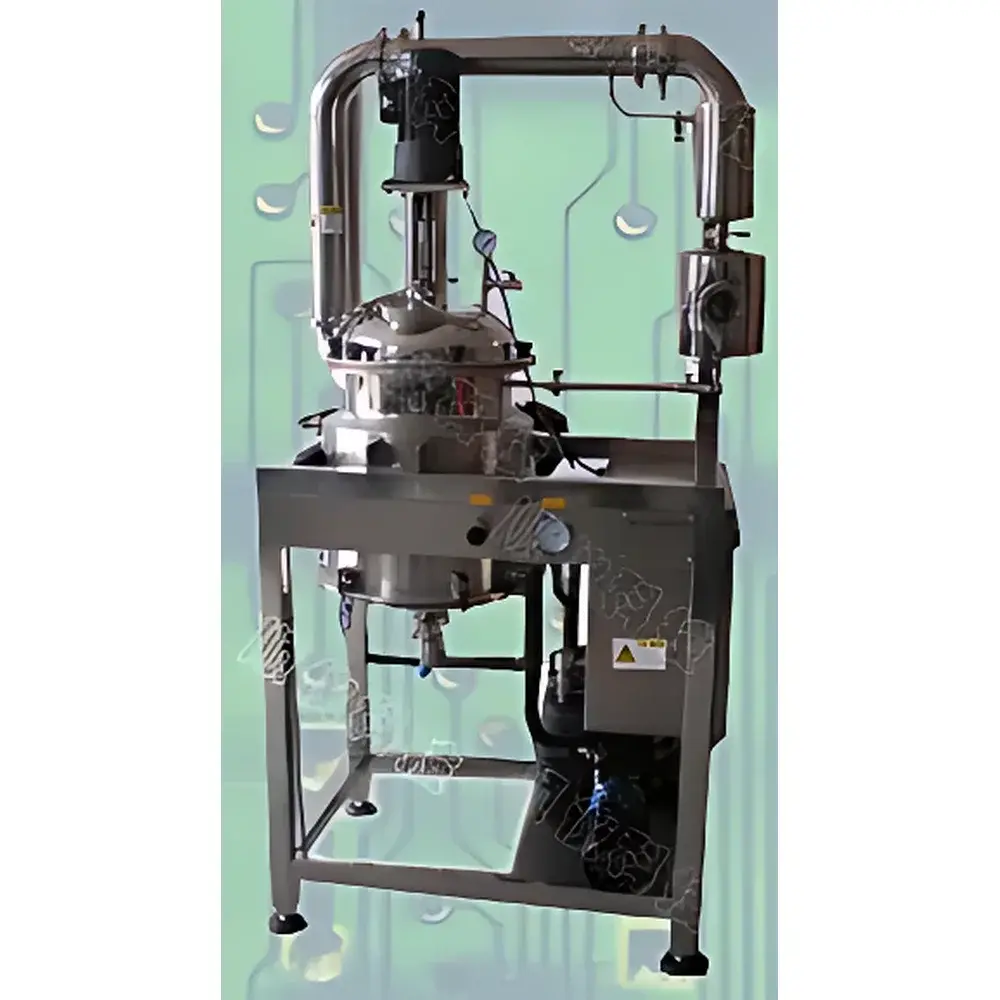
EX-TE Series Multifunctional Herbal Extraction Vessel
| Origin | Shanghai, China |
|---|---|
| Manufacturer Type | Authorized Distributor |
| Origin Category | Domestic (China) |
| Model | EX-TE-03 / EX-TE-05 / EX-TE-10 / EX-TE-30 / EX-TE-50 / EX-TE-100 |
| Capacity | 3–100 L |
| Design Pressure (Vessel) | 0.09 MPa |
| Design Pressure (Jacket) | 0.3–0.4 MPa |
| Heating Power | 3–15 kW |
| Agitation Power | 0.09–0.5 kW |
| Temperature Control Range | Ambient to 120 °C |
| Optional Ultrasonic Frequency | 15–60 kHz |
| Compliance | Designed for GLP-compliant R&D environments |
Overview
The EX-TE Series Multifunctional Herbal Extraction Vessel is an engineered laboratory-scale extraction system designed for reproducible, scalable, and process-optimized solid–liquid extraction of botanical matrices. Based on jacketed vessel thermodynamics with integrated direct heating and programmable agitation, the system supports multiple extraction modalities—including decoction, maceration, percolation, reflux, hydrodistillation, and solvent recovery—under atmospheric or controlled-pressure conditions. Its architecture conforms to fundamental principles of mass transfer kinetics and thermal equilibrium control, enabling precise manipulation of temperature, residence time, mixing intensity, and solvent–solid interaction dynamics. The vessel is not a generic “fat analyzer” but a dedicated extraction platform adapted for phytochemical R&D, natural product isolation, and formulation development in pharmaceutical, nutraceutical, food science, and bioprocessing laboratories.
Key Features
- Modular capacity range: Six standardized models (EX-TE-03 to EX-TE-100) covering 3 L to 100 L effective working volume—ideal for method development, pilot-scale feasibility studies, and batch-to-batch consistency validation.
- Integrated dual-zone thermal management: Internal electric heating elements provide uniform heat distribution across vessel wall and bottom; jacket pressure rating (0.3–0.4 MPa) supports steam or thermal oil utility integration where required.
- Three-layer thermal insulation: Minimizes ambient heat loss and improves energy efficiency during prolonged extraction cycles.
- Intelligent central controller with real-time PID regulation: Enables independent setpoint control and digital display of extraction temperature, heating temperature, agitation speed, and operational duration.
- Low-level liquid detection circuitry: Automatically deactivates heating elements when fluid level falls below safe threshold—preventing dry-run damage and ensuring equipment longevity.
- Expandable multi-unit configuration: Standardized mounting interface and communication protocol allow synchronized operation of up to 20 units via centralized supervisory software—supporting parallel experimental design (DOE) and statistical process analysis.
- Optional ultrasonic enhancement module: Equipped with focused transducer arrays (15–60 kHz selectable) and frame-type agitator geometry to maximize cavitation zone coverage across heterogeneous herbal loads—facilitating cell wall disruption without thermal degradation.
Sample Compatibility & Compliance
The EX-TE system accommodates diverse solid-phase matrices including dried herbs, granulated extracts, fermented biomass, protein-rich plant tissues, and starch-based substrates. It supports aqueous, hydroalcoholic, and low-boiling organic solvents (e.g., ethanol, acetone, ethyl acetate), with integrated condensation and reflux pathways for closed-loop solvent recovery. All wetted parts are constructed from electropolished 316L stainless steel meeting ASTM A270 and ASME BPE standards. The control architecture supports audit trail generation, user access levels, and electronic signature capability—aligning with FDA 21 CFR Part 11 requirements for regulated research environments. Documentation packages include IQ/OQ templates compliant with ISO/IEC 17025 and WHO TRS Annex 4 guidelines for laboratory equipment qualification.
Software & Data Management
A Windows-based HMI application provides intuitive graphical workflow configuration, parameter logging at configurable intervals (1–60 s), and CSV/Excel export of time-stamped datasets. Data fields include temperature (vessel core, jacket inlet/outlet), agitation RPM, ultrasonic power output (%), vacuum level (if equipped), pH (via optional inline probe), and liquid level status. Raw data files are timestamped, digitally signed, and stored with immutable metadata—enabling traceability for GLP audits. Remote monitoring via Ethernet or RS485 Modbus RTU is supported; OPC UA gateway integration is available upon request for enterprise LIMS or MES connectivity.
Applications
- Phytochemical screening: Optimization of active constituent yield (e.g., flavonoids, alkaloids, polysaccharides) under variable T/t/solvent conditions.
- Process parameter mapping: Correlation of ultrasonic frequency, amplitude, and duty cycle with extraction efficiency and selectivity.
- Stability assessment: Thermal degradation profiling of thermolabile compounds (e.g., volatile oils, glycosides) using sub-boiling ultrasonic protocols.
- Solvent recovery validation: Mass balance quantification of ethanol, methanol, or hexane recovery rates during reflux cycles.
- Regulatory dossier preparation: Generation of robust, instrumented extraction data for inclusion in IND submissions, EFSA dossiers, or Chinese NMPA registration packages.
- Teaching & training: Hands-on instruction in unit operations, mass transfer theory, and GxP-aligned lab practice for graduate programs in pharmaceutics and food engineering.
FAQ
Is the EX-TE series suitable for Good Manufacturing Practice (GMP) production environments?
No—it is classified as a laboratory R&D and pilot-scale development system. While it supports GLP-compliant data integrity features, it is not validated for commercial manufacturing per EU Annex 15 or USP <1058>.
Can third-party pH or dissolved oxygen probes be integrated into the control loop?
Yes—standard 4–20 mA or RS485 analog inputs are provided; custom firmware mapping is available for certified probes from Mettler Toledo, Hamilton, or Thermo Fisher.
What maintenance protocols are recommended for ultrasonic transducers?
Transducers require quarterly visual inspection for pitting or delamination; acoustic output calibration is advised every 500 operating hours using a calibrated hydrophone per IEC 61894.
Does the system support automated cleaning-in-place (CIP)?
Not natively—but CIP compatibility can be added via optional spray ball manifold, programmable valve sequencing, and conductivity-based rinse endpoint detection.
Are explosion-proof configurations available for flammable solvent use?
Yes—ATEX-certified variants (Zone 1, II 2G Ex db IIB T4 Gb) with intrinsically safe I/O and purge-compatible enclosures are offered for EX-TE-30 and larger models.



