
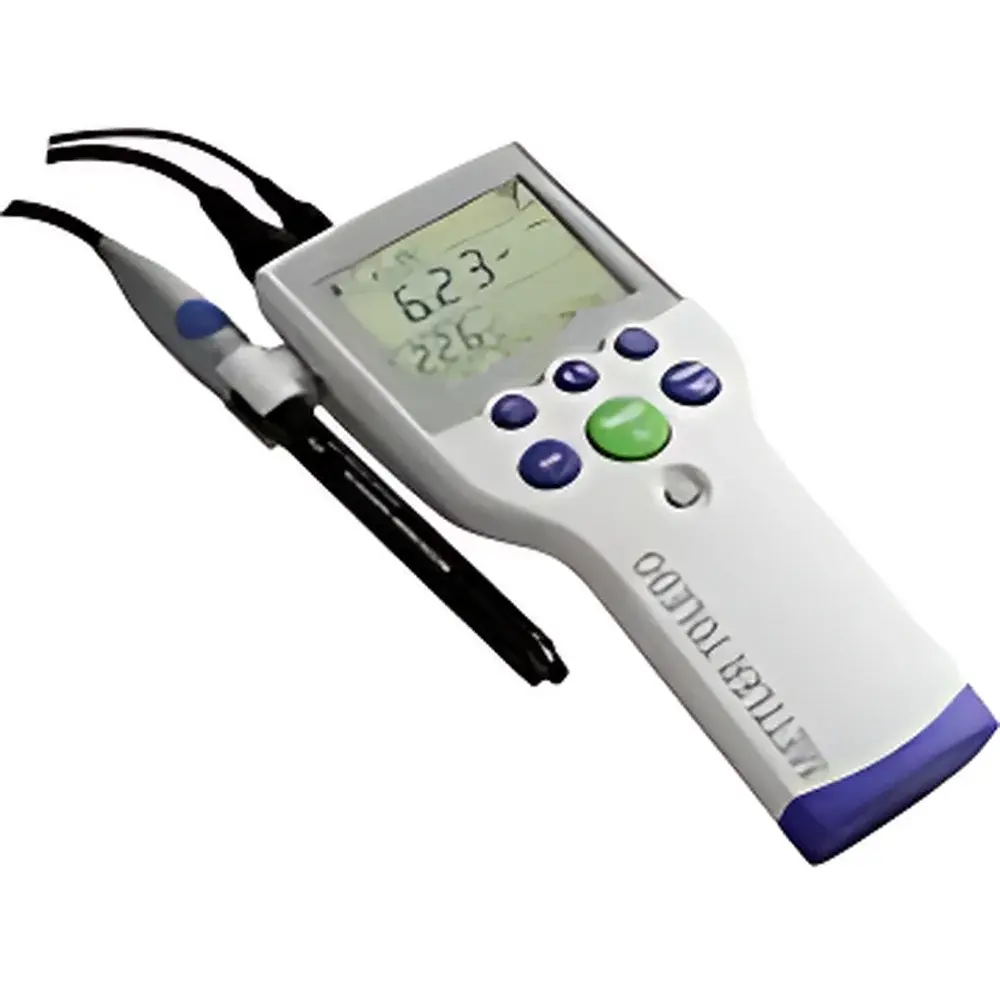
METTLER TOLEDO SevenGo™ SG2 Portable pH Meter
| Brand | METTLER TOLEDO |
|---|---|
| Origin | Switzerland |
| Model | SG2 |
| pH Range | 0.00–14.00 |
| pH Resolution | 0.01 |
| pH Accuracy (relative) | ±0.01 |
| mV Range | −1999 to +1999 mV |
| mV Resolution | 1 mV |
| mV Accuracy (relative) | ±1 |
| Temperature Range | −5.0 to 105.0 °C |
| Temperature Resolution | 0.1 °C |
| Temperature Accuracy | ±0.5 °C |
| Display | Custom LCD |
| IP Rating | IP67 |
| Data Storage | 30 measurements |
| Calibration | Up to 3-point, with predefined or user-defined buffer sets (DIN, NIST, US, TECH) |
| Connectivity | IR interface (RS232/USB via optional adapter) |
| Operating Environment | 5–40 °C, 5–80% RH (non-condensing) |
Overview
The METTLER TOLEDO SevenGo™ SG2 is a rugged, handheld pH and mV/ORP meter engineered for reliable field and routine laboratory use. Based on potentiometric measurement principles, the SG2 determines hydrogen ion activity in aqueous solutions via a glass pH electrode and reference junction, delivering traceable, reproducible results under variable environmental conditions. Its compact, ergonomic design—combined with an IP67-rated enclosure—ensures operational integrity in humid, dusty, or splash-prone environments, including wastewater treatment plants, food processing lines, educational labs, and environmental monitoring sites. Unlike benchtop meters, the SG2 prioritizes intuitive operation without sacrificing metrological rigor: all critical parameters—including real-time electrode status, battery level, temperature compensation, and endpoint stability—are continuously visible on its high-contrast custom LCD display.
Key Features
- IP67 ingress protection certified for dust-tightness and temporary immersion (up to 1 m for 30 min), enabling safe use in outdoor, industrial, or mobile applications.
- Automatic temperature compensation (ATC) using integrated or external Pt1000 sensors ensures accurate pH readings across −5.0 to 105.0 °C, critical for non-ambient sample analysis.
- Auto-endpoint detection locks measurement when signal stability meets ISO 7888-defined criteria (±0.01 pH / 1 mV over 10 s), minimizing operator subjectivity.
- Intelligent buffer recognition supports four globally standardized calibration protocols: DIN 19266, NIST SRM, US Pharmacopeia (USP), and METTLER TOLEDO’s TECH set—reducing calibration errors and training time.
- Onboard storage for up to 30 measurement records—including pH, mV, temperature, date/time stamp, and electrode ID—facilitates GLP-compliant documentation without external hardware.
- Infrared (IR) data transfer enables wireless export of results to printers or PCs; optional RS232 or USB adapters support integration into LIMS or QA/QC reporting workflows.
Sample Compatibility & Compliance
The SG2 is validated for use with standard aqueous samples, buffer solutions, and low-ionic-strength media typical in environmental, pharmaceutical, and food testing. It complies with IEC 61010-1 for electrical safety and meets EN 61326-1 for electromagnetic compatibility (EMC) in industrial environments. While not intrinsically safe, its sealed housing and low-power design align with general-purpose lab and field deployment requirements per ISO/IEC 17025 clause 5.5.2 (equipment suitability). Calibration traceability follows ISO/IEC 17025:2017 Annex A.2, referencing NIST-traceable buffer standards (e.g., SRM 186, 188, 191). The instrument supports audit-ready operation when paired with METTLER TOLEDO’s LabX Lite software (via IR-to-USB bridge), enabling electronic record retention compliant with FDA 21 CFR Part 11 principles for signature and change control.
Software & Data Management
Data generated by the SG2 is stored internally with timestamps and contextual metadata (temperature, electrode type, calibration status). Export occurs via IR link to compatible METTLER TOLEDO printers (e.g., LP51) or third-party systems equipped with IR receivers. For structured digital archiving, the optional RS232/USB interface allows direct connection to Windows-based PCs running METTLER TOLEDO’s free LabX Lite software—providing CSV export, trend visualization, and basic report generation. All exported files retain immutable measurement context, supporting internal QA reviews and external audits under GLP or GMP frameworks. No cloud dependency or subscription is required; data sovereignty remains fully under user control.
Applications
- Environmental fieldwork: rapid pH/mV screening of surface water, groundwater, soil extracts, and effluent streams per ASTM D1293 and ISO 10523.
- Food & beverage QC: batch verification of rinse water, brine solutions, dairy products, and fermentation media under HACCP-aligned SOPs.
- Educational laboratories: student-friendly platform for teaching electrochemical fundamentals, calibration theory, and uncertainty estimation per ISO/IEC Guide 98-3.
- Pharmaceutical water systems: conductivity-coupled pH checks of purified water (PW) and water for injection (WFI) per USP and EP 2.2.38.
- Industrial process support: portable verification of cleaning-in-place (CIP) solution neutrality prior to equipment reuse.
FAQ
Does the SG2 support automatic calibration with multiple buffer sets?
Yes—the SG2 recognizes four preloaded buffer families (DIN, NIST, US, TECH) and permits user-defined buffer values for specialized applications.
Is electrode diagnostics available during measurement?
Yes—real-time electrode impedance and asymmetry potential indicators appear continuously on-screen, alerting users to aging, clogging, or reference junction failure.
Can the SG2 be used for ORP measurements in redox-sensitive processes?
Yes—it measures mV across the full −1999 to +1999 mV range with 1 mV resolution and ±1 mV accuracy, suitable for chlorine residual, ozone, and anaerobic digestion monitoring.
What accessories are required for GLP-compliant data export?
An IR-to-USB adapter (e.g., METTLER TOLEDO IR-USB-01) and LabX Lite software are recommended for timestamped, editable CSV exports meeting basic ALCOA+ data integrity expectations.
How often should the instrument be verified between calibrations?
Per ISO/IEC 17025:2017, daily verification using a fresh check standard (e.g., pH 7.00 buffer) is advised for routine use; full recalibration is required if deviation exceeds ±0.02 pH from certified value.
Related Products




