
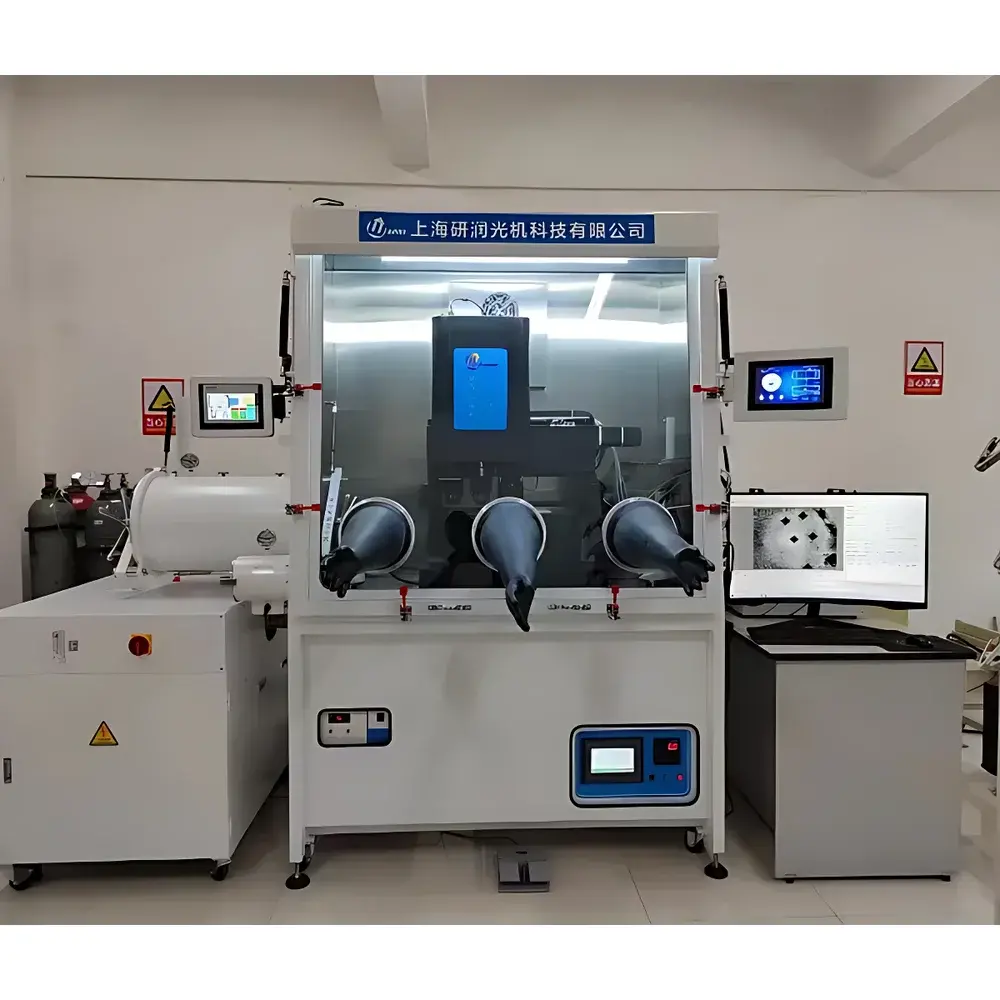
YANRUN IMAS-UHT1700CM Full-Field Dynamic Indentation Tester for Ultra-High-Temperature Characterization up to 1600 °C
| Brand | YANRUN |
|---|---|
| Origin | Shanghai, China |
| Manufacturer Type | OEM Manufacturer |
| Product Category | Domestic |
| Model | IMAS-UHT1700CM |
| Instrument Type | Vickers Hardness Tester |
| Temperature Range | 400–1600 °C |
| Max Furnace Temperature | 1700 °C |
| Load Range | 0.1–30 kgf (standard), optional up to 150 kgf |
| Load Accuracy | ≤±2% at ≤1 kgf |
| Displacement Resolution | 500 nm (standard), optional down to 20 nm (laser interferometry) |
| Optical Working Temperature | ≤1600 °C (10× or 20× objective) |
| Hold Time Capability | Up to 72 h at target temperature and load |
| Thermal Uniformity | ≤±5 °C across 100×80×80 mm furnace cavity |
| Heating Rate | 1–40 °C/min |
| Thermocouple Type | B-type |
| Heating Element | Four U-shaped MoSi₂ rods |
| Sample Size Limit | Ø30×30 mm |
| In-situ Exchange Time | ≤50 s at 1600 °C |
| Multi-axis Control | Up to 9 synchronized axes |
| Image Magnification | 1000× (10× objective), optional 2000× (20× objective) |
| Objective Resolution | 1.44 µm (10×), optional 1.19 µm (20×) |
| Cooling | Dual-mode (water + inert-gas quenching) |
Overview
The YANRUN IMAS-UHT1700CM is a full-field, in-situ dynamic indentation tester engineered for quantitative mechanical characterization of advanced materials under ultra-high-temperature (UHT) conditions ranging from 400 °C to 1600 °C. Unlike conventional hardness testers limited to ambient or moderate-temperature operation, the IMAS-UHT1700CM integrates high-temperature metrology, real-time force–displacement–time acquisition, and optical observation within a thermally stable, uniform furnace environment. Its core measurement principle is based on controlled quasi-static indentation using a geometrically defined indenter—typically a Berkovich or Vickers pyramid—while maintaining continuous thermal equilibrium between the sample, indenter, and optical train. The system operates on a modified depth-sensing indentation paradigm compliant with ISO 14577 and ASTM E2546, adapted for elevated-temperature applications where thermal drift, creep, and oxidation kinetics significantly influence mechanical response. Designed specifically for R&D in aerospace superalloys, nuclear ceramics, refractory composites, and next-generation thermal barrier coatings, the IMAS-UHT1700CM enables true in-situ, same-temperature-field property mapping without thermal cycling artifacts.
Key Features
- Full-field temperature control from 400 °C to 1600 °C, with furnace capability up to 1700 °C and thermal uniformity ≤±5 °C over a 100×80×80 mm cavity
- High-temperature optical path: 10× and optionally 20× objectives rated for continuous operation at ≤1600 °C, delivering 1000× or 2000× system magnification with sub-micron resolution (1.44 µm standard)
- Dynamic loading architecture supporting force-controlled, displacement-controlled, and rate-controlled modes; real-time acquisition of force–displacement–time data at ≥1 kHz sampling rate
- Multi-range load actuation: standard 0.1–30 kgf (3–294 N), with optional extension to 150 kgf (1471 N); load accuracy ≤±0.5% FS above 1 kgf
- In-situ sample exchange in ≤50 s at 1600 °C via thermally isolated rapid-transfer stage, enabling high-throughput comparative testing across multiple specimens under identical thermal history
- Nine-axis synchronized motion control (X/Y/Z/rotation + dual-Y for objective/indenter + Z-lift + tilt) with positioning resolution ≤0.1 µm and repeatability ≤±1 µm
- Dual-cooling infrastructure: closed-loop water chiller (±0.3 °C stability, 13 L/min flow) and high-pressure inert-gas quenching (≤5 s cooldown from 1600 °C to <100 °C)
- Integrated high-temperature piezoresistive load cell and laser interferometric displacement sensor (500 nm standard, optional 20 nm)
Sample Compatibility & Compliance
The IMAS-UHT1700CM accommodates disk-shaped samples up to Ø30×30 mm and supports diverse material classes—including Ni-based superalloys, SiC/Si₃N₄ ceramics, C/C composites, refractory metals (Mo, W, Nb), and oxide dispersion-strengthened (ODS) steels—under inert (Ar, N₂) or vacuum atmospheres. Optional glovebox integration (H₂O/O₂ ≤1 ppm) ensures handling of air-sensitive specimens. All hardware components exposed to >1000 °C—including the 1700 °C-rated indenter (110 mm × Ø8 mm Mo–Re alloy), furnace insulation (high-purity alumina fiber), and thermocouples (B-type)—comply with ASTM E230/E230M and IEC 60584-1 for high-temperature instrumentation. The system architecture supports GLP-compliant workflows: audit-trail-enabled software logging, electronic signatures, and data integrity per FDA 21 CFR Part 11 requirements when configured with validated firmware and access controls.
Software & Data Management
IMAS V7.0 software suite provides unified control of thermal ramping, multi-axis positioning, load application, image capture, and synchronized data acquisition. It supports automated test sequences—including pre-heating, dwell, multi-step loading, extended hold (up to 72 h), and unloading—with configurable triggers for image capture at user-defined displacement or time intervals. Raw force–displacement–time datasets are exported in HDF5 and CSV formats, compatible with MATLAB, Python (NumPy/Pandas), and commercial finite-element postprocessors. Built-in analysis modules compute Vickers hardness (HV), fracture toughness (KIC via Anstis equation), reduced modulus (Er), and creep compliance using Oliver–Pharr methodology adapted for thermal expansion compensation. Calibration routines include in-situ thermal drift correction, load-cell hysteresis mapping, and optical scale verification traceable to NIST standards.
Applications
- Temperature-dependent hardness mapping of turbine blade coatings (e.g., YSZ, La₂Zr₂O₇) across 800–1400 °C gradients
- In-situ creep–indentation coupling studies on directionally solidified NiAl–Cr(Mo) eutectics at 1300 °C
- Fracture resistance evaluation of SiC fiber-reinforced SiC matrix composites under thermal shock cycles
- Phase-transformation-induced hardening/softening kinetics in shape-memory alloys (NiTi, Fe–Mn–Al–Ni) during heating/cooling ramps
- Interfacial adhesion quantification via high-temperature scratch testing of diffusion-bonded dissimilar metal joints (e.g., Ti–Al, Cu–W)
- Validation of thermo-mechanical constitutive models for nuclear fuel cladding materials (Zr–Nb alloys, SiC composites) under prototypic LOCA conditions
FAQ
What is the maximum continuous operating temperature of the optical system?
The 10× and 20× objectives are rated for uninterrupted operation at ≤1600 °C for up to 50 hours per cycle, with active purge gas flow and thermal shielding.
Can the system perform hardness testing per ASTM E384 or ISO 6507?
Yes—the IMAS-UHT1700CM implements Vickers geometry (136° pyramidal indenter) and conforms to the indentation depth–load relationship specified in both standards, with thermal expansion corrections applied in real time.
Is remote diagnostics and software update support available?
All units include secure TLS-encrypted remote access capability for technical support, firmware updates, and performance validation—subject to customer-configured firewall policies and IT governance protocols.
How is thermal drift compensated during long-duration hold tests?
A dual-sensor strategy combines real-time thermal expansion modeling (based on material-specific CTE inputs) with periodic zero-load displacement recalibration using the laser interferometer, achieving sub-10 nm thermal drift stability over 72-hour holds.
Does the system meet electromagnetic compatibility (EMC) requirements for laboratory environments?
Yes—CE marking certification includes EN 61326-1:2013 (measurement/control lab equipment) and EN 55011:2016 (radiated/conducted emissions), verified per IEC 61000-4 series immunity testing.



