
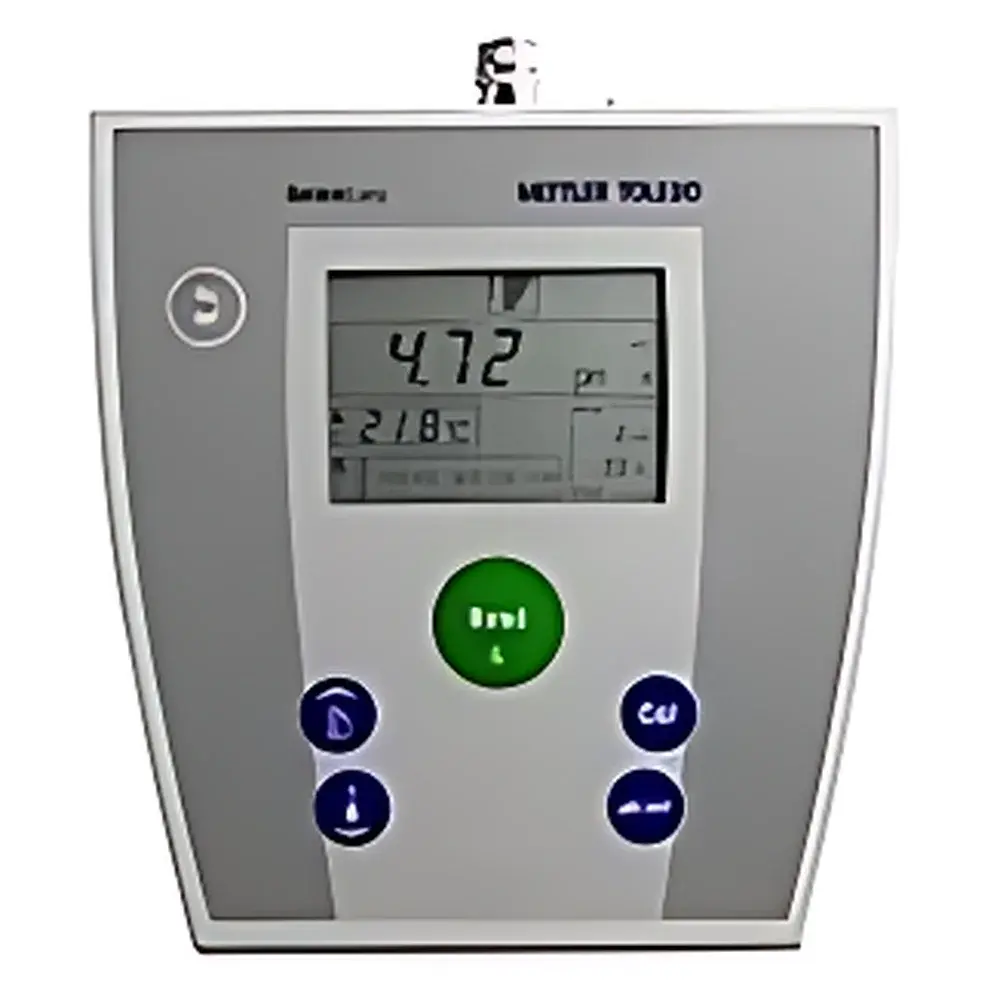
METTLER TOLEDO S20 SevenEasy™ pH Meter
| Brand | METTLER TOLEDO |
|---|---|
| Origin | Switzerland |
| Model | S20 |
| pH Range | 0.00–14.00 |
| pH Resolution | 0.01 |
| Relative pH Accuracy | ±0.01 |
| mV Range | −1999 to +1999 mV |
| mV Resolution | 1 mV |
| Relative mV Accuracy | ±0.4 |
| Temperature Range | −5.0 to 105.0 °C |
| Temperature Resolution | 0.1 °C |
| Temperature Accuracy | ±0.5 °C |
| Display | LCD |
| Power Supply | External AC adapter or 4× AA (LR6) batteries |
| Calibration | Auto-buffer recognition, user-definable buffer sets, ATC, auto-endpoint hold |
Overview
The METTLER TOLEDO S20 SevenEasy™ pH Meter is a benchtop electrochemical instrument engineered for precision, repeatability, and regulatory readiness in routine pH and redox (mV/ORP) measurements. Built upon METTLER TOLEDO’s legacy of metrological rigor, the S20 implements potentiometric measurement principles based on the Nernst equation—detecting the potential difference between a pH-sensitive glass electrode and a stable reference electrode in aqueous solution. Its design targets laboratories requiring traceable, auditable, and operationally efficient pH analysis across quality control, academic teaching, environmental monitoring, and pharmaceutical pre-formulation workflows. The instrument complies with fundamental electrochemical measurement standards—including ISO 7888 (water quality — determination of pH), ASTM D1293 (pH of water), and supports alignment with GLP and GMP documentation practices through structured calibration logging and endpoint validation.
Key Features
- Automatic Temperature Compensation (ATC): Integrated thermistor-based sensing enables real-time correction of pH readings according to sample temperature, minimizing systematic drift caused by thermal variation across the full operational range (−5.0 to 105.0 °C).
- Auto-Endpoint Hold: Intelligent signal stabilization logic detects electrochemical equilibrium and locks the displayed value only when drift falls below 0.01 pH units per second for ≥3 seconds—ensuring high inter-operator reproducibility without manual judgment.
- Auto-Buffer Recognition: The meter automatically identifies IUPAC- and DIN-compliant buffer solutions (e.g., pH 4.01, 7.00, 9.21, 10.01) during calibration, eliminating mislabeling errors and accelerating multi-point calibration sequences.
- High-Contrast LCD Display: A backlit, 2-line monochrome display presents primary measurement (pH or mV), temperature, electrode status, calibration progress, and unit indicators simultaneously—optimized for ambient-lit lab environments and glove-compatible operation.
- Dual Power Architecture: Supports uninterrupted operation via standard AC adapter or four AA alkaline cells—enabling flexible deployment in both fixed workstations and mobile field carts without dependency on mains power.
- User-Defined Calibration Protocols: Up to three custom buffer sets can be stored and recalled, supporting site-specific SOPs, regional regulatory requirements (e.g., USP , EP 2.2.3), and method-specific tolerance thresholds.
Sample Compatibility & Compliance
The S20 is validated for aqueous and low-ionic-strength samples typical in drinking water, buffer preparation, cell culture media, chemical synthesis intermediates, and cosmetic formulations. It accommodates standard BNC-input pH electrodes—including METTLER TOLEDO’s InLab® Expert Pro (included in S20K configuration)—which feature low-resistance glass membranes, integrated temperature sensors, and robust double-junction reference systems for minimized junction clogging and extended service life. While not intrinsically rated for hazardous areas, the device meets CE, FCC, and RoHS directives. Its calibration traceability aligns with ISO/IEC 17025 requirements when used with certified reference materials and documented procedures.
Software & Data Management
The S20 operates as a standalone instrument with embedded firmware; no proprietary PC software is required for basic operation. However, it supports RS232 serial output (via optional cable) for direct connection to LIMS or Excel-based data capture systems. All calibrations and measurements are timestamped and stored internally (up to 200 records). Audit trail functionality includes operator ID entry (manual text input), calibration date/time, buffer IDs used, slope (%), offset (mV), and temperature at time of calibration—facilitating FDA 21 CFR Part 11 readiness when paired with validated third-party data acquisition platforms.
Applications
- Pharmaceutical QC: Monitoring pH of injectables, ophthalmic solutions, and dissolution media per USP and Ph. Eur. 2.2.3.
- Food & Beverage: Verifying acidification endpoints in dairy fermentation, juice stabilization, and vinegar titration support.
- Environmental Labs: Field-deployable pH screening of surface water, wastewater effluents, and soil extracts under ISO 10523.
- Academic Teaching: Introducing core electrochemical concepts—Nernstian response, liquid junction potential, and calibration uncertainty—to undergraduate chemistry students.
- Chemical Manufacturing: In-process control of neutralization reactions, catalyst activation baths, and cleaning-in-place (CIP) rinse verification.
FAQ
Does the S20 support GLP-compliant calibration reporting?
Yes—each calibration event logs buffer IDs, slope, offset, temperature, date/time, and operator entry, enabling reconstruction of measurement history per GLP Annex 3 and ISO/IEC 17025 clause 7.7.
Can I use non-METTLER TOLEDO electrodes with the S20?
Any BNC-compatible pH or ORP electrode may be connected; however, optimal ATC performance and auto-buffer recognition require electrodes with integrated Pt1000 or NTC thermistors and digital identification (e.g., InLab® series).
Is the internal memory battery-backed?
No—the S20 does not retain stored data during full power loss; users are advised to export critical records via RS232 before shutdown.
What is the recommended recalibration frequency?
Per ISO 7888 and laboratory SOPs, recalibration is required before each analytical batch, after electrode replacement, following prolonged storage (>24 h), or when measured slope deviates >5% from theoretical (59.16 mV/pH at 25 °C).
Does the S20 meet FDA 21 CFR Part 11 requirements out-of-the-box?
The instrument provides foundational audit trail elements but requires integration with validated electronic record systems to satisfy full Part 11 criteria—including electronic signatures, system access controls, and record retention policies.





