
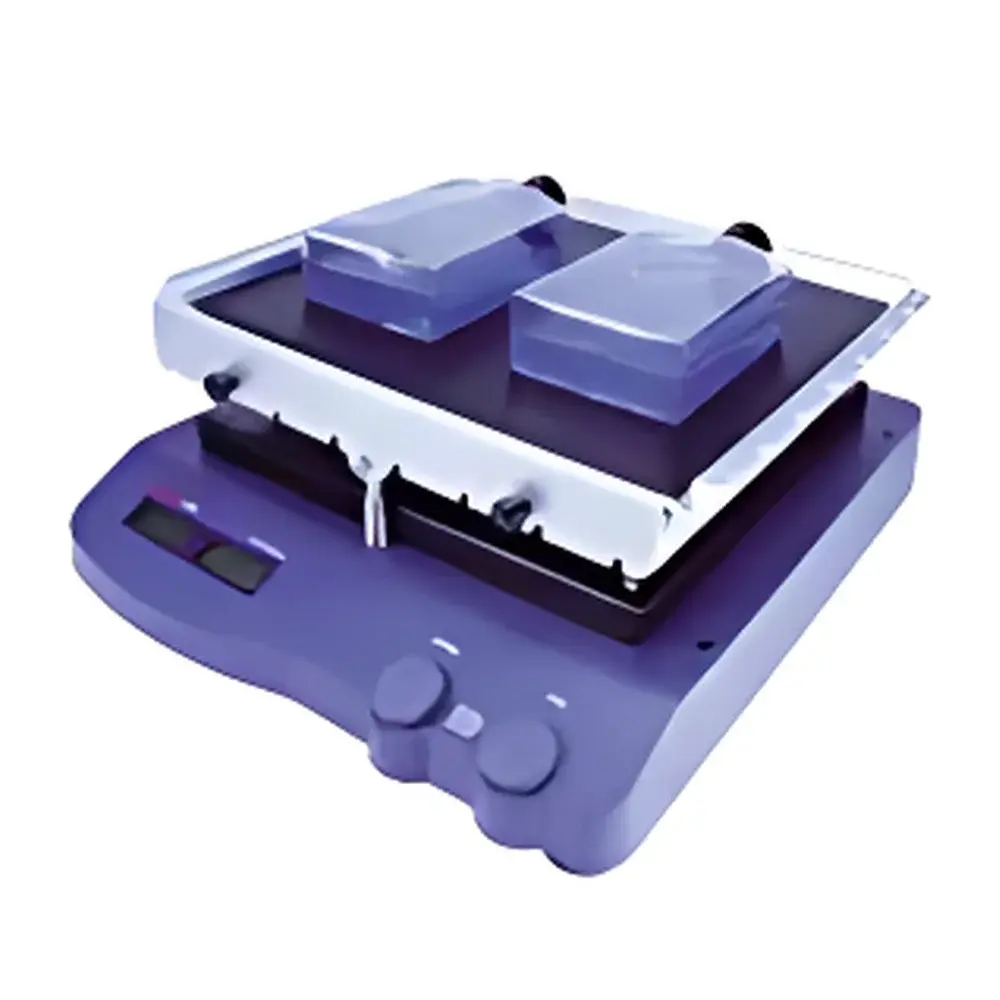
DLAB SK-R330-Pro Rocking Platform Shaker
| Brand | DLAB |
|---|---|
| Origin | Beijing, China |
| Manufacturer Type | Authorized Distributor |
| Country of Origin | China |
| Model | SK-R330-Pro |
| Voltage | 100–240 VAC |
| Frequency | 50/60 Hz |
| Power Consumption | 40 W |
| Motor Type | DC Motor |
| Rocking Angle | 9° |
| Max Load Capacity | 10 kg |
| Speed Range | 10–70 rpm |
| Speed Display | LCD |
| Timer Function | Yes |
| Timer Display | LCD |
| Timer Range | 1–1199 min |
| Operation Modes | Timed & Continuous |
| Dimensions (D×W×H) | 410 × 360 × 200 mm |
| Net Weight | 9 kg |
| Ambient Temperature Range | 5–40 °C |
| Relative Humidity Limit | ≤80% RH (non-condensing) |
| Ingress Protection Rating | IP21 |
Overview
The DLAB SK-R330-Pro Rocking Platform Shaker is an engineered solution for gentle, consistent, and reproducible horizontal oscillation in life science and clinical laboratory workflows. Designed around a precise rocking motion—achieved via a balanced eccentric drive mechanism—the instrument delivers controlled angular displacement of ±4.5° (total rocking angle: 9°) at adjustable speeds between 10 and 70 rpm. This low-shear agitation mode is optimized for applications where sample integrity must be preserved while ensuring uniform reagent contact, such as post-electrophoretic gel processing, antibody-based assays, and suspension-based cell handling. Its compact footprint (410 × 360 × 200 mm), lightweight construction (9 kg), and universal power input (100–240 VAC, 50/60 Hz) make it suitable for benchtop deployment across multi-voltage international laboratories—including core facilities, QC labs, and academic research suites operating under GLP-aligned protocols.
Key Features
- Intuitive dual-line LCD interface displaying real-time speed (rpm) and remaining timer duration simultaneously—enabling rapid parameter verification without interrupting operation.
- Precision-engineered rocking platform with integrated anti-slip silicone matting, minimizing lateral sample displacement during extended runs—even with loosely capped tubes, Petri dishes, or hybridization trays.
- Flexible operational modes: programmable timed runs (1–1199 minutes) or uninterrupted continuous operation, supporting both standardized protocols and exploratory assay development.
- Robust DC motor architecture ensures stable rotational torque across the full speed range, low acoustic emission (<45 dB(A)), and minimal heat generation—critical for temperature-sensitive biological samples.
- Compliance-ready design: IP21-rated enclosure provides protection against vertically falling solid objects and limited ingress of moisture; meets DIN EN 60529 requirements for general laboratory environments.
Sample Compatibility & Compliance
The SK-R330-Pro accommodates a broad spectrum of common labware, including but not limited to: standard electrophoresis gels (mini and midi formats), Western blot transfer cassettes, multi-well plates (6–96-well), glass staining trays, conical centrifuge tubes (up to 50 mL), and T-25/T-75 flasks used in adherent and suspension cell culture maintenance. Its 10 kg load capacity supports simultaneous processing of multiple vessels without compromising motion consistency. From a regulatory standpoint, the device aligns with foundational infrastructure requirements for ISO/IEC 17025-accredited testing laboratories and supports audit-readiness in environments governed by FDA 21 CFR Part 11 (when paired with validated electronic record systems), EU Annex 11, and CLIA-certified workflows—particularly where documented agitation parameters (speed, duration, angle) are required for SOP traceability.
Software & Data Management
While the SK-R330-Pro operates as a standalone hardware unit without embedded connectivity, its deterministic mechanical behavior and repeatable parameter setpoints enable seamless integration into digitally managed lab ecosystems. Users may log operational metadata—including start time, speed, duration, and ambient conditions—via LIMS or ELN platforms. The absence of proprietary firmware simplifies validation: IQ/OQ protocols can be executed using standard calibration tools (e.g., optical tachometer for rpm verification, digital inclinometer for angle confirmation), and all settings remain persistent through power cycling. For labs implementing electronic batch records, the device’s clear, unambiguous LCD readouts facilitate accurate manual entry and reduce transcription error risk.
Applications
- Electrophoresis workflow support: uniform gel staining (e.g., Coomassie, silver nitrate) and destaining with minimized band diffusion.
- Molecular hybridization: efficient probe binding in Southern/Northern blotting and in situ hybridization protocols.
- Immunodetection: consistent antibody incubation and wash steps in ELISA, Western blotting, and immunoprecipitation (IP) workflows.
- Cell biology: gentle resuspension of pelleted cells, serum-free media exchange, and low-stress passaging of sensitive primary cultures.
- Diagnostic assay development: reproducible antigen–antibody interaction kinetics studies under standardized agitation conditions.
FAQ
What is the maximum recommended load for optimal performance?
The rated maximum load is 10 kg; however, for long-duration runs (>4 hours) or high-speed operation (>60 rpm), we recommend maintaining loads ≤7 kg to ensure bearing longevity and motion stability.
Can the SK-R330-Pro be used inside a cold room or incubator?
It is rated for ambient temperatures between 5–40 °C and relative humidity ≤80% non-condensing. Use within refrigerated environments (e.g., 4 °C cold rooms) is permissible only if condensation is actively prevented and airflow around the unit’s ventilation grilles remains unobstructed.
Is the rocking angle user-adjustable?
No—the 9° total rocking angle is fixed by mechanical design to guarantee consistent fluid dynamics and avoid calibration drift across instruments.
Does the device support external triggering or RS-232/USB control?
No—it is a manually operated, stand-alone unit without digital communication interfaces. Automation integration requires external relay-based timing systems.
How often should routine maintenance be performed?
DLAB recommends visual inspection of the rocker arm linkage and platform mounting screws every 6 months; no lubrication or internal servicing is required under normal usage conditions.



