
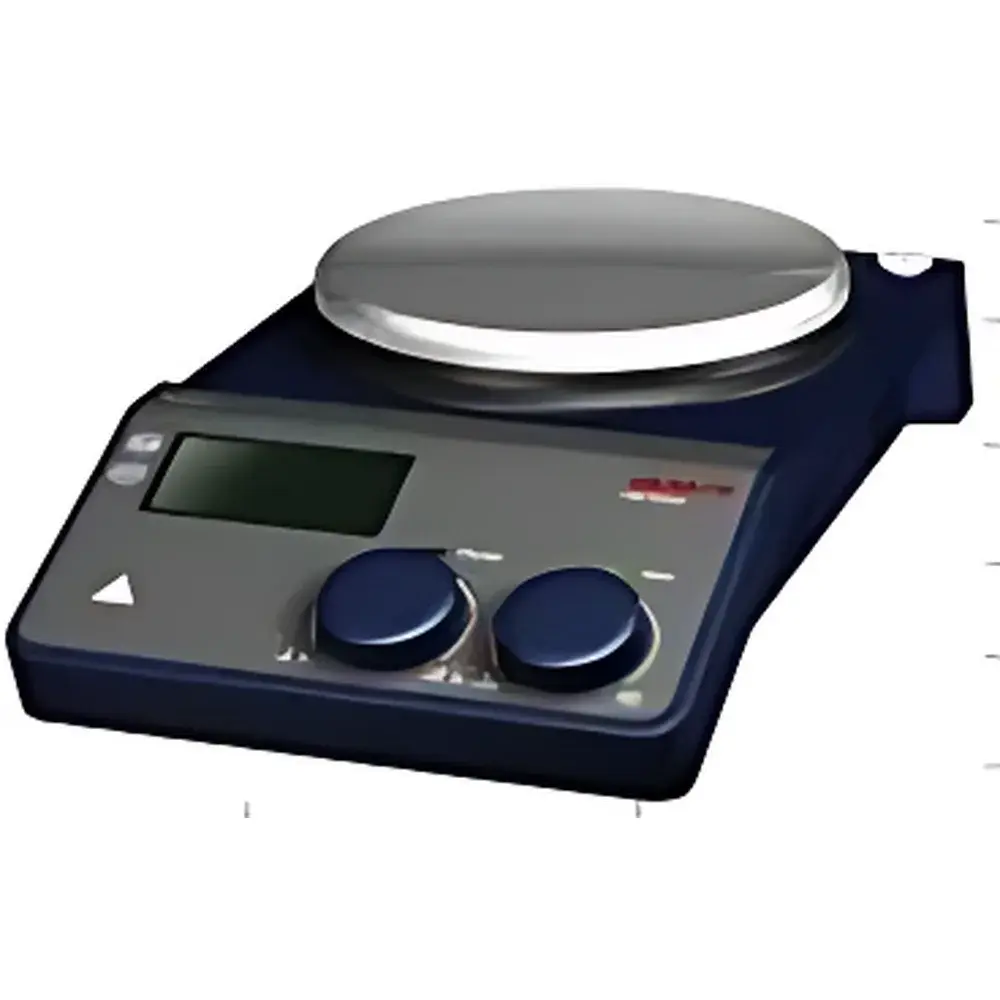
DLAB MS-S and MS-H Series Magnetic Stirrers
| Brand | DLAB |
|---|---|
| Model | MS-S (Non-heating) / MS-H-S & MS-H-Pro (Heating) |
| Type | Benchtop Magnetic Stirrer |
| Power Supply | 220 VAC, 50/60 Hz |
| Max. Stirring Volume (H₂O) | 20 L |
| Speed Range | 0–1500 rpm (MS-S/MS-H-S), 100–1500 rpm (MS-S-Pro/MS-H-Pro) |
| Speed Display | Analog scale (MS-S/MS-H-S) or Backlit LCD (MS-S-Pro/MS-H-Pro) |
| Heating Power | 500 W (MS-H-S/MS-H-Pro) |
| Max. Heating Temp | 340 °C |
| Heating Rate (1 L H₂O) | 6 K/min |
| Temperature Display & Control | LCD with 0.1 °C resolution (MS-H-Pro) |
| Motor | Brushless DC (MS-S/MS-H-S) or Brushless Pancake Outer Rotor (MS-S-Pro/MS-H-Pro) |
| Motor Output Power | 10 W |
| Workplate Material | Stainless steel (non-heating models) or Enamel-coated steel (heating models) |
| Workplate Diameter | φ135 mm |
| Safety | Dual independent thermal cutoff circuits (trip at 350 °C plate surface temp), IP42 enclosure rating (MS-Pro series), automatic stir bar detection & recapture (MS-H-Pro/MS-S-Pro), residual heat warning display |
| Connectivity | RS232 interface for PC-based parameter configuration, data logging, and remote monitoring |
| Compliance | DIN EN 60529 (IP42), DIN 12878 (for external temperature probe interface), GLP-compatible audit trail via software |
Overview
The DLAB MS-S and MS-H Series magnetic stirrers are precision-engineered benchtop instruments designed for reproducible, low-vibration mixing of liquid samples in research laboratories, quality control environments, and pharmaceutical development settings. These devices operate on the principle of magnetic coupling: a rotating permanent magnet or electromagnetic drive beneath a non-magnetic workplate induces synchronous rotation of a magnetic stir bar immersed in the sample vessel. This contactless torque transmission eliminates mechanical shaft seals and contamination risks associated with overhead stirrers, making the system ideal for sterile, sealed, or corrosive applications. The MS-H variants integrate resistive heating elements beneath an enamel-coated steel plate, enabling simultaneous stirring and temperature-controlled incubation—critical for kinetic studies, solubility testing, and dissolution protocols. All models feature brushless motor architectures to ensure long-term stability, minimal electromagnetic interference, and consistent rotational output across variable load conditions.
Key Features
- Brushless DC or pancake-type outer rotor motors delivering constant speed under changing viscosity or vessel geometry—no drift observed during ramped heating or high-viscosity media handling.
- Dual independent thermal protection circuits: primary PID-controlled heating regulation and secondary hardware-based cutoff at 350 °C surface temperature, compliant with IEC 61000-4 immunity requirements.
- Intelligent stir bar management (MS-Pro models): real-time detection of stir bar stalling or ejection, followed by automatic re-synchronization without user intervention—reducing experimental failure rates in unattended overnight runs.
- Enamel-coated heating plates resistant to common laboratory acids, bases, and organic solvents; stainless steel plates on non-heating units provide corrosion resistance and ease of cleaning.
- RS232 serial interface supporting bidirectional communication with Windows-based DLAB StirControl™ software for parameter scripting, time-stamped data export (speed, temperature, elapsed time), and electronic lab notebook (ELN) integration.
- Backlit LCD displays (MS-Pro series) with 0.1 °C temperature resolution and 1 rpm speed resolution, enabling precise protocol adherence in GLP/GMP-regulated workflows.
Sample Compatibility & Compliance
The MS-S and MS-H platforms accommodate standard glassware including beakers (50 mL to 2 L), Erlenmeyer flasks, and jacketed reactors up to 20 L water-equivalent volume. Stir bar compatibility spans lengths from 20 mm to 80 mm, with optimal performance achieved using PTFE- or glass-coated magnets rated for temperatures up to 350 °C. Units conform to DIN EN 60529 (IP42 ingress protection), ensuring operational safety in humid or splash-prone environments. The MS-H-Pro model supports DIN 12878-compliant PT1000 probes for external temperature feedback—enabling accurate control within USP dissolution apparatus validation and ASTM E2912-22 thermal uniformity testing. Firmware and software comply with FDA 21 CFR Part 11 requirements for electronic records and signatures when used with validated configurations.
Software & Data Management
DLAB StirControl™ software (v3.2+) provides full remote operation via RS232 connection. Users define multi-step methods—including ramp-hold profiles for speed and temperature, alarm thresholds, and auto-shutdown triggers. All actions generate timestamped logs with operator ID fields, supporting audit readiness per ISO/IEC 17025 clause 7.7. Data exports are available in CSV and XML formats compatible with LIMS and statistical analysis platforms (e.g., JMP, Python pandas). The software includes built-in calibration verification tools for speed and temperature sensors, generating printable reports traceable to NIST-traceable references.
Applications
These stirrers serve diverse roles across analytical, formulation, and process development labs: buffer preparation and pH equilibration in molecular biology; catalyst dispersion in heterogeneous reaction screening; solvent evaporation control during sample concentration; accelerated stability testing per ICH Q1A(R3); and dissolution testing per USP Apparatus II. In academic settings, they support polymerization kinetics, nanoparticle synthesis, and electrochemical cell conditioning where precise thermal and hydrodynamic control directly impacts nucleation behavior and particle size distribution.
FAQ
What is the maximum recommended operating temperature for the enamel heating plate?
The maximum safe surface temperature is 340 °C; the integrated thermal cutoff activates at 350 °C to prevent coating degradation.
Can the MS-H-Pro maintain temperature stability during rapid viscosity changes?
Yes—the fuzzy logic controller dynamically adjusts power delivery based on real-time thermal load estimation, achieving ±0.5 °C stability over 8-hour periods under controlled ambient conditions.
Is third-party software integration supported?
RS232 ASCII command protocol documentation is publicly available, enabling integration with LabVIEW, MATLAB, or custom Python scripts using pySerial.
Does the unit meet electromagnetic compatibility (EMC) standards for use near sensitive instrumentation?
All models comply with EN 61326-1:2013 for laboratory equipment, with conducted and radiated emissions tested below Class B limits.
How is calibration performed for temperature and speed verification?
DLAB provides factory calibration certificates (traceable to national standards); field verification uses NIST-traceable digital thermometers and optical tachometers—procedures outlined in the User Manual Annex C.



