
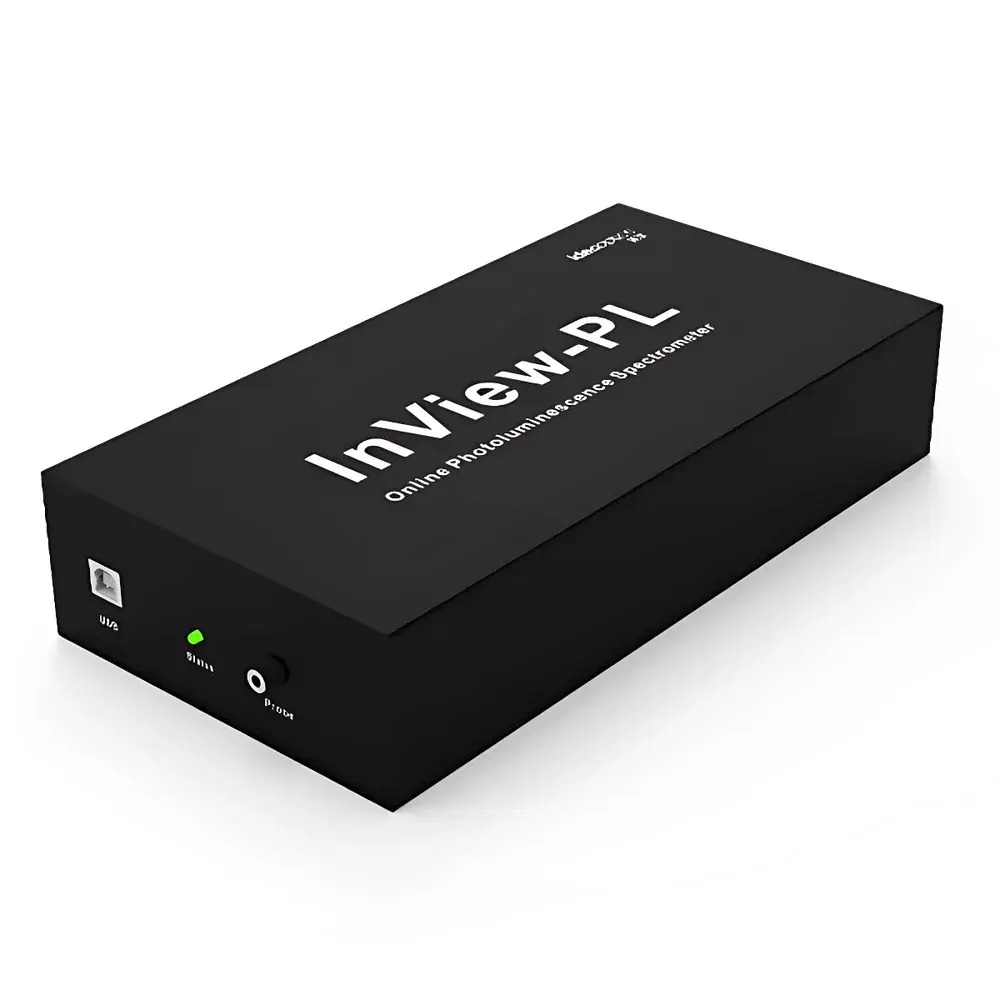
IdeaOptics InView-PL In-situ Online Photoluminescence Spectrometer
| Brand | IdeaOptics |
|---|---|
| Origin | Shanghai, China |
| Manufacturer Type | Original Equipment Manufacturer (OEM) |
| Product Origin | Domestic (China) |
| Model | InView-PL |
| Price | Upon Request |
| Spectral Resolution | ~5 nm |
| Excitation Range | 400–1100 nm (absorption coverage) |
| Emission Range | 600–1050 nm (photoluminescence coverage) |
| Sampling Rate | ≥10 Hz |
Overview
The IdeaOptics InView-PL is an in-situ online photoluminescence (PL) spectrometer engineered for real-time, non-invasive optical monitoring of thin-film formation and phase evolution under operational process conditions. Based on steady-state photoluminescence spectroscopy with broadband excitation and high-sensitivity detection, the system captures dynamic spectral signatures—including PL intensity, peak position, full width at half maximum (FWHM), absorption edge shift, and scattering contributions—during active material synthesis or thermal treatment. Its core architecture integrates a thermoelectrically cooled back-illuminated CCD spectrometer with calibrated spectral responsivity, enabling quantitative spectral acquisition even under low photon flux (<0.1 sun equivalent). Designed specifically for compatibility with roll-to-roll, spin-coating, vapor-assisted crystallization (VAC), thermal annealing, and aging platforms, the InView-PL delivers time-resolved optical fingerprints essential for elucidating nucleation kinetics, crystal phase transitions, defect passivation dynamics, and degradation pathways in optoelectronic thin films.
Key Features
- ≥10 Hz real-time sampling rate under process-relevant illumination intensities (≤0.1 sun), achieved via large-area excitation geometry and low-noise cooled detector architecture
- Factory-calibrated spectral irradiance response across 400–1100 nm, ensuring traceable photometric accuracy and eliminating systematic distortions from grating efficiency variation or pixel-to-pixel QE non-uniformity
- Single-fiber collinear probe design: excitation and collection share identical spatial footprint, guaranteeing intrinsic positional fidelity and eliminating alignment drift during long-term in-situ operation
- Compact mechanical form factor (Φ150 mm × 300 mm L) certified for integration through standard glovebox airlocks (e.g., MBraun, Jacomex), supporting inert-atmosphere characterization of air-sensitive materials including perovskites and organic semiconductors
- Modular optical interface compatible with UV LED, laser diode, or broadband lamp sources; optional fiber-coupled excitation filters for selective band-edge excitation
Sample Compatibility & Compliance
The InView-PL supports in-situ monitoring of solid-state thin films deposited on transparent or reflective substrates (e.g., ITO/glass, Si wafers, sapphire, flexible PET), as well as colloidal suspensions in sealed quartz cuvettes. It complies with ISO/IEC 17025 principles for measurement traceability, with each unit delivered with NIST-traceable irradiance calibration certificate. The system meets electromagnetic compatibility requirements per EN 61326-1:2013 and operates within Class II laser safety limits when configured with standard LED excitation modules. Data acquisition workflows support GLP-compliant audit trails when paired with validated software environments, and raw spectral data export adheres to ASTM E131-22 (Standard Terminology Relating to Molecular Spectroscopy) conventions.
Software & Data Management
Acquisition and analysis are performed using IdeaOptics’ proprietary SpectraView Suite, a Windows-based application supporting real-time spectral streaming, time-series stack visualization, kinetic parameter fitting (e.g., mono-/bi-exponential decay modeling), and batch processing of multi-dimensional datasets. All spectra are stored in HDF5 format with embedded metadata (timestamp, temperature, stage position, excitation power), enabling FAIR (Findable, Accessible, Interoperable, Reusable) data handling. Export options include CSV, ASCII, and JCAMP-DX for third-party analysis (Origin, MATLAB, Python SciPy). Software validation documentation is available upon request for regulated environments requiring 21 CFR Part 11 compliance.
Applications
- Perovskite thin-film crystallization monitoring: Tracking PL redshift, linewidth narrowing, and intensity recovery during thermal annealing to correlate optical signatures with α-phase formation and halide segregation onset
- In-situ quantum dot synthesis control: Simultaneous acquisition of absorption onset and PL peak evolution enables endpoint determination and stoichiometric feedback for CsPbBr₃, FAPbI₃, and mixed-cation QD systems
- Epitaxial wafer uniformity mapping: Rapid point-scanning mode facilitates wafer-scale PL homogeneity assessment across GaN, AlGaN, and perovskite-on-silicon heterostructures
- Operando stability testing: Long-duration (>100 h) spectral logging under controlled humidity/oxygen partial pressure inside gloveboxes to quantify photoinduced phase segregation or ion migration rates
- Luminescent material screening: High-throughput comparative evaluation of host-guest energy transfer efficiency in OLED emitter layers and down-conversion phosphors
FAQ
What excitation sources are compatible with the InView-PL?
The system accepts fiber-coupled light sources ranging from 365 nm UV LEDs to 1050 nm NIR laser diodes; recommended configurations include 405 nm, 450 nm, and 532 nm excitation for perovskite and quantum dot applications.
Can the InView-PL operate inside a nitrogen-filled glovebox?
Yes—the entire spectrometer head and single-fiber probe are rated for continuous operation in O₂ < 0.1 ppm and H₂O < 0.1 ppm environments; no vacuum or purge gas interfaces are required.
Is spectral radiometric calibration included?
Each unit ships with factory-applied absolute irradiance calibration (W·m⁻²·nm⁻¹) traceable to NIST Standard Reference Materials, documented in a formal calibration certificate.
How is temporal resolution maintained at low excitation fluence?
Through optimized optical throughput (f/2.4 Czerny-Turner design), high-quantum-efficiency deep-depletion CCD sensor, and on-chip binning modes that preserve signal-to-noise ratio without compromising frame rate.
Does the system support automated triggering from external process equipment?
Yes—TTL-compatible trigger input/output ports enable synchronization with spin coater rotation signals, furnace ramp controllers, or syringe pump actuation events.





