
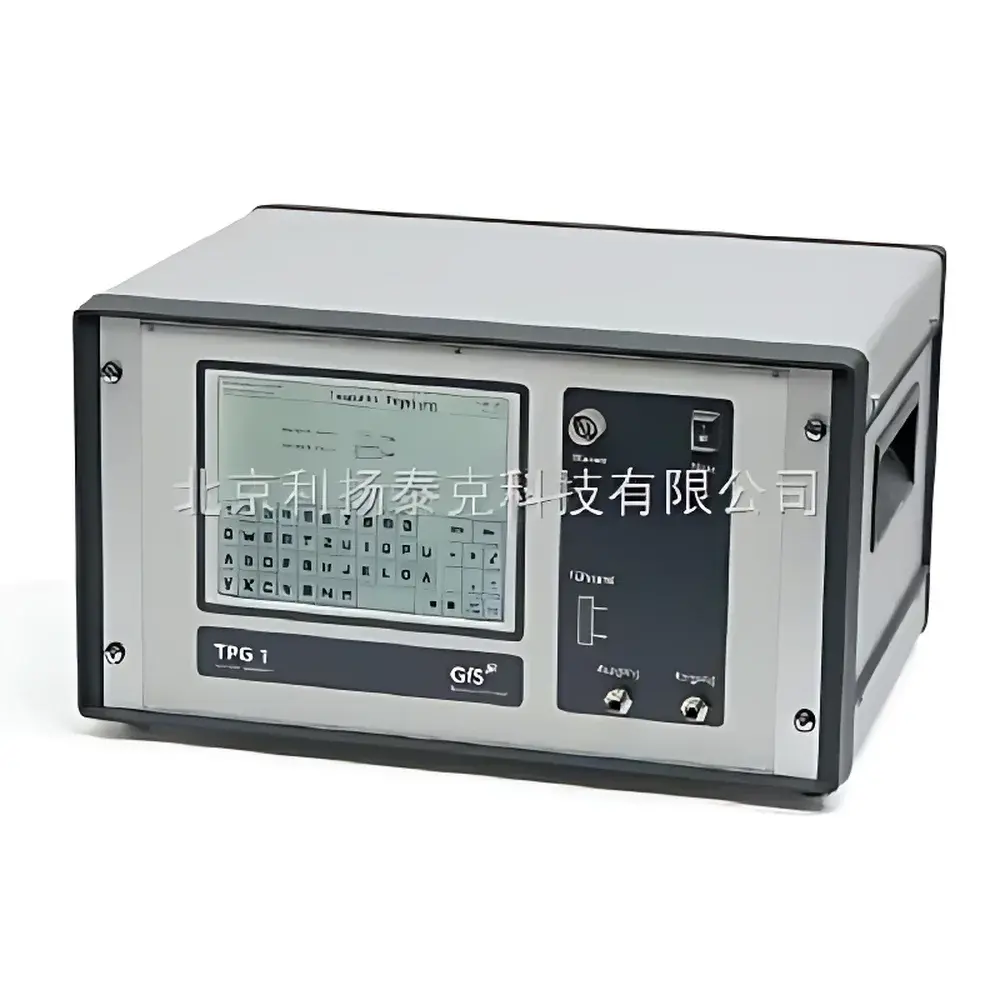
GFS TPG1 Precision Dew Point Generator
| Brand | GFS |
|---|---|
| Origin | Germany |
| Model | TPG1 |
| Instrument Type | Humidity Generator |
| Flow Rate | ~2 L/min |
| Dew Point Range | −50 °C to +10 °C |
| Accuracy | ±2 °C (dew point) |
| Display | 10-inch touchscreen LCD |
| Control Modes | Fixed dew point, ramp (linear slope), or step profiling |
| Chamber Material | Stainless steel, borosilicate glass, brass, PTFE, NBR, PUR, aluminum, nickel |
| Power Supply | 230 VAC, 50–60 Hz |
| Power Consumption | 50 W |
| Communication Interfaces | RS232, optional 4–20 mA input/output (4 channels) |
| Operating Temperature | −10 °C to +40 °C |
| Enclosure Rating | IP20 |
| Dimensions | 19″ rack mount, 6 HU |
| Weight | ~25 kg |
| Long-term Stability | Optimized for continuous calibration-grade operation |
Overview
The GFS TPG1 Precision Dew Point Generator is a laboratory-grade humidity reference source engineered for metrologically traceable calibration and verification of hygrometers, dew point sensors, moisture analyzers, and process humidity transmitters. It operates on the principle of chilled-mirror dew point generation combined with precise thermal control of compressed dry air—cooled to a stable dew point as low as −70 °C upstream—to produce a highly reproducible, dynamically adjustable humid gas stream. Unlike saturation-based generators, the TPG1 employs a thermally stabilized mixing chamber where metered flows of ultra-dry air and controlled water vapor are blended under laminar conditions, enabling accurate realization of dew point setpoints from −50 °C to +10 °C. Its design prioritizes long-term stability and minimal hysteresis, making it suitable for accredited calibration laboratories operating under ISO/IEC 17025 requirements and for R&D environments demanding repeatable humidity exposure testing.
Key Features
- High-accuracy dew point generation with ±2 °C uncertainty across the full operating range (−50 °C to +10 °C), verified against NIST-traceable reference standards.
- 10-inch industrial-grade capacitive touchscreen interface with intuitive graphical workflow navigation, real-time trend plotting, and multi-language support (English, German, French, Spanish).
- Programmable control modes: fixed-point stabilization, linear ramp (user-defined slope in °C/min), and multi-step sequences for dynamic profile testing.
- Gas-wetted components constructed exclusively from inert, low-outgassing materials—including electropolished stainless steel (316L), borosilicate glass, PTFE-sealed valves, and nickel-plated brass—to prevent catalytic moisture interaction or surface adsorption artifacts.
- Integrated flow regulation ensures consistent output at ~2 L/min (NTP), with built-in pressure regulation and particulate filtration (0.1 µm) to protect downstream instrumentation.
- Modular I/O architecture supports optional analog interfaces: four isolated 4–20 mA inputs (e.g., for external sensor feedback) and four configurable 4–20 mA outputs (e.g., for PLC integration or remote alarm signaling).
Sample Compatibility & Compliance
The TPG1 is compatible with all standard humidity sensing technologies—including capacitance polymer sensors, aluminum oxide, quartz crystal microbalances (QCM), and chilled-mirror hygrometers—provided inlet gas temperature and pressure fall within specified limits (≤40 °C, ≤1.5 bar abs). It meets mechanical and electrical safety requirements per EN 61010-1:2019 and electromagnetic compatibility per EN 61326-1:2021. While not intrinsically safe, its IP20-rated 19″ rack-mount enclosure complies with typical laboratory environmental classifications. For regulatory compliance workflows, the device supports audit-ready operation when paired with validated software: timestamped calibration logs, user-access-controlled parameter locking, and exportable CSV reports satisfy documentation needs for ISO/IEC 17025, FDA 21 CFR Part 11 (with electronic signature add-on), and GLP/GMP validation protocols.
Software & Data Management
The TPG1 operates natively via its embedded Linux-based controller, eliminating dependency on external PCs. All configuration, sequence programming, and real-time monitoring occur locally through the touchscreen UI. For advanced integration, the RS232 serial port enables bidirectional SCPI-compatible command communication—supporting automated test scripts (Python, LabVIEW, MATLAB) and integration into centralized lab management systems. Calibration data—including setpoint history, actual chamber dew point, flow rate, and ambient temperature—are logged internally with millisecond timestamps and exportable via USB flash drive. Optional firmware upgrades include enhanced security features: role-based access control (admin/operator), encrypted log archives, and configurable data retention policies aligned with quality management system requirements.
Applications
- Primary and secondary calibration of industrial and laboratory hygrometers in national metrology institutes and accredited calibration labs.
- Validation of humidity-controlled environmental chambers (e.g., climate test chambers per IEC 60068-3-4) and cleanroom monitoring systems.
- Material testing under defined humidity stress conditions—e.g., polymer hygroscopic expansion, pharmaceutical tablet stability, or semiconductor packaging moisture barrier evaluation.
- Development and verification of new humidity sensor architectures, including MEMS-based and optical dew point detectors.
- Supporting ASTM E2767 (Standard Practice for Calibrating Hygrometers), ISO 4677 (Humidity Measurement—Generation of Reference Humid Gas), and VDI/VDE 3547 Part 2 (Calibration of Humidity Measuring Devices).
FAQ
What is the minimum achievable dew point with the TPG1?
The TPG1 generates stable humid gas down to −50 °C dew point; however, its internal cooling subsystem is capable of chilling supply air to −70 °C, ensuring sufficient margin for reliable low-dew-point operation.
Can the TPG1 be used with non-compressed air sources?
No—the generator requires a clean, oil-free, desiccated compressed air supply (dew point ≤ −70 °C, particle-filtered to 0.1 µm) as its dry gas carrier; nitrogen or argon may be substituted with appropriate pressure regulation and flow recalibration.
Is external software required to operate the device?
No—all core functionality is fully accessible via the integrated touchscreen interface; external software is optional and only needed for automated system integration or custom reporting workflows.
How often does the TPG1 require maintenance or recalibration?
Annual verification against a certified reference dew point meter is recommended; routine maintenance includes filter replacement every 6 months and inspection of PTFE seals and mixing chamber integrity per manufacturer’s service schedule.
Does the TPG1 support remote monitoring over Ethernet or Wi-Fi?
The base model includes RS232 only; Ethernet or Wi-Fi connectivity is not standard but can be implemented via third-party serial-to-Ethernet converters compliant with RFC 2217, subject to network security policy review.



