
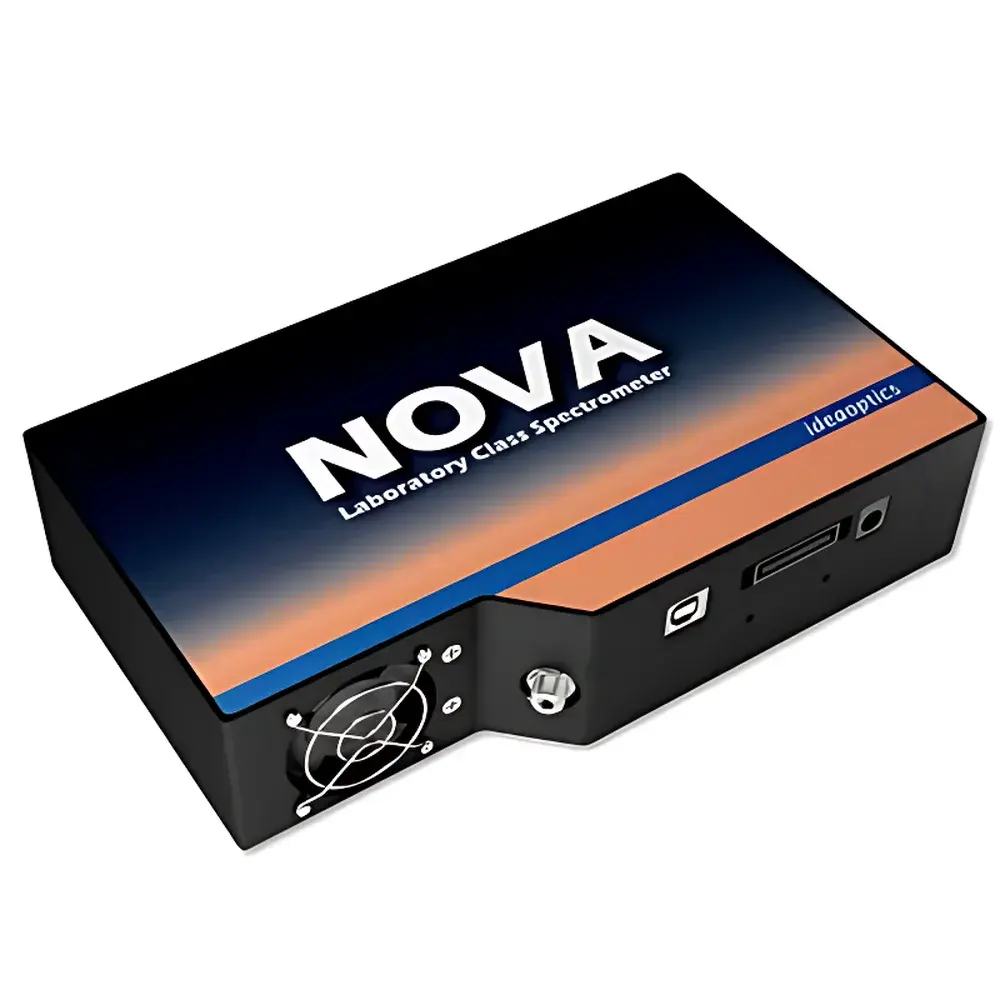
IdeaOptics NOVA Cooled Fiber Optic Spectrometer
| Brand | IdeaOptics |
|---|---|
| Origin | Shanghai, China |
| Manufacturer | Yes |
| Country of Origin | China |
| Model | NOVA |
| Spectral Range | 200–1100 nm (customizable) |
| Detector Type | Back-Illuminated CCD |
| Sensitivity | High |
| Signal-to-Noise Ratio (SNR) | 1,000:1 (at saturation) |
| Dynamic Range | 10,000:1 |
Overview
The IdeaOptics NOVA Cooled Fiber Optic Spectrometer is a high-performance, thermoelectrically cooled spectrometer engineered for low-light spectral measurement applications requiring exceptional signal fidelity and long integration stability. Built upon a precision optical bench with optimized aberration correction and high-efficiency diffraction grating design, the NOVA employs an on-chip thermoelectric cooler (TEC) to stabilize the CCD detector at temperatures up to 40 °C below ambient—significantly suppressing dark current generation and enabling reliable operation during extended exposure periods. Its core measurement principle relies on dispersive spectroscopy using a fixed-grating monochromator architecture coupled with a back-illuminated CCD sensor, delivering high spectral resolution across the ultraviolet–visible–near-infrared (UV-VIS-NIR) range (200–1100 nm). This architecture ensures consistent wavelength calibration stability and minimal thermal drift, making it suitable for quantitative spectral analysis in research-grade and industrial QA/QC environments.
Key Features
- On-chip thermoelectric cooling (TEC) reduces detector operating temperature by up to 40 °C below ambient, minimizing dark current and enhancing SNR stability over time.
- Back-illuminated CCD detector with peak quantum efficiency (QE) of 95%—particularly advantageous in the UV region (200–400 nm), where conventional front-illuminated sensors exhibit significant QE roll-off.
- High dynamic range of 10,000:1 enables accurate capture of signals spanning multiple intensity orders—critical for absorption ratio measurements and dual-beam referencing.
- Optimized optical path design delivers high throughput and low stray light (<0.05% at 600 nm), supporting trace-level fluorescence and Raman detection without spectral contamination.
- Modular fiber-coupled interface compatible with standard SMA 905 connectors, allowing seamless integration into custom optical setups including microscopes, angle-resolved systems, and flow cells.
- Rugged aluminum housing with passive thermal management ensures mechanical stability and long-term calibration retention under laboratory and light industrial conditions.
Sample Compatibility & Compliance
The NOVA spectrometer supports a broad range of sample configurations through flexible fiber-optic input—enabling non-contact, remote, or in-situ spectral acquisition from liquids, solids, gases, and thin films. It is routinely deployed in configurations compliant with ASTM E308 (computing color coordinates), ISO 13406-2 (display spectral characterization), and USP (pharmaceutical absorbance validation protocols). While not intrinsically certified for GMP/GLP environments, its stable thermal architecture, reproducible pixel-to-wavelength mapping, and audit-ready data logging capabilities (via optional SDK integration) support compliance with FDA 21 CFR Part 11 requirements when implemented within validated software workflows. No hazardous materials are used in construction; RoHS and REACH conformity apply to all electronic and optical subassemblies.
Software & Data Management
The NOVA is supported by IdeaOptics’ cross-platform SpectraSuite software suite (Windows/macOS/Linux), providing real-time spectral visualization, multi-curve overlay, peak identification, and export in CSV, TXT, and HDF5 formats. A comprehensive C/C++/Python SDK enables full hardware control—including integration time, TEC setpoint, and ROI selection—for automated measurement sequences. All spectral acquisitions include embedded metadata (timestamp, integration time, detector temperature, calibration file ID), ensuring traceability. Optional firmware updates preserve backward compatibility while extending functionality such as dark-frame subtraction routines and spectral smoothing algorithms compliant with ISO/IEC 17025 uncertainty estimation guidelines.
Applications
- Fluorescence spectroscopy: Detection of weak emission bands with high SNR and minimal background interference—ideal for quantum dot characterization, biological fluorophore quantification, and lifetime decay studies.
- Raman spectroscopy: Paired with notch or edge filters, the NOVA captures low-intensity Stokes-shifted signals with sufficient resolution to resolve vibrational modes in polymers, pharmaceuticals, and 2D materials.
- Absorption & transmission spectroscopy: Accurate measurement of optical density across three decades of intensity difference between reference and sample beams—used in thin-film thickness modeling and concentration assays.
- Microspectroscopy: Coupled with microscope objectives and fiber bundles, the system acquires spatially resolved spectra from micron-scale features in semiconductor wafers, mineral inclusions, or tissue sections.
- Angle-resolved spectroscopy: Integrated into goniometric stages for measuring directional reflectance, photonic crystal band structure, or polarization-dependent scattering profiles.
FAQ
What cooling method does the NOVA use, and how does it affect performance?
The NOVA integrates an on-chip thermoelectric cooler (TEC) that stabilizes the CCD at up to 40 °C below ambient temperature. This directly suppresses thermally generated dark current, improving SNR consistency during exposures exceeding several seconds.
Is the spectral range truly customizable outside 200–1100 nm?
Yes—optical gratings, entrance slit options, and detector coatings can be modified per order to optimize for specific sub-ranges (e.g., deep-UV 190–400 nm or extended NIR 900–1700 nm), subject to detector and grating availability.
Does the NOVA support external triggering and synchronization?
Yes—the device features TTL-compatible trigger input/output ports for precise timing alignment with lasers, shutters, or motion stages in automated measurement platforms.
How is wavelength calibration maintained over time and temperature?
Each unit ships with a factory-applied, NIST-traceable calibration using mercury-argon lamp lines. Onboard temperature sensors feed real-time corrections to the wavelength solution, limiting drift to <0.02 nm over a 10 °C ambient change.
Can the NOVA operate in continuous acquisition mode for kinetic studies?
Yes—full-frame readout rates reach up to 15 Hz (depending on ROI and USB bandwidth), and streaming mode supports buffer-based acquisition for time-resolved monitoring of rapid spectral changes.
Related Products




