
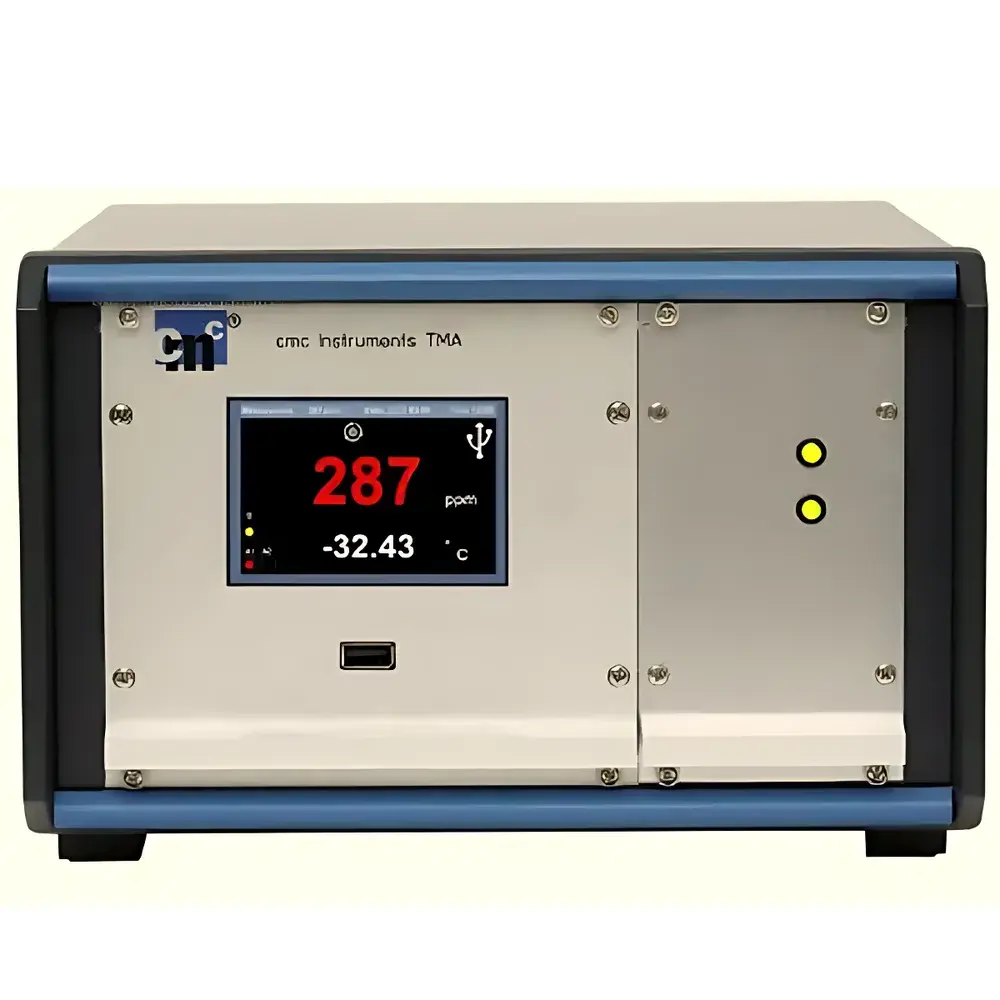
CMC iTMA-204 P₂O₅ Electrolytic Moisture Analyzer for Corrosive and Reactive Gases
| Brand | CMC |
|---|---|
| Origin | Germany |
| Model | iTMA-204 |
| Product Type | Online Dew Point Analyzer |
| Principle | Phosphorus Pentoxide (P₂O₅) Electrolytic Method |
| Operating Temperature | −10 °C to +50 °C |
| Accuracy | ±1% of full scale |
| Repeatability | ±0.1% of full scale |
| Measurement Ranges | 0–10 ppm / 0–100 ppm / 0–1,000 ppm / 0–2,500 ppm (auto/manual range switching) |
| Response Time (T₅₀) | <8 s |
| Sample Flow Rate | 20 NL/h |
| Recommended Sample Pressure | 0.1–0.5 barg |
| Sample Temperature | 5–50 °C |
| Environmental Operating Range | 5–65 °C |
| Display | Touchscreen with multilingual UI (including Chinese) |
| Analog Output | 0/4–20 mA (configurable) |
| Alarm Outputs | 2 relay outputs |
| Dimensions (Desktop Unit) | 258 × 168 × 325 mm (W × H × D) |
| Weight | ~5 kg |
| Cable Standard | 3 m (up to 300 m optional) |
Overview
The CMC iTMA-204 is a high-stability, online electrolytic moisture analyzer engineered for continuous trace moisture monitoring in aggressive, reactive, and corrosive process gases—including chlorine (Cl₂), hydrogen chloride (HCl), sulfur dioxide (SO₂), hydrogen sulfide (H₂S), fluorine (F₂), and other halogenated or acidic gas streams. It employs the well-established phosphorus pentoxide (P₂O₅) electrolytic measurement principle: water vapor in the sample gas is irreversibly electrolyzed at a thin-film H₃PO₄-coated electrode pair—typically fabricated from platinum or rhodium wire—within a fused-silica cell. The resulting electrolysis current is stoichiometrically proportional to the water concentration (per Faraday’s law), enabling absolute, calibration-free quantification down to sub-ppm levels. Unlike optical or capacitive methods, this technique delivers inherently stable zero and span performance without drift-induced recalibration requirements, making it ideal for critical purity assurance in semiconductor feedstock gas lines, chlor-alkali plant off-gas monitoring, specialty chemical synthesis loops, and high-purity industrial gas distribution networks.
Key Features
- True absolute measurement principle—no periodic recalibration needed under normal operating conditions
- Electrode regeneration capability via controlled current reversal, restoring sensor sensitivity without physical replacement
- Microprocessor-controlled auto-ranging across four selectable spans (0–10 ppm to 0–2,500 ppm H₂O)
- Sub-second T₁₀ response (<1 s) and rapid T₅₀ stabilization (<8 s), enabling real-time process feedback
- Fused-silica sensor cell with chemically inert electrode substrates optimized for Cl₂, HCl, and other oxidizing/corrosive matrices
- Integrated self-diagnostics at power-on and during operation, compliant with NAMUR NE 43 signaling standards
- Robust desktop enclosure (IP20-rated) with touchscreen HMI supporting multilingual interface configuration
Sample Compatibility & Compliance
The iTMA-204 is validated for use with non-reactive carrier gases (e.g., Ar, He, N₂, H₂, O₂) and highly reactive species including Cl₂, HCl, SO₂, H₂S, F₂, and SF₆—provided the gas matrix does not chemically attack phosphoric acid or reduce P₂O₅. Excluded gases include strong reducing agents (e.g., NH₃, silanes) or species forming stable phosphate adducts (e.g., PH₃ beyond trace levels). The analyzer meets electromagnetic compatibility (EMC) per EN 61326-1 and safety requirements per EN 61010-1. Its analog output and relay alarms support integration into SIL-2-capable safety instrumented systems (SIS) when deployed with appropriate system-level validation. Data integrity features align with GLP/GMP expectations for audit-ready operation, though native 21 CFR Part 11 compliance requires external data logging infrastructure.
Software & Data Management
While the iTMA-204 operates as a standalone field instrument with embedded firmware, its 4–20 mA output and Modbus RTU (optional RS-485 interface) enable seamless integration into DCS, SCADA, or centralized LIMS platforms. All operational parameters—including range selection, alarm thresholds, zero suppression, and linearization coefficients—are configurable via the front-panel touchscreen. Event logs (power cycles, range changes, alarm triggers) are stored internally with timestamps. For long-term trending, third-party historian software can archive analog output signals with ≤1 Hz sampling resolution. No proprietary PC software is required for basic commissioning or routine maintenance.
Applications
- Continuous moisture verification in chlorine liquefaction and cylinder filling stations
- In-line monitoring of HCl gas purity prior to PVC monomer synthesis
- Trace H₂O detection in SO₂ streams used in sulfuric acid production
- Quality control of ultra-high-purity electronic-grade gases (e.g., ClF₃, WF₆ precursors)
- Leak detection support in sealed gas-handling systems via moisture ingress profiling
- Compliance verification against ISO 8573-1 Class 1–3 dew point specifications for compressed reactive gases
FAQ
Does the iTMA-204 require regular calibration with certified moisture standards?
No—its P₂O₅ electrolytic principle provides absolute measurement traceable to fundamental electrochemical constants; only periodic verification (e.g., annual check with NIST-traceable standard gas) is recommended for QA/QC documentation.
Can the sensor be exposed to liquid water or condensate?
No—condensation will permanently damage the P₂O₅ film and electrode structure. Sample gas must remain fully gaseous; inline coalescing filters and temperature-controlled sample lines are mandatory upstream.
What maintenance intervals are recommended for routine operation?
Sensor regeneration every 6–12 months depending on total accumulated moisture load; desiccant in the internal sample dryer should be replaced quarterly; no moving parts require lubrication or adjustment.
Is explosion-proof certification available for hazardous area installation?
The base iTMA-204 is rated for Zone 2/Class I Div 2 environments; ATEX or IECEx-certified variants (e.g., iTMA-204-Ex) are available upon request with modified housing and intrinsically safe barrier integration.
How does pressure variation affect measurement accuracy?
The analyzer assumes constant sample pressure within the specified 0.1–0.5 barg range; deviations beyond this band introduce density-related errors in ppmv-to-ppmw conversion—pressure compensation requires external transducer input via optional analog integration.
Related Products




