
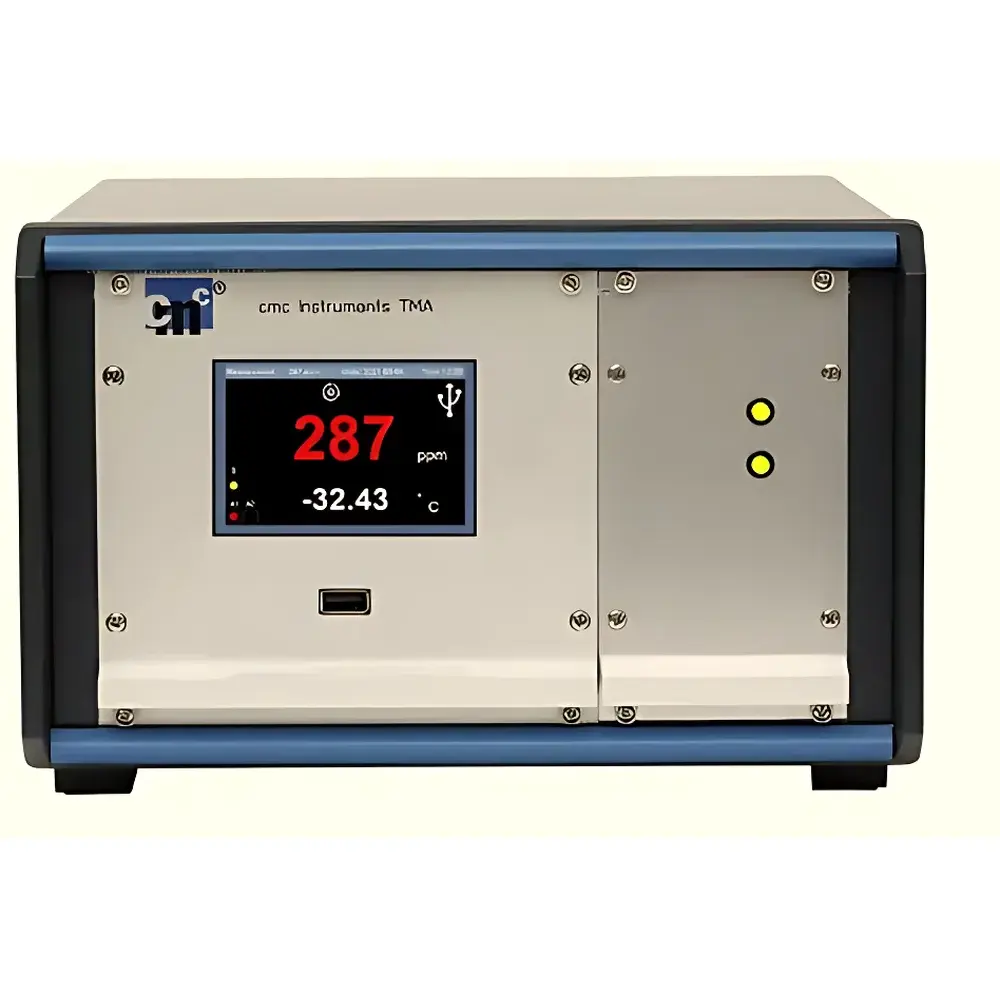
CMC TMA-202 P₂O₅ Electrolytic Trace Moisture Analyzer for Chlorine and Hydrogen Chloride
| Brand | CMC (HimSi) |
|---|---|
| Origin | Germany |
| Model | TMA-202 |
| Application | Online dew point measurement in corrosive and combustible gases |
| Principle | Phosphorus pentoxide (P₂O₅) electrolytic sensor |
| Operating Temperature | -10 °C to +50 °C |
| Accuracy | ±1% of full scale |
| Repeatability | ±0.1% of full scale |
| Measurement Ranges | 0–10 ppm, 0–100 ppm, 0–1000 ppm, 0–2500 ppm (auto/manual range switching) |
| Response Time (T₉₀) | <1 s |
| T₅₀ Response | <8 s |
| Sample Flow Rate | 20 NL/h |
| Recommended Sample Pressure | 0.1–0.5 barg |
| Sample Temperature | 5–50 °C |
| Environmental Operating Range | 5–65 °C |
| Analog Output | 0/4–20 mA (configurable) |
| Alarm Outputs | 2 relay outputs |
| Display | Touchscreen with optional Chinese language interface |
| Enclosure Options | 19" rack-mount (482 × 133 × 350 mm), wall-mount (300 × 260 × 280 mm), benchtop (257 × 160 × 316 mm), and ATEX-certified variants (TMA-202-Ex series) |
Overview
The CMC TMA-202 is a high-stability, online trace moisture analyzer engineered for continuous, absolute measurement of water vapor concentration in aggressive industrial process gases—particularly chlorine (Cl₂), hydrogen chloride (HCl), sulfur dioxide (SO₂), hydrogen sulfide (H₂S), and other acid gases where conventional capacitive or chilled-mirror technologies fail due to corrosion, condensation, or chemical interference. Its core sensing principle relies on the electrochemical decomposition of water via a phosphorus pentoxide (P₂O₅) electrolytic cell—a NIST-traceable, primary-standard method defined in ISO 8573-8 and ASTM D7443. In this system, water molecules are quantitatively split into hydrogen and oxygen at a P₂O₅-coated electrode pair, generating a Faradaic current directly proportional to the mass flow of H₂O in the sample stream. As P₂O₅ is hygroscopic and regenerates in situ during operation, the sensor requires no periodic recalibration under stable operating conditions—making it uniquely suited for unattended, long-term monitoring in chlorine production, HCl synthesis, semiconductor etch gas delivery, and fluorination processes.
Key Features
- True absolute measurement: No drift-based calibration required; traceable to fundamental electrochemical principles
- P₂O₅ sensor architecture with platinum or rhodium electrodes and ultra-thin H₃PO₄ electrolyte film—optimized for chemical resistance in Cl₂/HCl environments
- Sub-second T₉₀ response (<1 s) and rapid T₅₀ (<8 s), enabling real-time control of drying systems and purge validation
- Four auto-switching measurement ranges (0–10 ppm, 0–100 ppm, 0–1000 ppm, 0–2500 ppm) with seamless transition and no manual intervention
- Integrated microprocessor control with built-in self-diagnostic routines compliant with NAMUR NE 43 standards
- ATEX/IECEx-certified explosion-proof variants (TMA-202-Ex series) for Zone 1/21 hazardous areas handling Cl₂ or HCl
- Rack-mount (19″), wall-mount, and benchtop configurations—designed for integration into central control rooms, skid-mounted analyzers, or field cabinets
Sample Compatibility & Compliance
The TMA-202 demonstrates exceptional compatibility with high-purity and reactive gases including Cl₂, HCl, SO₂, H₂S, F₂, O₃, SF₆, freons, and noble gases (He, Ne, Ar, Kr, Xe). It avoids catalytic decomposition or membrane saturation issues common in metal-oxide or tunable diode laser (TDLAS) sensors. The P₂O₅ cell remains inert toward most halogenated and acidic species—except those that chemically react with phosphoric acid (e.g., strong reducing agents like PH₃ at elevated concentrations). All models meet CE marking requirements and comply with EMC Directive 2014/30/EU and Low Voltage Directive 2014/35/EU. ATEX-certified versions conform to EN 60079-0, -1, and -11 for Group II (non-mining) equipment. For regulated pharmaceutical or semiconductor applications, the instrument supports audit-ready data logging and optional 21 CFR Part 11-compliant software modules.
Software & Data Management
The TMA-202’s embedded firmware enables full local configuration via its capacitive touchscreen interface, supporting multiple languages—including English, German, French, and optional Chinese. All operational parameters (range selection, alarm thresholds, analog output scaling, relay logic) are stored in non-volatile memory. Optional Ethernet or RS-485 Modbus RTU connectivity allows integration into DCS/SCADA platforms (e.g., Siemens PCS7, Emerson DeltaV). Raw sensor current, temperature-compensated ppm values, diagnostic flags (e.g., low electrolyte status, over-range detection), and relay state logs are timestamped and exportable via USB or network interface. Firmware updates follow IEC 62443-2-4 guidelines for secure remote maintenance.
Applications
- Chlor-alkali plants: Continuous moisture monitoring in liquefied chlorine before cylinder filling (per ISO 8573-8 Class 1 requirements)
- HCl synthesis loops: Verification of desiccant tower efficiency and prevention of stainless steel stress corrosion cracking
- Semiconductor fab gas cabinets: Ultra-trace H₂O verification in Cl₂ and HCl etch process lines (≤1 ppm detection limit)
- Fluorochemical manufacturing: Moisture control in HF, F₂, and perfluorinated feedstock streams
- Pharmaceutical excipient drying: Validation of nitrogen purge dryness in API synthesis reactors
- Calibration gas production: Certification of certified reference materials (CRMs) for moisture in reactive gas matrices
FAQ
Is the P₂O₅ sensor affected by chlorine exposure?
No—the sensor’s platinum/rhodium electrodes and stabilized P₂O₅/H₃PO₄ electrolyte layer are chemically inert to Cl₂ under typical process conditions (≤10 bar, ≤50 °C). Long-term stability exceeds 18 months in continuous Cl₂ service.
Does the TMA-202 require zero/span gas for routine operation?
Not for daily use. The electrolytic principle provides inherent zero stability. Span verification may be performed annually using NIST-traceable moisture-in-nitrogen standards per ISO 6142.
Can the analyzer operate at sub-atmospheric sample pressure?
Yes—within the specified 0.1–0.5 barg range. For vacuum applications, a calibrated back-pressure regulator must be installed upstream to maintain minimum flow and prevent diffusion-limited response.
What maintenance intervals are recommended?
Sensor regeneration (electrode film restoration) is triggered automatically when signal decay exceeds preset thresholds. Full sensor replacement is typically required every 24–36 months depending on cumulative moisture load and gas matrix aggressiveness.
Is Modbus TCP supported out-of-the-box?
Standard firmware includes Modbus RTU over RS-485. Modbus TCP requires optional Ethernet module (order code: TMA-202-ETH) and firmware v3.2 or later.
Related Products





