
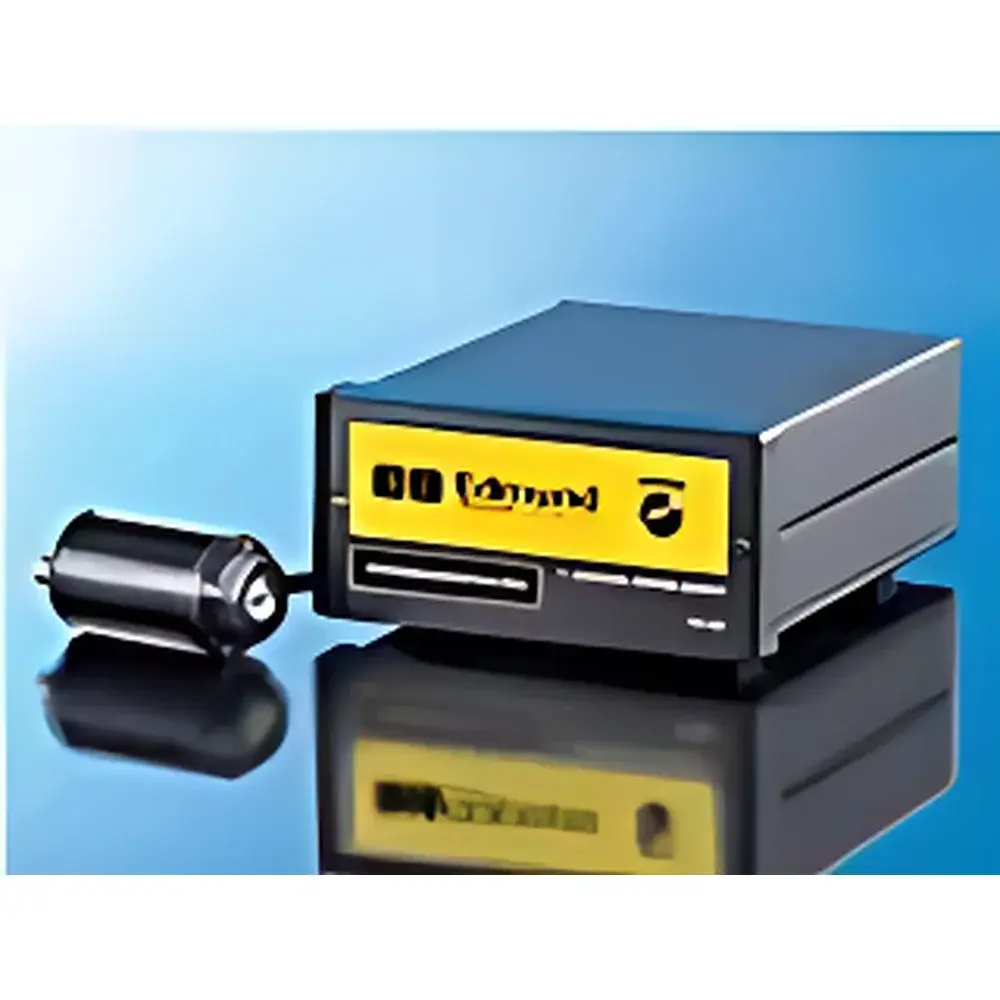
Newport Photodiode Receiver Module Series (Model: newopto)
| Brand | Edmund Optics |
|---|---|
| Model | newopto |
| Detector Types | UV Si, Vis Si, NIR InGaAs, Extended InGaAs, PbS, PbSe |
| Spectral Ranges | 200–1000 nm (Si), 300–1000 nm (Si), 800–1600 nm (InGaAs), 800–1700 nm (InGaAs), 1000–1700 nm (InGaAs), 1200–2500 nm (InGaAs), 1200–2600 nm (InGaAs), 1000–2800 nm (PbS), 1000–4500 nm (PbSe) |
| Active Area Diameters | 1.0 mm, 2.0 mm, 2.5 mm, 3.0 mm, 5.0 mm, 10.0 mm, 11.0 mm |
| Cooling Options | Thermoelectric (TEC) cooling available |
| Output Interface | Analog voltage (0–5 V or ±5 V, configurable), compatible with oscilloscopes and DAQ systems |
| Integrated Pre-amplifier | Low-noise, transimpedance design |
| Compliance | RoHS-compliant construction |
Overview
The Newport Photodiode Receiver Module Series (model: newopto) is a modular, application-optimized photodetection platform engineered for precision optical power and intensity measurement across ultraviolet, visible, near-infrared, and mid-infrared spectral bands. Each module integrates a calibrated photodiode sensor with a low-noise, high-bandwidth transimpedance preamplifier in a compact, shielded housing—eliminating the need for external signal conditioning. The architecture follows fundamental photoelectric detection principles: incident photons generate electron-hole pairs in the semiconductor junction; the resulting photocurrent is linearly converted to a stable analog voltage output via a precision feedback resistor network. This direct voltage output enables seamless interfacing with standard laboratory instrumentation—including digital oscilloscopes, lock-in amplifiers, and PC-based data acquisition (DAQ) systems—without additional signal conditioning stages. Designed for use in research-grade optical setups, laser characterization labs, spectrophotometer subsystems, and industrial process monitoring, the series supports traceable, repeatable measurements under varying ambient thermal and electromagnetic conditions.
Key Features
- Modular detector selection: Nine photodiode material options—including UV-enhanced silicon (200–1000 nm), standard and extended-range InGaAs (up to 2600 nm), PbS (1000–2800 nm), and PbSe (1000–4500 nm)—enable spectral coverage from deep UV to long-wave IR.
- Active area flexibility: Standard diameters of 1.0 mm, 2.0 mm, 2.5 mm, 3.0 mm, 5.0 mm, 10.0 mm, and 11.0 mm accommodate divergent beam profiles, fiber-coupled inputs, and spatially resolved detection requirements.
- Thermoelectric cooling (TEC) option: Integrated Peltier elements reduce dark current by up to two orders of magnitude in InGaAs and Pb-based modules, directly improving signal-to-noise ratio (SNR) for low-light and high-dynamic-range applications.
- EMI-hardened design: Fully shielded aluminum housing, grounded metal can packaging, and optimized PCB layout minimize susceptibility to radiated and conducted interference—critical for operation near RF sources or switching power supplies.
- Factory-calibrated responsivity: Each module ships with NIST-traceable calibration data (wavelength-dependent A/W values) referenced to primary standards, supporting compliance with ISO/IEC 17025 uncertainty budgets.
- Plug-and-play analog output: Configurable unipolar (0–5 V) or bipolar (±5 V) voltage output with fixed gain scaling simplifies system integration and eliminates software-based gain compensation errors.
Sample Compatibility & Compliance
The newopto receiver modules are compatible with free-space collimated beams, fiber-optic pigtails (FC/PC, SMA-905), and integrated optical assemblies requiring OEM-level detector subunits. All variants comply with RoHS Directive 2011/65/EU and meet CE marking requirements for electromagnetic compatibility (EN 61326-1) and safety (EN 61010-1). For regulated environments—including pharmaceutical analytical instrumentation and clinical optical diagnostics—the modules support GLP/GMP documentation workflows: calibration certificates include serial-numbered traceability, measurement uncertainty statements, and environmental test conditions (23 °C ±1 °C, 40–60% RH). While not FDA 21 CFR Part 11-certified as standalone devices, their analog output architecture facilitates audit-ready integration into validated instrument control systems when paired with compliant DAQ hardware and software.
Software & Data Management
These modules operate as analog front-end sensors and require no proprietary drivers or firmware. Voltage outputs are directly acquired using industry-standard DAQ platforms (e.g., National Instruments USB-6211, Keysight 34972A, or Thorlabs PM100D-compatible interfaces). For time-resolved measurements, users may apply LabVIEW, Python (with PyDAQmx or nidaqmx), or MATLAB Instrument Control Toolbox to implement synchronized sampling, averaging, and real-time baseline correction. Calibration coefficients are supplied in CSV format, enabling automated responsivity compensation during post-processing. Optional custom firmware integration (via I²C or SPI on OEM versions) supports remote gain switching and temperature telemetry—facilitating closed-loop thermal stabilization in automated optical test stations.
Applications
- Laser power stability monitoring in CW and pulsed laser systems (e.g., Ti:sapphire oscillators, fiber lasers, Q-switched Nd:YAG)
- Spectral radiance validation in integrating sphere-based LED and OLED characterization setups
- FTIR and dispersive spectrometer detector arrays (as single-channel reference or alignment monitors)
- Optical coherence tomography (OCT) reference arm detection with InGaAs variants
- Gas absorption spectroscopy using PbSe modules for CO, CO₂, and hydrocarbon detection in 2–4 µm band
- UV curing dose monitoring in semiconductor photolithography and additive manufacturing processes
- Photovoltaic cell quantum efficiency (QE) mapping with calibrated Si and InGaAs receivers
FAQ
What spectral calibration standards are applied during factory calibration?
Each module is calibrated against NIST-traceable tungsten-halogen and deuterium lamp sources, with spectral responsivity measured at 10-nm intervals across its specified range using a monochromator-based setup compliant with ISO 17025 clause 6.4.
Can these modules be used in vacuum or controlled atmosphere enclosures?
Yes—standard housings are rated for operation at ambient pressure; optional hermetic TO-can or stainless-steel vacuum-compatible variants are available upon request (lead time: 8–12 weeks).
Is dark current drift compensated in TEC-cooled models?
TEC stabilization maintains diode junction temperature within ±0.1 °C; dark current drift is reduced to <0.5% per hour at –20 °C, verified per ASTM E1421-20 Annex A2 protocols.
Do you provide spectral responsivity curves for each serial-numbered unit?
Yes—individual calibration reports, including full wavelength-responsivity tables and expanded uncertainty budgets (k=2), are delivered digitally with every shipment.
Are custom gain ranges or output impedances supported?
OEM configurations support user-defined transimpedance gains (10⁴–10⁸ V/A), differential outputs, and 50-Ω impedance matching for RF-coupled applications—subject to minimum order quantities.




