
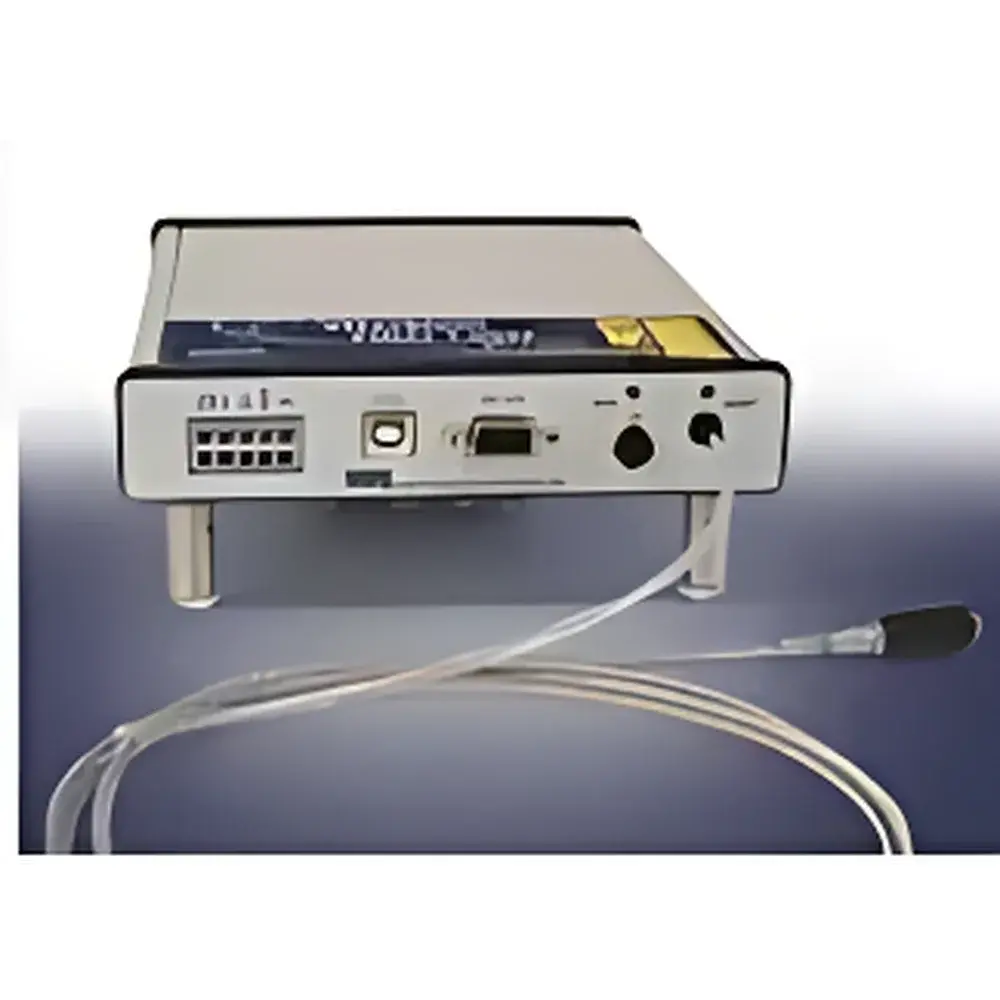
MPB newopto Passively Mode-Locked All-PM Fiber Laser
| Brand | MPB |
|---|---|
| Model | newopto |
| Emission Wavelength | 1020–1100 nm |
| Output Power | 10–20 mW (with PM preamplifier), 150 mW (with PM booster amplifier), 3000 mW (with high-power PM booster) |
| Pulse Duration | 2–50 ps |
| Repetition Rate | 30–100 MHz |
| Polarization | Linear, Fully Polarization-Maintaining (PM) Fiber Architecture |
| Operating Mode | Self-Starting Passive Mode-Locking |
Overview
The MPB newopto Passively Mode-Locked All-PM Fiber Laser is an engineered ultrafast light source designed for demanding scientific and industrial applications requiring stable, low-noise, sub-nanosecond pulse generation. Based on nonlinear polarization evolution (NPE) or semiconductor saturable absorber mirror (SESAM)-assisted passive mode-locking within a fully polarization-maintaining (PM) fiber cavity, this laser delivers transform-limited picosecond pulses without active electronic modulation or external RF synchronization. Its monolithic all-fiber architecture—free of free-space optics or bulk components—ensures long-term environmental stability, immunity to misalignment, and intrinsic compatibility with fiber-coupled downstream instrumentation. The laser operates in the Yb-doped gain window (1020–1100 nm), supporting direct integration with standard single-mode PM fibers (e.g., PANDA or Bow-tie type), enabling seamless coupling into nonlinear frequency conversion stages, optical parametric amplifiers (OPAs), or scanning microscopy platforms.
Key Features
- Fully polarization-maintaining (PM) fiber design ensures consistent linear polarization extinction ratio >20 dB across operating conditions, eliminating polarization drift during thermal or mechanical stress.
- Self-starting passive mode-locking mechanism enables reliable turn-on without manual intervention or pump power ramping protocols—critical for unattended operation in automated metrology or multi-user lab environments.
- Modular amplification architecture: configurable output levels via optional PM preamplifier (10–20 mW), PM booster amplifier (150 mW), or high-power PM booster stage (up to 3000 mW), preserving pulse duration and temporal fidelity.
- Thermally stabilized oscillator cavity minimizes timing jitter (<100 fs RMS integrated from 10 kHz to 10 MHz) and amplitude noise (<0.3% RMS over 24 h), meeting requirements for time-resolved pump-probe experiments.
- No moving parts, no consumables, and no periodic realignment—engineered for continuous operation exceeding 20,000 hours MTBF under controlled laboratory conditions.
Sample Compatibility & Compliance
This laser system is compatible with standard FC/APC or collimated free-space interfaces for integration into OEM instruments or custom optical benches. Its emission profile complies with IEC 60825-1:2014 Class 4 laser safety requirements when operated above 500 mW; lower-power configurations meet Class 3B specifications. All fiber components conform to Telcordia GR-1209-CORE and GR-1221-CORE reliability standards. The system supports traceable calibration documentation upon request and is suitable for use in GLP-compliant laboratories where instrument qualification (IQ/OQ/PQ) protocols are implemented. While not certified to FDA 21 CFR Part 11 by default, its digital control interface (RS-232/Ethernet) permits integration into validated software environments supporting audit trail and electronic signature functionality.
Software & Data Management
The laser includes embedded microcontroller-based firmware with remote monitoring via ASCII command set over RS-232 or TCP/IP. Real-time telemetry includes pump diode current/voltage, internal temperature sensors (±0.1 °C resolution), output power feedback (via integrated photodiode), and mode-locking status flag. Optional LabVIEW™, Python, and MATLAB® drivers enable script-driven parameter sweeps (e.g., repetition rate tuning via cavity length modulation), synchronized triggering (TTL/PECL outputs), and time-stamped logging of operational metrics. All data exports comply with HDF5 and CSV formats for interoperability with analysis frameworks such as OriginLab or Igor Pro. Firmware updates are performed via secure signed binary upload, ensuring version control and integrity verification.
Applications
- Multi-photon microscopy: Provides high peak power (>1 kW) picosecond pulses ideal for two-photon excited fluorescence (TPEF) and second-harmonic generation (SHG) imaging in thick biological specimens with reduced photodamage compared to femtosecond sources.
- Ultrafast spectroscopy: Serves as pump or probe source in transient absorption, time-resolved photoluminescence (TRPL), and coherent anti-Stokes Raman scattering (CARS) setups requiring precise inter-pulse delay control and low timing jitter.
- Semiconductor micromachining: Enables non-thermal ablation of GaN, SiC, and transparent conductive oxides (TCOs) with minimal heat-affected zones due to controllable pulse energy deposition at high repetition rates.
- Optical sampling & metrology: Used in asynchronous optical sampling (ASOS) systems for characterization of high-speed photonic devices (e.g., modulators, detectors) up to 100 Gbaud.
- Frequency comb seeding: Functions as a robust, turn-key oscillator for Er/Yb-fiber-based optical frequency combs when coupled with nonlinear broadening and f–2f interferometry modules.
FAQ
Is this laser compatible with third-party pulse compressors or spectral broadening modules?
Yes—the fully PM output allows direct splicing or connectorized coupling to hollow-core photonic crystal fiber (HC-PCF), tapered fiber, or chirped fiber Bragg grating (CFBG) compressors without polarization degradation.
Can repetition rate be tuned externally?
The base oscillator operates at fixed cavity-determined repetition rates (30–100 MHz); fine-tuning (±100 kHz) is achievable via piezoelectric fiber stretcher integration, available as a factory-configured option.
Does the system include beam delivery optics?
No—output is delivered via PM fiber pigtail (typically 1.5 m length, FC/APC connector); free-space collimation or focusing optics must be selected separately based on application-specific M² and divergence requirements.
What maintenance is required over its service life?
None beyond periodic inspection of fiber connectors and ambient temperature/humidity monitoring; no alignment, cleaning, or recalibration is necessary under normal operating conditions.
Is OEM integration support available?
Yes—MPB provides mechanical drawings, electrical interface schematics, firmware API documentation, and custom labeling options for volume OEM deployments.




