
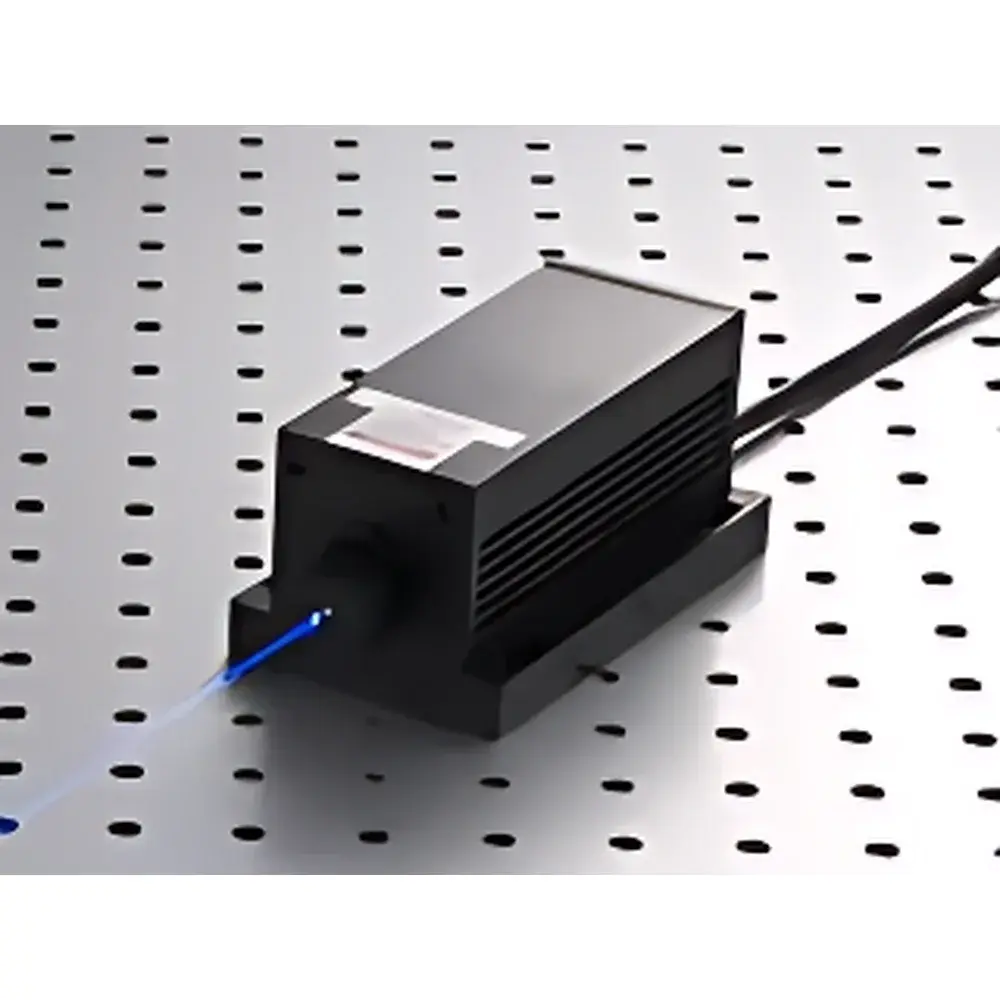
NewOpto LDM Series Semiconductor Laser Modules
| Brand | NewOpto |
|---|---|
| Model | LDM-405 / LDM-445 / LDM-635/638 / LDM-650 |
| Wavelength | 405±5 nm, 445±5 nm, 635±5 nm / 638±5 nm, 650±5 nm |
| Spatial Mode | Near TEM₀₀ (405/445 nm), Multimode (635/638/650 nm) |
| Output Power | 10–200 mW (405 nm), 100–1000 mW (445 nm), 200–800 mW (635/638 nm), 250–900 mW (650 nm) |
| Operation Mode | CW or Analog/Modulated |
| Beam Diameter (1/e²) | 4.0 mm (405/635/638 nm), 2×4 mm (445 nm), 5.0 mm (650 nm) |
| Beam Divergence | ≤0.5 mrad (405 nm), <3×0.5 mrad (445 nm), ≤2 mrad (635/638 nm), 1.5 or 3 mrad (650 nm) |
| Power Stability | <3% over 4 hrs (405/445 nm), <3% over 2 hrs (635/638/650 nm) |
| Warm-up Time | <2 min |
| Operating Temperature | 20–30 °C |
| Storage Temperature | 10–50 °C |
| Lifetime | 10,000 hrs (405/445 nm), 5,000 hrs (635/638/650 nm) |
Overview
The NewOpto LDM Series Semiconductor Laser Modules are engineered for precision integration into industrial, scientific, and OEM optical systems requiring stable, compact, and wavelength-specific visible laser sources. Based on high-efficiency edge-emitting diode technology, these modules operate on the principle of stimulated emission in III–V semiconductor heterostructures (e.g., GaN for blue/violet, AlGaInP for red). Unlike DPSS or fiber lasers, semiconductor laser modules offer direct electrical-to-optical conversion with minimal thermal load, enabling rapid turn-on, low power consumption, and robust mechanical stability. Each module integrates a laser diode, collimating optics, thermoelectric cooler (TEC), and driver circuitry in a hermetically sealed, industry-standard housing—designed to maintain beam pointing stability and spectral purity under continuous-wave (CW) or analog-modulated operation. The series spans four primary wavelength bands—405 nm (violet), 445 nm (blue), 635/638 nm (orange-red), and 650 nm (red)—selected to align with absorption peaks in fluorescence excitation, photopolymerization, optical alignment, and spectroscopic calibration.
Key Features
- Four standardized wavelength options with tight tolerance: ±5 nm at 405, 445, 635/638, and 650 nm
- High spatial coherence: Near TEM00 output for 405 nm and 445 nm variants; multimode optimized for brightness and coupling efficiency in red bands
- Integrated TEC and feedback-controlled driver ensuring <3% power drift over 2–4 hours—critical for long-duration metrology and imaging
- Beam parameters fully characterized per ISO 11146: collimated 1/e² diameters from 4.0 mm to 5.0 mm; divergence specified per full-angle definition
- Compact OEM-ready package with SMA905 or FC/PC fiber-coupling options available upon request
- No consumables or periodic alignment required—true maintenance-free operation over rated lifetime
Sample Compatibility & Compliance
The LDM modules are compatible with standard optomechanical mounts (e.g., Thorlabs KM100, Newport U100), microscope illumination paths, and automated stage-integrated platforms. All units comply with IEC 60825-1:2014 Class 3B laser safety requirements when operated within specified power limits. Electrical design conforms to EN 61326-1 (EMC for laboratory equipment) and RoHS 2015/863/EU. While not certified for medical device integration out-of-the-box, the modules meet baseline photobiological safety thresholds (IEC 62471) for Class 1/1M exposure scenarios when used with appropriate beam-shaping optics and interlocks. Documentation includes full test reports for power stability, spectral width (FWHM ≤ 2 nm typical), and mode profile—supporting GLP-compliant instrument qualification protocols.
Software & Data Management
Each LDM module supports analog modulation (0–5 V input) and TTL blanking (rise/fall time <1 µs), enabling synchronization with cameras, shutters, or data acquisition systems. Optional digital interface kits (RS-232 or USB-C) provide remote control of output power, modulation frequency, and temperature setpoint via ASCII command protocol. Logged operational data—including cumulative runtime, thermal history, and power deviation trends—can be exported as CSV for audit trails. While no proprietary GUI is bundled, the modules integrate natively with LabVIEW (NI-VISA), Python (PySerial), and MATLAB Instrument Control Toolbox—facilitating traceable calibration workflows compliant with ISO/IEC 17025 and FDA 21 CFR Part 11 when paired with validated acquisition software.
Applications
- Biomedical instrumentation: Excitation source for fluorescence microscopy (DAPI, FITC, TRITC), flow cytometry alignment, and confocal line scanning
- Industrial metrology: Precision triangulation sensors, laser line generators for 3D surface profiling, and encoder calibration targets
- Materials characterization: Photoluminescence mapping, Raman excitation (especially 445 nm for reduced fluorescence background), and thin-film thickness measurement via interference
- OEM system integration: Embedded illumination in handheld spectrometers, portable DNA sequencers, and automated inspection stations
- Research laboratories: Pump source for optical parametric oscillators (OPOs), seed lasers for ultrafast amplifiers, and holographic interferometry references
FAQ
Are these modules suitable for FDA-regulated diagnostic devices?
Yes—when integrated into a Class II or III medical device with full system-level risk management (ISO 14971) and validation per IEC 62304, the LDM series provides the reliability and documentation depth required for regulatory submissions.
Can I request custom wavelengths outside the standard portfolio?
NewOpto supports tailored designs between 375 nm and 1064 nm; minimum order quantities and lead times apply for non-standard epitaxial wafers.
Do the modules include built-in photodiode monitoring?
All LDM variants feature internal monitor photodiodes with analog voltage output (0–5 V), calibrated to ±5% against NIST-traceable power meters.
What is the maximum permissible ambient temperature during operation?
The specified operating range is 20–30 °C; sustained operation above 35 °C requires external forced-air cooling or derating of output power to maintain lifetime specifications.
Is fiber coupling included or optional?
Free-space collimated output is standard; fiber-coupled versions (SMF-28, multimode 105/125 µm) are available as configurable options with FC/PC or SMA905 connectors.




