
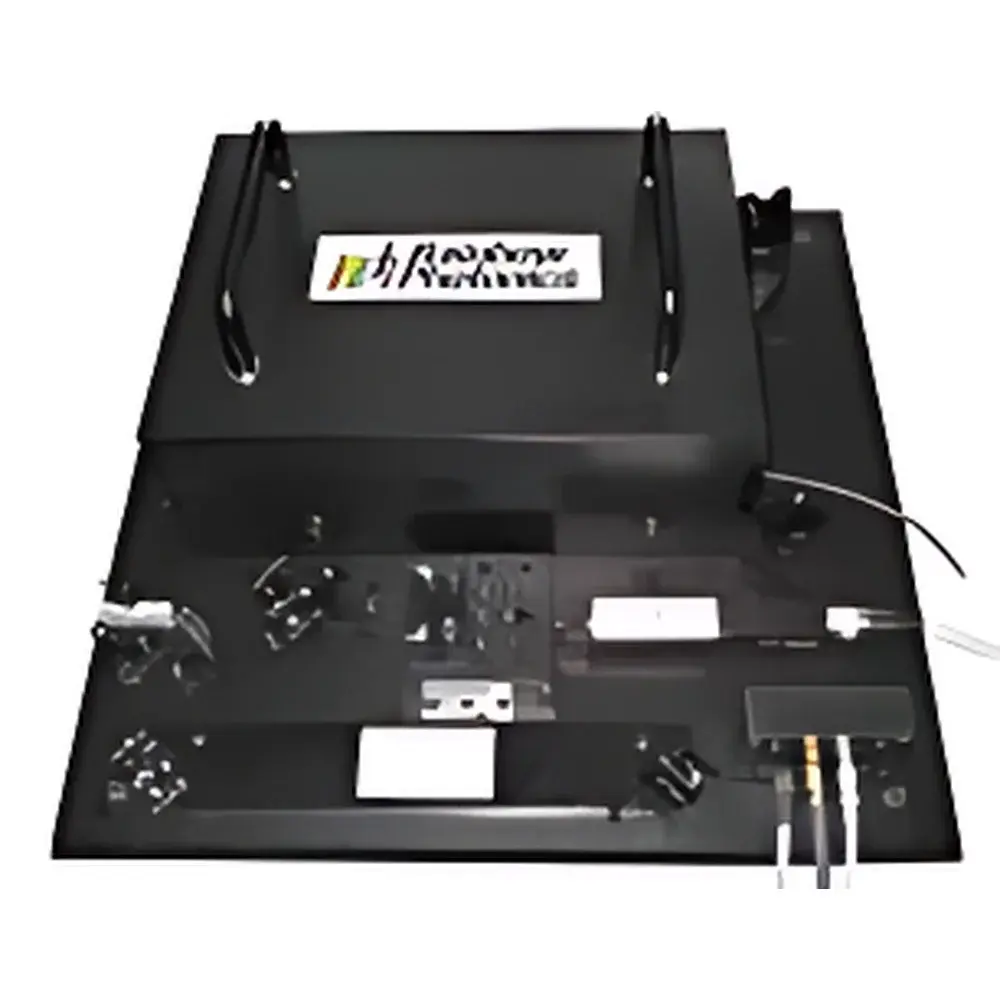
Rainbow Photonics TeraKit Series Time-Domain Terahertz Spectroscopy Systems
| Brand | Rainbow Photonics |
|---|---|
| Origin | Switzerland |
| Model | TeraKit-D / TeraKit-O / TeraKit-DS |
| THz Generation Crystal | DAST / OH1 / DSTMS |
| Frequency Range (Reflection) | 0.3–20 THz / 0.1–10 THz / 0.1–15 THz |
| Frequency Range (Transmission) | 0.3–11 THz / 0.1–3 THz / 0.1–11 THz |
| Optimal Phase-Matching Wavelength | 1300–1600 nm / 1200–1460 nm / 1300–1700 nm |
| External Pump Requirement | Femtosecond Laser (70–80 fs pulse width) |
| Optional THz Imaging Scan Area | 50 mm × 50 mm or 100 mm × 100 mm |
Overview
The Rainbow Photonics TeraKit Series comprises modular, turnkey time-domain terahertz (THz-TDS) spectroscopy systems engineered for high-fidelity broadband THz generation and coherent detection. Based on optical rectification and electro-optic sampling principles, these systems operate in both reflection and transmission geometries—enabling non-contact, non-ionizing characterization of dielectric, semiconductor, and biomolecular materials across the 0.1–20 THz spectral window. Each configuration integrates a precision mechanical delay line, photoconductive or nonlinear crystal-based THz emitters (DAST, OH1, or DSTMS), balanced electro-optic detectors, broadband THz optics, and synchronized electronic control units. Designed for seamless integration with commercial femtosecond laser sources operating in the near-infrared telecom band (1200–1700 nm), the TeraKit platform supports ultrafast carrier dynamics studies, low-energy phonon analysis, and thickness-resolved layer inspection without vacuum requirements.
Key Features
- Modular architecture supporting rapid reconfiguration between reflection and transmission measurement modes
- Three emitter crystal options—DAST (broadband, high dynamic range), OH1 (optimized for 1200–1460 nm pumping), and DSTMS (extended phase-matching bandwidth up to 1700 nm)
- Coherent detection with sub-100 fs temporal resolution and signal-to-noise ratio > 70 dB (at 1 THz, 1 min acquisition)
- Motorized, high-stability delay line with <100 nm positioning repeatability and 100 ps maximum scan range
- Optimized THz beam delivery using off-axis parabolic mirrors and polyethylene or TPX lenses for minimal dispersion and absorption
- Compatibility with standard Ti:sapphire, Yb-fiber, and Er-fiber femtosecond oscillators and amplifiers (pulse widths < 80 fs, repetition rates 1–100 MHz)
Sample Compatibility & Compliance
The TeraKit systems accommodate solid, liquid, and thin-film samples—including pharmaceutical tablets, polymer composites, semiconductor wafers, and hydrated biological tissues—without destructive preparation. Reflection-mode operation enables stand-off or in-situ measurements of opaque or layered structures (e.g., paint coatings, packaged electronics). Transmission mode supports quantitative analysis of absorption coefficients, refractive indices, and complex dielectric functions via standard Fourier-transform algorithms. All hardware and firmware comply with CE marking directives for electromagnetic compatibility (EMC Directive 2014/30/EU) and low-voltage safety (LVD Directive 2014/35/EU). System calibration protocols align with ISO/IEC 17025 guidelines for metrological traceability, and data acquisition software supports audit trails required under GLP and GMP environments.
Software & Data Management
Control and analysis are executed via TeraSoft—a cross-platform application built on Qt and Python, offering real-time waveform visualization, automated baseline correction, and multi-parameter fitting (Drude-Lorentz, Debye, and Tauc models). Raw time-domain traces and Fourier-transformed spectra are stored in HDF5 format with embedded metadata (laser parameters, environmental conditions, user annotations). Export options include CSV, MATLAB .mat, and SDF (Spectral Data Format) compliant with ASTM E1492-22. For regulated laboratories, optional 21 CFR Part 11-compliant modules provide electronic signatures, role-based access control, and immutable audit logs. Remote monitoring and scripting interfaces (TCP/IP, Python API) support integration into automated QA/QC workflows and synchrotron beamline control systems.
Applications
- Pharmaceutical solid-state analysis: polymorph identification, hydrate/dehydrate kinetics, and tablet coating uniformity mapping
- Advanced materials R&D: carrier mobility in 2D semiconductors, phonon-polariton dispersion in perovskites, and interfacial charge transfer in heterostructures
- Non-destructive evaluation: delamination detection in CFRP, corrosion under insulation, and moisture ingress in building materials
- Security screening: spectral fingerprinting of explosives, narcotics, and precursor chemicals through barrier materials
- Biomedical research: label-free protein conformational dynamics, DNA hybridization monitoring, and cancer tissue margin assessment ex vivo
FAQ
What laser specifications are required to drive the TeraKit systems?
A femtosecond laser with central wavelength matching the phase-matching window of the selected crystal (1200–1700 nm), pulse duration ≤ 80 fs, average power ≥ 50 mW (oscillator) or ≥ 1 W (amplifier), and repetition rate between 1 kHz and 100 MHz is required.
Can the system perform THz imaging without modification?
Yes—optional motorized X-Y translation stages enable raster-scanning THz imaging over 50 mm × 50 mm or 100 mm × 100 mm fields of view; full integration with TeraSoft includes real-time amplitude/phase image reconstruction and ROI-based spectral extraction.
Is vacuum operation necessary for optimal performance?
No—ambient air operation is standard; however, purge enclosures (N₂ or dry air) are available to suppress water vapor absorption lines below 1 THz for high-resolution gas-phase spectroscopy.
How is system calibration performed and maintained?
Factory calibration includes time-zero alignment, THz beam profiling, and reference sample measurements (e.g., silicon wafer, quartz plate); users can execute daily verification routines using built-in reference signals and NIST-traceable THz standards upon request.
Does Rainbow Photonics provide application support for method development?
Yes—technical specialists offer remote and on-site assistance for experimental design, spectral interpretation, and regulatory documentation (e.g., IQ/OQ/PQ protocols, validation reports per ISO 13485 or ICH Q5C).






