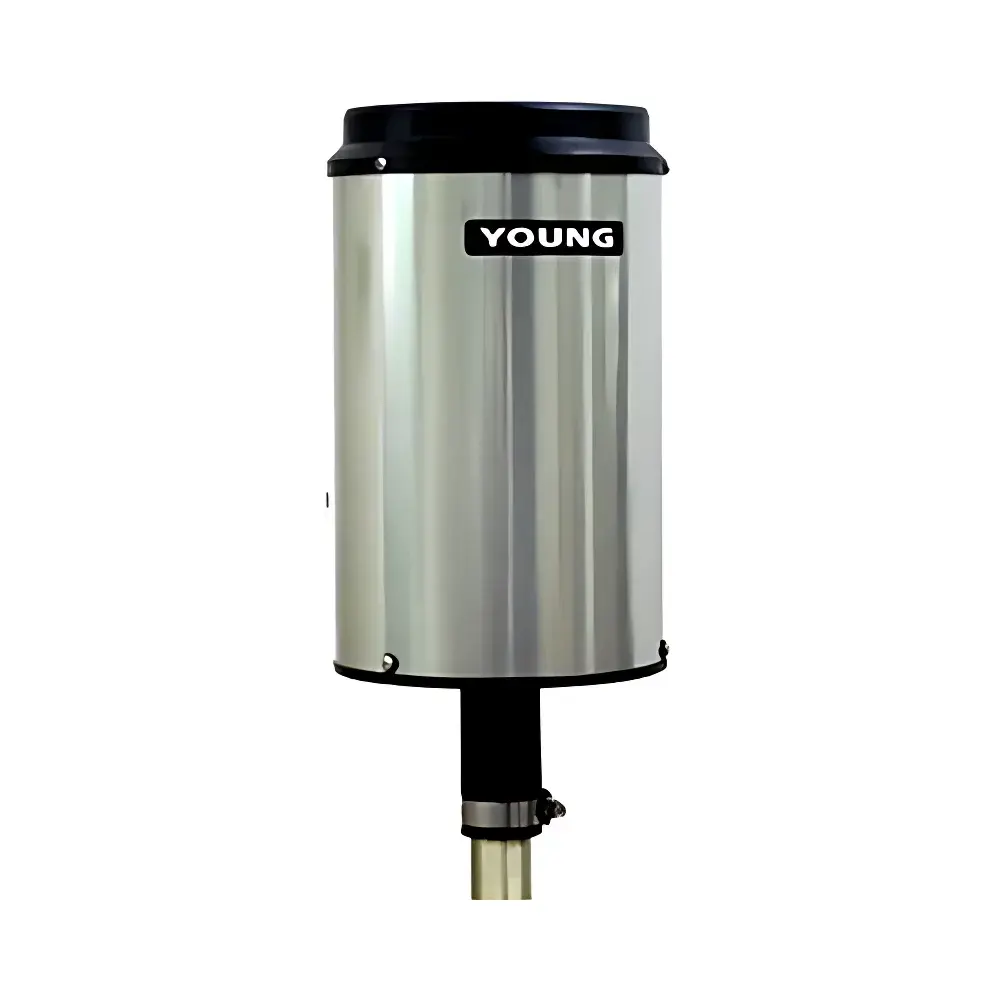
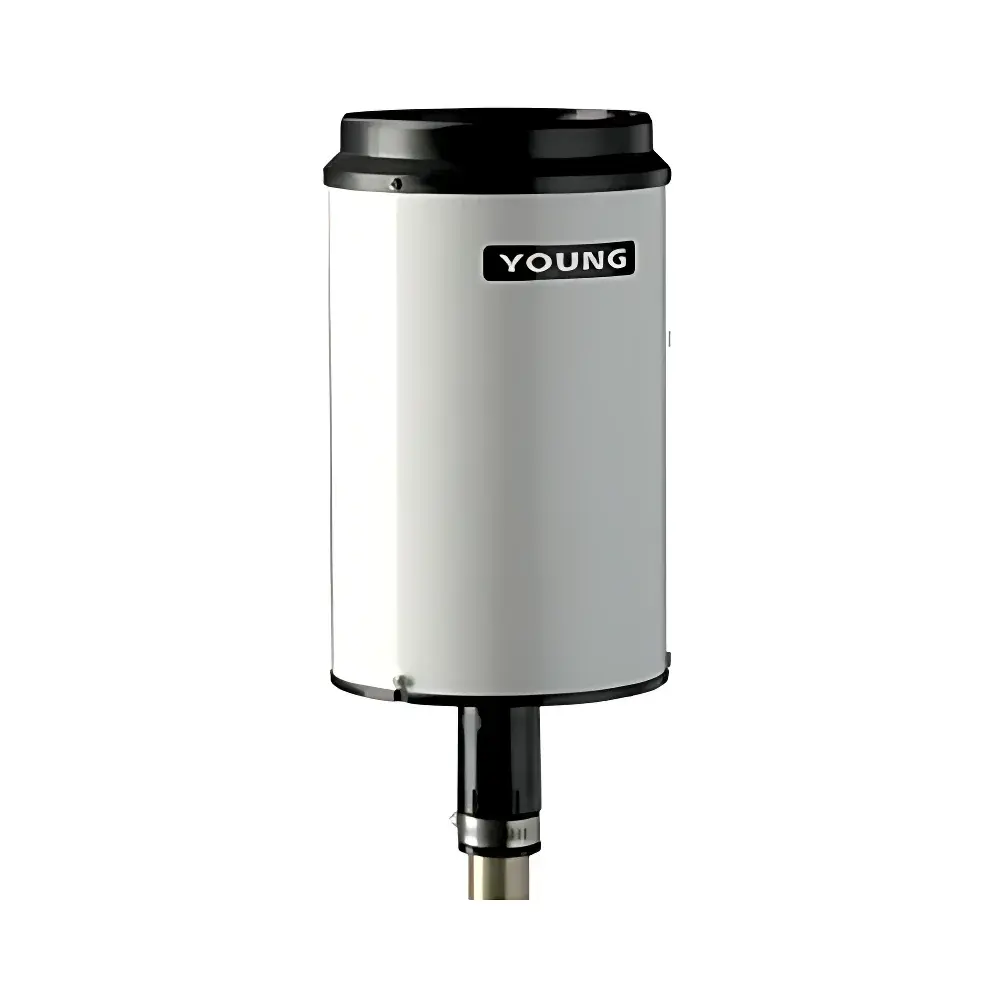
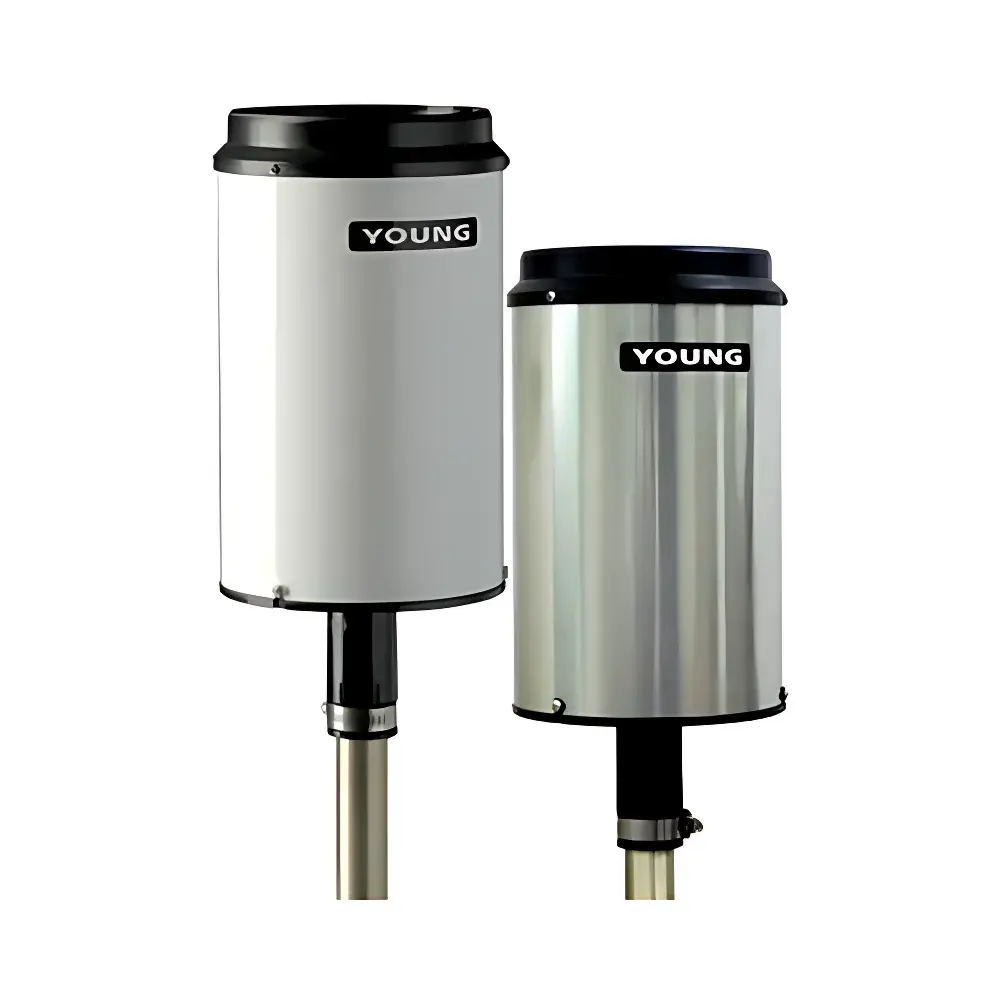
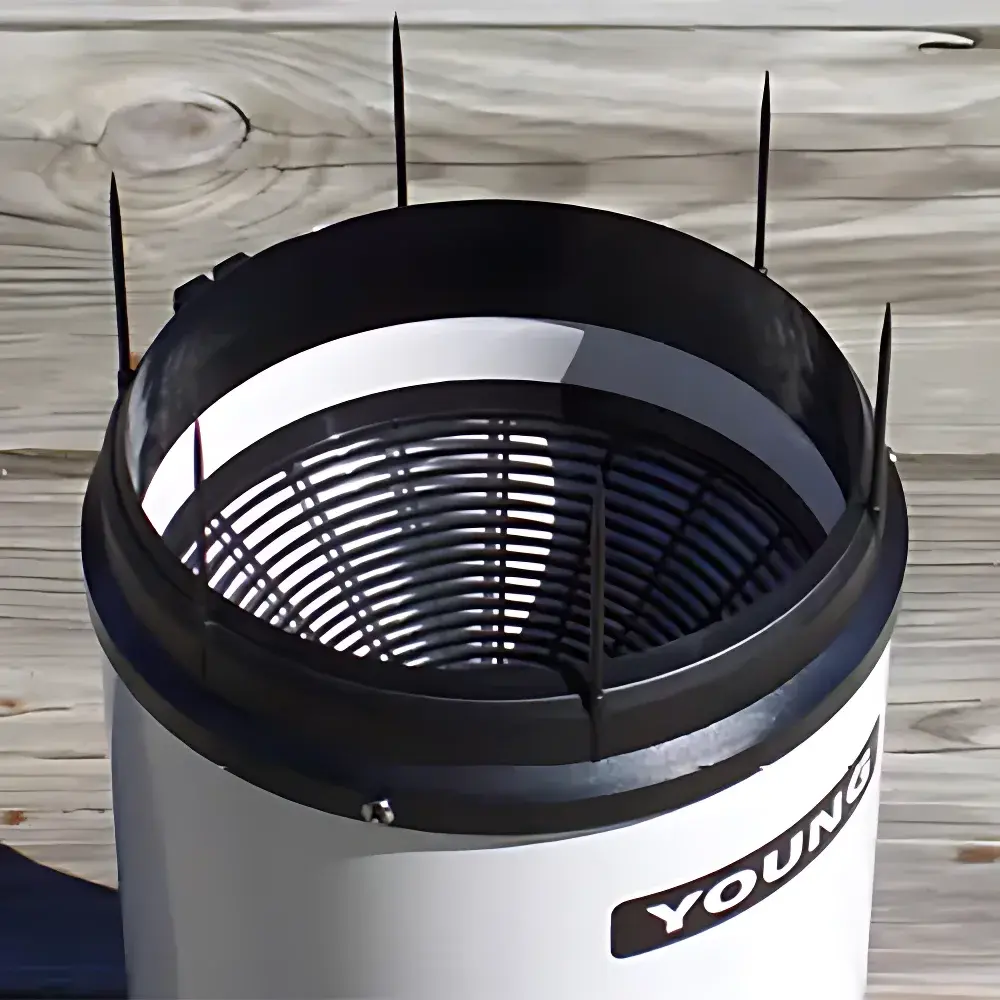
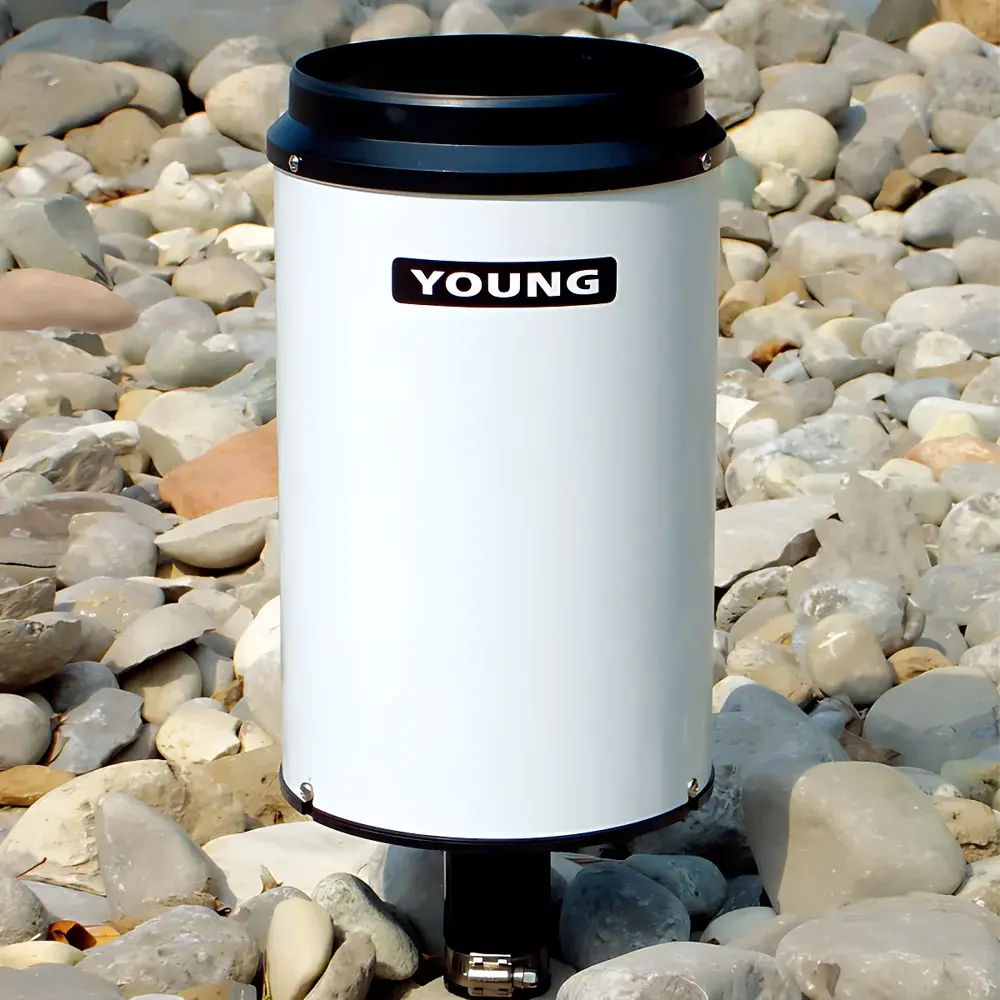
R.M. Young 52203 Tipping Bucket Rain Gauge
| Brand | R.M. Young |
|---|---|
| Origin | USA |
| Model | 52203 |
| Collection Area | 200 cm² |
| Resolution | 0.01 mm |
| Accuracy | ±2% (up to 25 mm/hr), ±3% (up to 50 mm/hr) |
| Operating Temperature | −20 °C to +50 °C |
| Output | Reed Switch |
| Mounting | 1″ NPT pipe clamp or 3-bolt flange (160 mm diameter ring) |
| Dimensions | 18 cm diameter × 30 cm height (39 cm with enclosure) |
| Power Consumption | Not applicable (non-heated) |
| Compliance | WMO-recommended design |
Overview
The R.M. Young 52203 Tipping Bucket Rain Gauge is a precision meteorological sensor engineered for long-term, field-deployable measurement of liquid precipitation in accordance with World Meteorological Organization (WMO) performance guidelines. It operates on the well-established tipping bucket principle: rainfall collected through a calibrated orifice flows into a dual-chamber bucket assembly mounted on a low-friction pivot. Each chamber holds exactly 0.01 mm of rainfall equivalent (corresponding to 0.2 mL per tip, based on the 200 cm² collection area). When one chamber fills to its calibrated threshold, gravity and mechanical balance cause it to tip, emptying its contents while simultaneously actuating a hermetically sealed reed switch. The opposing chamber then assumes the collection role—ensuring continuous, uninterrupted measurement without dead time. This mechanical-electrical transduction provides high reproducibility, minimal hysteresis, and immunity to electromagnetic interference—critical attributes for unattended operation in remote or electrically noisy environments.
Key Features
- WMO-compliant geometry and material selection: stainless steel funnel and anodized aluminum housing minimize surface tension effects, reduce splash error, and ensure rapid drainage—significantly lowering undercatch due to wind-induced turbulence or adhesion.
- Precision-machined tipping mechanism with factory-calibrated bucket volume and optimized center-of-gravity positioning ensures stable tipping thresholds across temperature extremes.
- Integrated bullseye level and adjustable leveling screws enable rapid, traceable field alignment—essential for maintaining measurement integrity on uneven terrain or pole-mounted installations.
- Modular mounting system supports both 1-inch NPT pipe clamping and rigid 3-bolt flange attachment (160 mm diameter), accommodating standard meteorological tower configurations and custom support structures.
- Optional bird deterrent kit (Model 52250) features a smooth, sloped perimeter ring that prevents avian perching—reducing contamination, blockage, and erroneous tips caused by debris accumulation or nesting behavior.
- No internal heating element; designed for reliable operation in ambient conditions ranging from −20 °C to +50 °C—ideal for temperate, subtropical, and arid climate monitoring networks where freezing precipitation is infrequent or managed via external site protocols.
Sample Compatibility & Compliance
The 52203 is validated for measurement of liquid-phase precipitation only. It is not suitable for solid precipitation (e.g., snow, sleet) without auxiliary melting systems. Its 200 cm² effective collection area and 0.01 mm resolution meet WMO Recommendation No. 8 (2018) for Class A rain gauge performance criteria under moderate-intensity rainfall (≤50 mm/hr). Accuracy specifications are empirically derived from controlled wind tunnel testing per ISO 9060:2018 Annex D methodologies. The device complies with IEC 60529 IP65 ingress protection standards when installed with its standard weatherproof enclosure. While not intrinsically certified for hazardous locations, its passive reed-switch output interface enables safe integration into SCADA, datalogger, and telemetry systems compliant with IEC 61000-4 immunity standards.
Software & Data Management
The 52203 outputs discrete closure pulses (dry contact, non-latching reed switch) compatible with all industry-standard data acquisition platforms—including Campbell Scientific CR-series loggers, Onset HOBO UX120, Delta-T GP2, and generic PLC inputs. Pulse counting is performed externally; no embedded firmware or configuration is required. For regulatory or quality-critical deployments (e.g., EPA-approved monitoring networks, GLP-compliant hydrological studies), the pulse stream may be logged with timestamped audit trails using software supporting IEC 62443-3-3 or FDA 21 CFR Part 11–compliant electronic record architectures. Calibration certificates traceable to NIST SRM 2811 are available upon request.
Applications
- Real-time hydrometeorological networks for flood forecasting and watershed modeling
- Agricultural irrigation scheduling and evapotranspiration (ET) budgeting
- Environmental impact assessments (EIA) and long-term climate trend analysis
- Urban stormwater management system validation and CSO event logging
- Educational meteorology laboratories requiring WMO-aligned instrumentation
- Calibration reference for radar-based quantitative precipitation estimation (QPE)
FAQ
What is the difference between Model 52203 and Model 52202?
The 52203 is the non-heated variant, intended for use in environments where freezing precipitation is rare or mitigated externally. The 52202 includes an integrated thermostatically controlled heater (18 W, 120 V/60 Hz) enabling continuous operation during freezing rain or snowmelt conditions.
Can the 52203 be used in freezing climates?
It is not recommended for sustained sub-zero operation without supplemental heating or manual maintenance. Ice bridging across the funnel or bucket hinge may cause undercatch or mechanical lockup.
Is calibration adjustment possible in the field?
No—tip volume is mechanically fixed at manufacture. Field verification requires comparison against a calibrated weighing-type gauge per WMO Guide to Instruments and Methods of Observation (CIMO Guide, Chapter 10).
What cable type is recommended for pulse signal transmission?
Twisted-pair, shielded cable (e.g., Belden 8761) with grounded drain wire, limited to ≤300 m length to maintain signal integrity and suppress EMI-induced false counts.
Does the device require routine maintenance?
Yes—biannual inspection for debris, insect nests, or mineral deposits is advised. Cleaning should use deionized water and soft brush; abrasive agents or solvents may degrade anodized surfaces or seal integrity.