
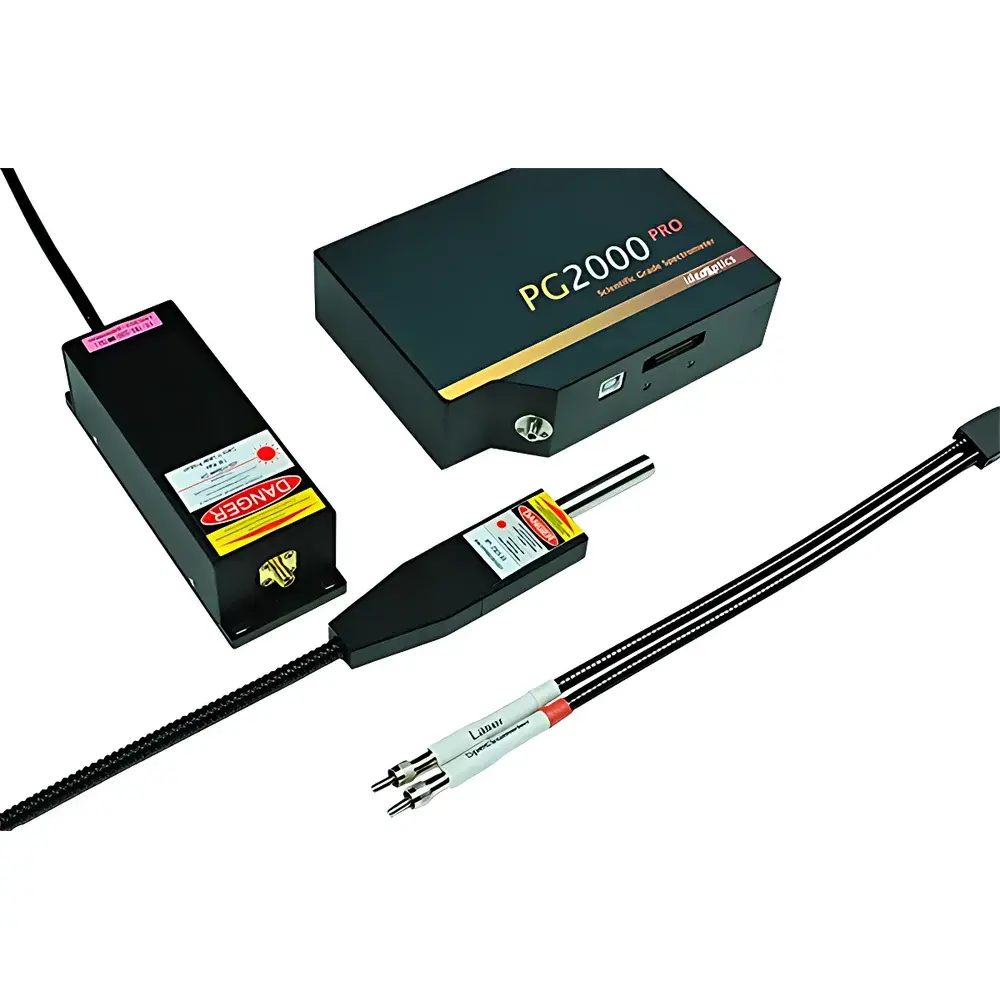
IdeaOptics Kun Modular Raman Spectrometer
| Brand | IdeaOptics |
|---|---|
| Origin | Shanghai, China |
| Manufacturer Type | Manufacturer |
| Regional Category | Domestic (China) |
| Model | Kun |
| Instrument Type | Portable / Handheld Raman Spectrometer |
| Laser Options | 532 nm & 785 nm fiber-coupled lasers |
| Spectral Range | 175–4000 cm⁻¹ (configurable) |
| Spectral Resolution | up to 2.5 cm⁻¹ |
| Detector | 2048-pixel back-thinned CCD |
| Peak Quantum Efficiency | 75% |
| Cooling | Uncooled architecture |
| Power Consumption | Low-power design |
| Modularity | Independent laser, probe, and spectrometer modules |
Overview
The IdeaOptics Kun Modular Raman Spectrometer is an engineered platform for high-fidelity, field-deployable Raman spectroscopy based on elastic inelastic light scattering principles. Designed around a modular architecture, it separates core optical subsystems—laser excitation source, fiber-optic sampling probe, and spectrometer engine—enabling flexible configuration without compromising spectral integrity. Unlike integrated handheld systems with fixed optical paths, the Kun platform supports interchangeable 532 nm and 785 nm fiber-coupled diode lasers, each optimized for specific sample classes: 532 nm for enhanced sensitivity in low-fluorescence inorganic or crystalline matrices, and 785 nm for reduced fluorescence interference in organic, biological, or petroleum-based samples. Its back-thinned CCD detector delivers 75% peak quantum efficiency across the visible–NIR range, ensuring high signal-to-noise ratio (SNR) even under low-light or battery-powered operation. The uncooled detector architecture eliminates thermoelectric cooling requirements, significantly reducing power draw while maintaining baseline stability suitable for >2-hour continuous acquisition on external portable power banks.
Key Features
- Modular subsystem architecture: independent laser module, fiber-optic Raman probe, and PG2000-Pro spectrometer unit—each replaceable and upgradeable without system recalibration
- Dual-wavelength laser support: factory-aligned 532 nm (for high-resolution inorganic analysis) and 785 nm (for fluorescence-suppressed organic detection), both fiber-coupled for stable beam delivery
- Back-thinned 2048-pixel CCD detector: achieves 75% peak QE and sub-5 e⁻ read noise at 1 MHz readout, enabling low-light spectral acquisition without active cooling
- Configurable spectral performance: selectable high-throughput or high-resolution optical benches; combined configurations yield spectral coverage from 175 cm⁻¹ to 4000 cm⁻¹ with resolution down to 2.5 cm⁻¹ (FWHM)
- Low-power operational profile: total system draw <2.5 W in typical acquisition mode—validated for sustained use with USB-C PD power banks and 12 V vehicle adapters
Sample Compatibility & Compliance
The Kun platform accommodates solid, liquid, and semi-solid samples via standardized 1/4″-28 threaded fiber probe interfaces compatible with industry-standard immersion, reflection, and standoff probes (up to 100 mm working distance). Its 785 nm configuration meets ASTM E1840-22 guidelines for forensic trace material identification under ambient lighting conditions, while the 532 nm variant supports ISO 8510-2 compliant pigment and polymer characterization. All firmware and control software comply with GLP data integrity requirements, including electronic signature support, audit trail logging, and user-access-level permissions per 21 CFR Part 11 Annex 11 recommendations. No internal moving parts or consumables ensure long-term calibration stability—certified drift <0.1 cm⁻¹ over 8-hour thermal cycling (20–35 °C).
Software & Data Management
Control and analysis are performed via RamanStudio™ v4.x, a Windows/Linux-compatible application supporting real-time spectral preview, automated cosmic ray removal, fluorescence background subtraction (polynomial + iterative morphological filtering), and library matching against NIST RM 8010, SDBS, and custom user-defined databases. Raw data is stored in HDF5 format with embedded metadata (laser wavelength, integration time, grating position, temperature), ensuring FAIR (Findable, Accessible, Interoperable, Reusable) compliance. Batch processing pipelines support ASTM E2529-20-compliant peak intensity normalization and multivariate analysis (PCA, PLS-DA) for quantitative classification tasks. Export options include CSV, JCAMP-DX, and Bruker OPUS-compatible formats for LIMS integration.
Applications
- Food adulterant screening: Detection of trace hexamethylenetetramine (urotropine) in dried tofu at concentrations <50 ppm using 785 nm excitation and 120 s integration—validated against LC-MS/MS reference methods (GB 5009.293-2022)
- Petrochemical process monitoring: In-situ octane/cetane number estimation in refinery streams via multivariate regression on C–H stretch region (2800–3000 cm⁻¹) with <±0.8 unit uncertainty vs. ASTM D2699/D2700 reference testing
- Customs and border protection: Field identification of illicit narcotics (e.g., fentanyl analogues, synthetic cannabinoids) under variable ambient lighting using adaptive background correction and spectral correlation matching (threshold: r ≥ 0.985)
- Pharmaceutical raw material verification: Polymorph discrimination in API batches (e.g., ritonavir Form I vs. II) via low-wavenumber lattice mode analysis (100–250 cm⁻¹) enabled by extended-range optical configuration
FAQ
Can the Kun system be configured for sub-100 cm⁻¹ measurements?
Yes—optional ultra-low-wavenumber optics (down to 10 cm⁻¹) are available as a factory-installed upgrade, requiring modified notch filters and calibrated alignment fixtures.
Is spectral calibration traceable to NIST standards?
Each unit ships with a certificate of calibration verified against NIST SRM 2241 (silicon) and SRM 2242 (cyclohexane), with wavelength accuracy ±0.2 cm⁻¹ and intensity linearity ±2.5% over full dynamic range.
Does the system support remote operation via Ethernet or Wi-Fi?
The embedded ARM-based controller supports TCP/IP communication and RESTful API access for integration into automated QA/QC workflows; Wi-Fi module optional (IEEE 802.11ac, WPA3-Enterprise compatible).
What maintenance is required for long-term field deployment?
No routine optical alignment or lamp replacement is needed; only periodic verification of laser power output (using integrated photodiode monitor) and spectral calibration check every 6 months—or after mechanical shock exceeding 25 g.






