
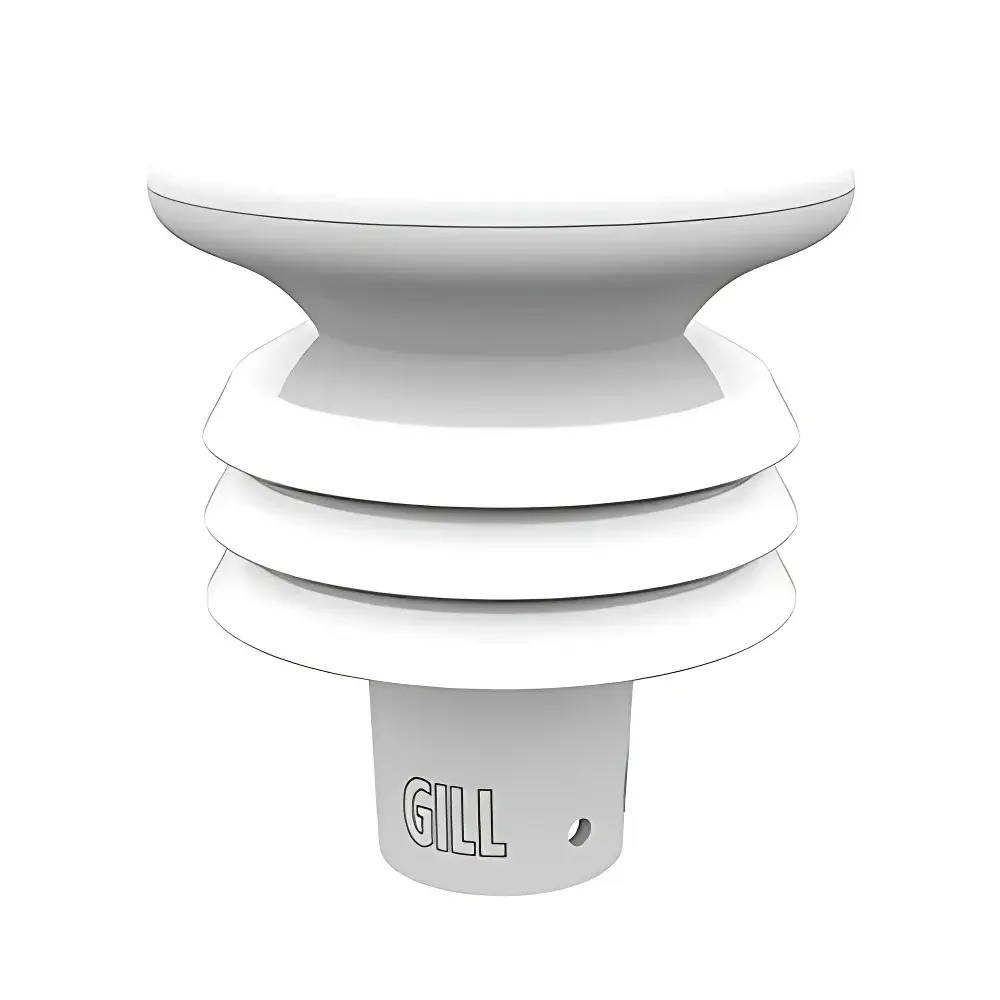
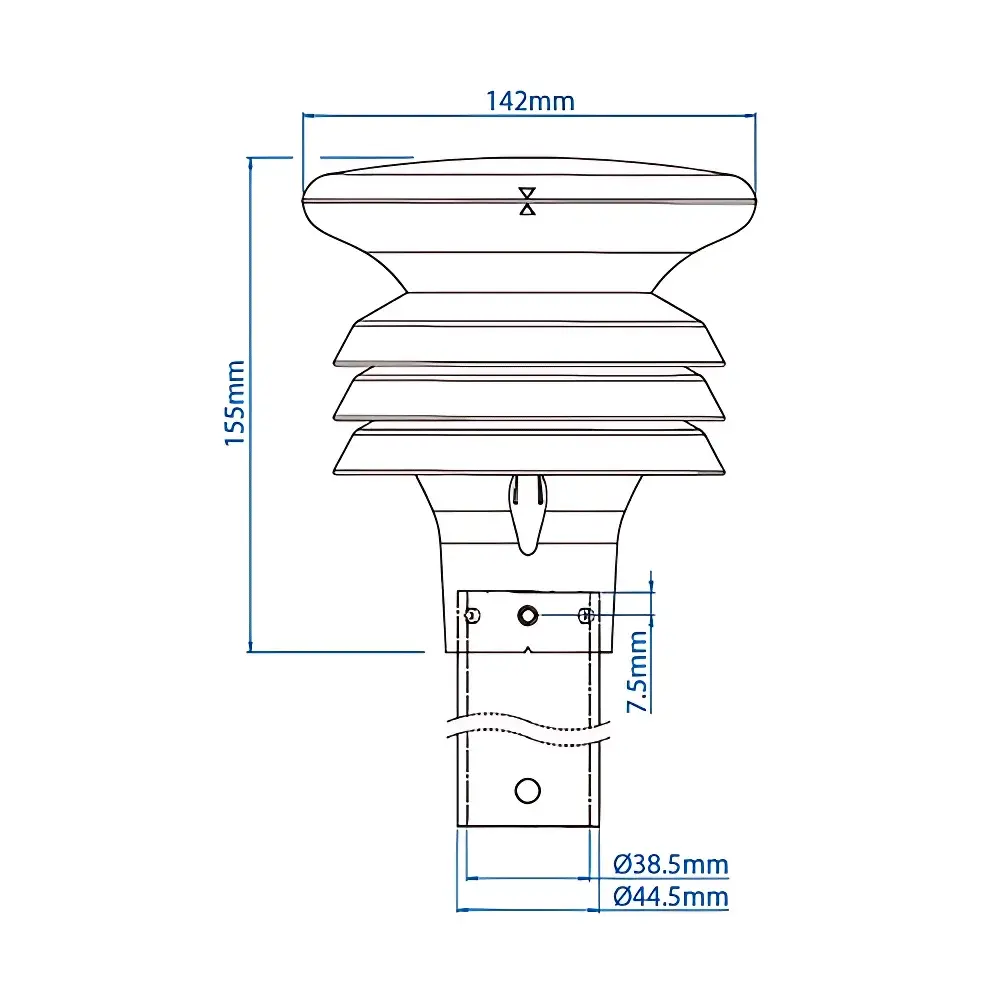
Gill GMX300 Compact Weather Station
| Brand | Gill |
|---|---|
| Origin | United Kingdom |
| Model | GMX300 |
| Instrument Type | Portable Weather Station |
| Enclosure | Triple-layer passive ventilation solar radiation shield (UV-stabilized polycarbonate) |
| Measured Parameters | Air Temperature, Relative Humidity, Atmospheric Pressure, Absolute Humidity, Air Density, Wet-Bulb Temperature, Tilt Angle, Solar Position (Sunrise/Sunset, Solar Noon, Twilight), Altitude (GPS-assisted, manual input) |
| Output Interfaces | RS-232 / RS-422 / RS-485 (ASCII), SDI-12, NMEA 0183, MODBUS RTU, Analog Outputs (optional) |
| Environmental Rating | IP66 |
| Operating Temperature Range | −40 °C to +70 °C |
| Power Supply | 6–30 V DC |
Overview
The Gill GMX300 Compact Weather Station is a self-contained, maintenance-free environmental sensing platform engineered for long-term, high-reliability deployment in demanding outdoor applications. Designed and manufactured in the United Kingdom by Gill Instruments—a leader in precision meteorological instrumentation—the GMX300 integrates calibrated temperature, humidity, and barometric pressure sensors within a single, compact housing. Its measurement architecture relies on passive thermodynamic equilibrium principles: air exchange occurs exclusively through a triple-layer, UV-resistant, naturally ventilated solar radiation shield—eliminating moving parts, power-dependent fans, or mechanical aspiration. This design ensures stable thermal boundary conditions for temperature and humidity sensing while minimizing radiative heating errors and condensation risk. The station operates across extreme climatic zones (−40 °C to +70 °C) and conforms to WMO guidance for Class II exposure, making it suitable for unattended operation in remote or infrastructure-constrained locations.
Key Features
- Passive ventilation radiation shield: Triple-layer polycarbonate construction with optimized airflow geometry, compliant with ISO 4690 and WMO No. 8 guidelines for natural aspiration of temperature/humidity sensors
- No moving parts: Eliminates mechanical failure modes, reduces calibration drift, and extends service intervals beyond five years under typical field conditions
- Multi-parameter fusion: Simultaneous derivation of dew point, wet-bulb temperature, absolute humidity (g/m³), air density (kg/m³), and sea-level pressure (hPa) from primary sensor inputs
- Integrated solar position engine: Computes sunrise/sunset times, solar noon, civil/nautical/astronomical twilight, and solar zenith/azimuth angles using GPS-assisted altitude and UTC time synchronization
- Industrial-grade communications: Standard support for ASCII protocols over RS-232/422/485, SDI-12 (for compatibility with legacy dataloggers), NMEA 0183 (for marine/navigation integration), and MODBUS RTU (for SCADA and building management systems)
- IP66-rated enclosure: Fully protected against dust ingress and powerful water jets, enabling deployment in coastal, industrial, and agricultural environments without additional weatherproofing
Sample Compatibility & Compliance
The GMX300 is designed for ambient atmospheric sampling only; it does not require consumables, purge gases, or sample conditioning hardware. Its sensor suite meets EN 13030:2001 (meteorological instruments – requirements for temperature and humidity sensors) and complies with IEC 60529 for ingress protection. Data outputs are structured to support traceable environmental monitoring workflows aligned with ISO/IEC 17025 laboratory accreditation requirements. While the unit itself does not include built-in audit trail or electronic signature functionality, its ASCII and MODBUS output formats are compatible with third-party data acquisition systems validated under FDA 21 CFR Part 11 and EU Annex 11 for regulated applications such as environmental qualification of pharmaceutical facilities or GxP-aligned climate-controlled storage validation.
Software & Data Management
Gill provides the free-to-use GMX Configurator utility for local setup, firmware updates, and output protocol configuration via USB-to-serial interface. Raw sensor data streams are fully documented in the GMX300 Communication Protocol Manual, enabling seamless integration into custom SCADA, IoT edge gateways, or cloud platforms (e.g., AWS IoT Core, Azure IoT Hub) using standard parsing logic. All ASCII frames include timestamp, checksum, and parameter identifiers—facilitating automated validation, outlier detection, and metadata enrichment. For long-term archival, the station supports direct logging to external SD cards via compatible dataloggers (e.g., Campbell Scientific CR1000X, HOBO UX120) using SDI-12 or serial protocols. No proprietary cloud subscription is required for basic operation or data retrieval.
Applications
- Building energy management: Real-time outdoor air enthalpy calculation for HVAC optimization and demand-controlled ventilation
- Transportation infrastructure: Fog, icing, and wind-chill monitoring at bridges, tunnels, and airport runways per FAA AC 150/5220-22B and EASA AMC 20-193
- Agricultural microclimate networks: Crop evapotranspiration (ET₀) modeling using FAO-56 Penman-Monteith inputs derived from GMX300 outputs
- Renewable energy site assessment: Correlation of solar irradiance proxies (via solar position + clear-sky models) and wind resource screening with co-located anemometers
- Coastal erosion and flood forecasting: Barometric pressure trend analysis for early storm surge detection in conjunction with tidal gauges
- Educational meteorology labs: Curriculum-aligned datasets for teaching atmospheric thermodynamics, instrument error sources, and data quality assurance practices
FAQ
Does the GMX300 include an integrated GPS module?
No—the GMX300 does not contain an active GPS receiver. Altitude must be manually configured during setup to enable accurate solar position calculations and MSL pressure derivation.
Can the GMX300 operate independently without external power?
It requires a continuous 6–30 V DC supply; no internal battery is provided. However, it draws less than 15 mA at 12 V DC, making it compatible with solar-charged battery systems commonly used in remote telemetry.
Is calibration certificate included with shipment?
A factory calibration report (traceable to UKAS-accredited standards) is supplied with each unit. Optional on-site recalibration services are available through Gill’s global network of authorized service centers.
What is the recommended recalibration interval?
Gill recommends verification every 24 months under normal operating conditions; extended intervals up to 36 months may be justified with documented field performance trending per ISO/IEC 17025 Clause 7.7.
How is tilt angle measured, and what is its purpose?
A solid-state MEMS inclinometer provides ±0.5° resolution tilt data, primarily used for diagnostic validation of mounting integrity and correction of pressure sensor orientation effects in non-horizontal installations.
Related Products







