
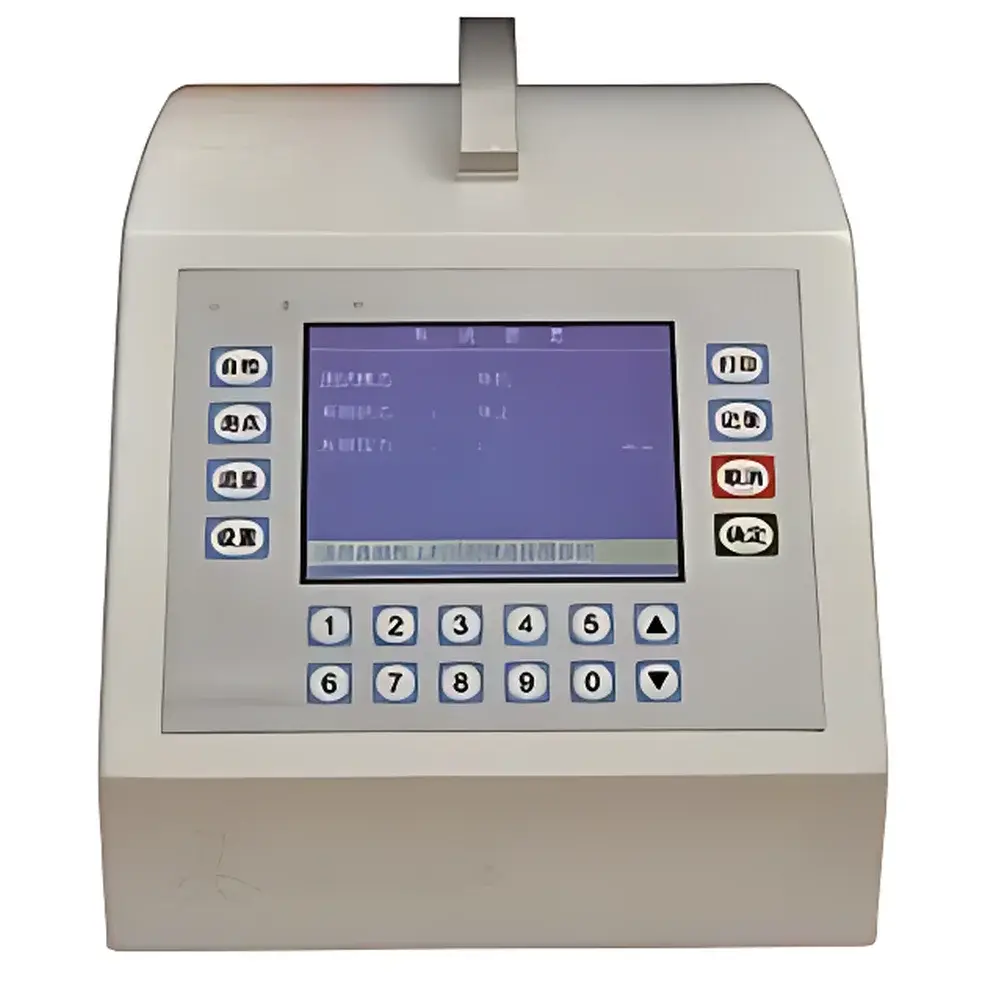
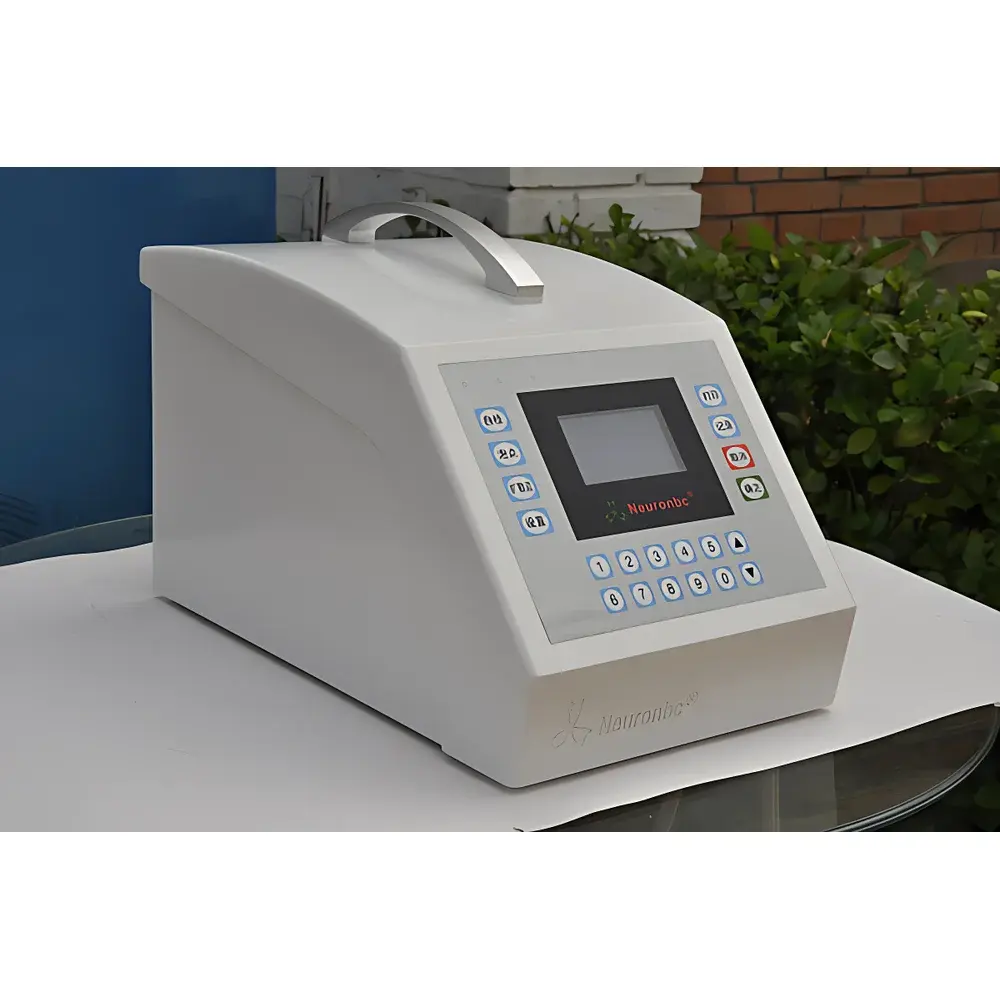
NeuronBC Integtest Series 4.0 Filter Integrity Tester FIT-V4.0
| Brand | NeuronBC |
|---|---|
| Origin | Beijing, China |
| Model | FIT-V4.0 |
| Power Supply | 100–240 VAC, 50 Hz, 120 W |
| Operating Pressure Range | 100–8000 mbar (115 psi) |
| Test Methods | Bubble Point, Diffusion Flow, Pressure Hold, Water Intrusion |
| Accuracy | Bubble Point ±50 mbar |
| Test Range | Bubble Point 590–6900 mbar |
| Display | 5.7″ TFT monochrome LCD with backlight |
| Data Storage | 500 test records |
| Connectivity | RS232 serial interface |
| Language | English / Chinese |
| Operating Environment | ISO Class B cleanroom compliant |
| Dimensions (W×D×H) | 240 × 400 × 270 mm (base) + 220 mm (top module) |
| Weight | 7.5 kg |
Overview
The NeuronBC Integtest Series 4.0 Filter Integrity Tester (Model FIT-V4.0) is a fully automated, regulatory-compliant instrument engineered for quantitative integrity verification of sterilizing-grade membrane filters and filtration systems used in pharmaceutical, biotechnology, and medical device manufacturing. It implements standardized physical test principles—namely bubble point, diffusion flow, pressure hold, and water intrusion—to assess pore structure integrity, wetting state, and potential defects in hydrophobic and hydrophilic membranes. The system operates on the fundamental principle that a fully wetted membrane resists gas passage until applied pressure exceeds the capillary entry pressure (bubble point), while post-wetting gas diffusion under constant pressure reflects membrane defect density and seal integrity. Designed to meet the stringent validation and documentation requirements of current Good Manufacturing Practice (cGMP), European Pharmacopoeia (EP), United States Pharmacopeia (USP <1207>), and FDA 21 CFR Part 11, the FIT-V4.0 supports both pre-use and post-use testing protocols mandated for critical sterile processes.
Key Features
- Automated, closed-loop gas delivery system with precisely modulated upstream pressurization—eliminates operator-induced variability and ensures consistent ramp rates and dwell times per ASTM F838-22 and ISO 13408-2.
- Real-time upstream volume measurement via integrated volumetric compensation—enables accurate net diffusion flow calculation independent of system compressibility or temperature drift.
- Dual-mode operation: manual mode for troubleshooting and method development; automatic mode for routine GMP batch release testing with full audit trail generation.
- 5.7″ high-contrast monochrome TFT display with adjustable backlight—optimized for visibility in controlled environments including ISO Class B cleanrooms.
- Onboard thermal printer supporting GLP-compliant hardcopy output with timestamp, operator ID, test parameters, raw data, and pass/fail status.
- Robust mechanical architecture with stainless-steel internal manifolds and chemically resistant seals—validated for repeated exposure to IPA, ethanol, and purified water during filter wetting procedures.
Sample Compatibility & Compliance
The FIT-V4.0 accommodates a broad spectrum of filter configurations across liquid and gas applications. It validates disc membranes (Φ25–300 mm), standard cartridge filters (2.5″–40″, up to 15 cores), capsule filters, mini-cartridges, flat-sheet modules, and air-breathing vent filters. Its pressure range (100–8000 mbar) and flow sensitivity (down to 1 mL/min diffusion) support both hydrophobic PTFE/PVDF air filters and hydrophilic PVDF/PES sterilizing filters used in bioprocess fluid paths. All firmware logic and electronic record structures conform to FDA 21 CFR Part 11 requirements—including electronic signature enforcement, user-level access control (admin/operator/auditor roles), and immutable audit trails with time-stamped event logging. The system satisfies Annex 11 (EU GMP) and ICH Q5A(R2) expectations for computerized system validation and is routinely deployed in facilities undergoing FDA, EMA, and NMPA inspections.
Software & Data Management
Data integrity is enforced at the firmware level: every test generates a unique identifier, captures environmental conditions (ambient temperature/humidity), records real-time pressure and flow curves, and stores metadata including operator login, filter lot number, and process step reference. The internal memory retains 500 complete test records with full traceability. RS232 serial output enables seamless integration with LIMS or MES platforms using ASCII-based protocol (customizable delimiter and field mapping). All electronic records comply with ALCOA+ principles—attributable, legible, contemporaneous, original, accurate, complete, consistent, enduring, and available—and support retrospective review during regulatory audits or deviation investigations. Optional CSV export facilitates statistical trend analysis (e.g., SPC charts for bubble point drift over filter lifecycle).
Applications
- Pre-use and post-use integrity testing of sterilizing filters in bioreactor harvest, buffer preparation, and final fill lines.
- Verification of tank vent filters and compressed air/gas distribution systems prior to aseptic operations.
- Water-for-injection (WFI) and purified water point-of-use filter qualification per USP <1231> and EU Annex 1.
- Validation of ultrafiltration membranes in viral clearance studies and downstream purification trains.
- Supporting risk-based filter lifecycle management—including revalidation intervals, reuse protocols, and steam-in-place (SIP) cycle impact assessment.
FAQ
Does the FIT-V4.0 support both hydrophilic and hydrophobic filter testing?
Yes—it is validated for bubble point and diffusion flow testing of both hydrophilic (e.g., PVDF, PES, nylon) and hydrophobic (e.g., PTFE, PP) membranes using appropriate wetting agents and test gases (air or nitrogen).
Is upstream volume calibration required before each test?
No—the instrument performs automatic upstream volume determination prior to each test sequence using an integrated pressure decay algorithm, eliminating manual calibration steps and reducing operator dependency.
Can test data be exported for external analysis?
Yes—via RS232 interface using configurable ASCII format; raw pressure/time and flow/time datasets are exportable for advanced statistical modeling or regulatory submission packages.
What regulatory standards does the FIT-V4.0 directly address?
It fulfills technical and documentation requirements of USP <1207>, EP 2.6.27, ISO 13408-2, ASTM F838-22, FDA 21 CFR Part 11, EU Annex 11, and China GMP Annex 1 (2022).
How is user access controlled to ensure data integrity?
Three-tier role-based authentication (Admin, Operator, Auditor) enforces procedural segregation; all actions—including parameter changes, record deletion, or report printing—are logged with user ID and timestamp in an uneditable audit trail.
Related Products




