
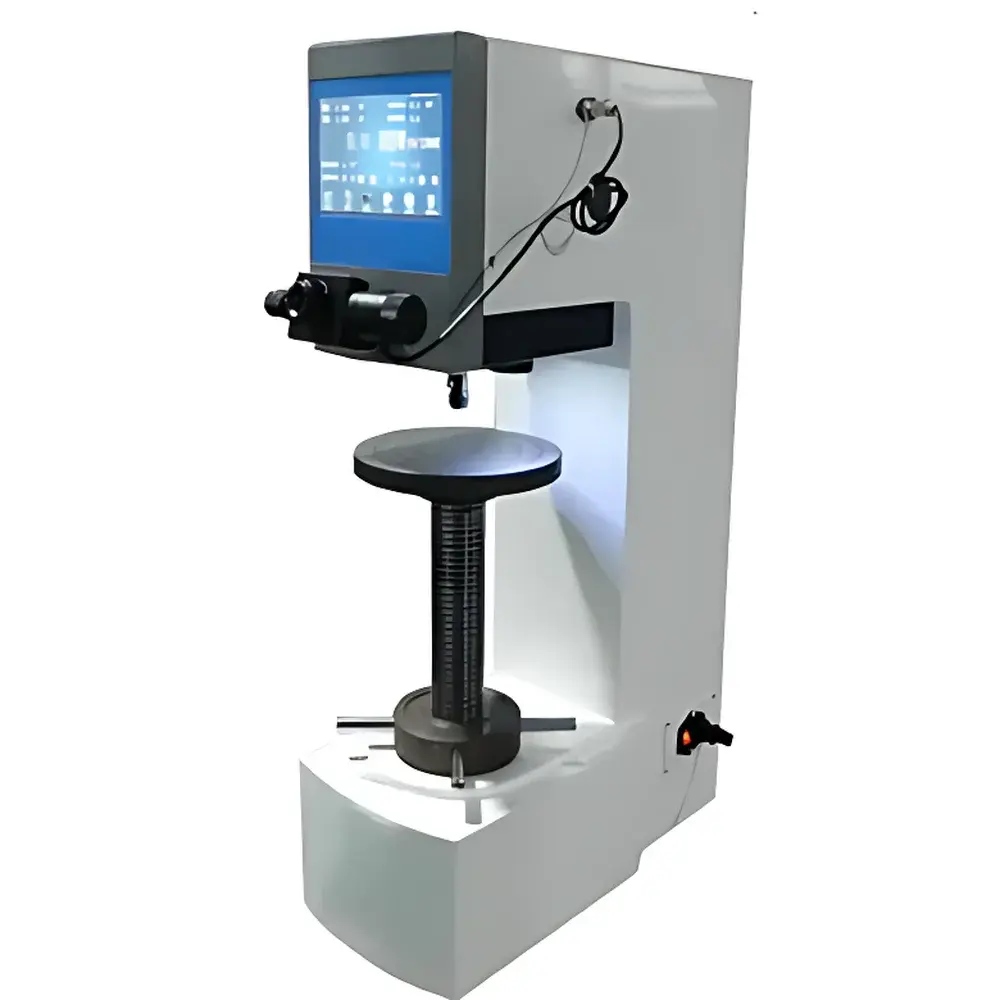
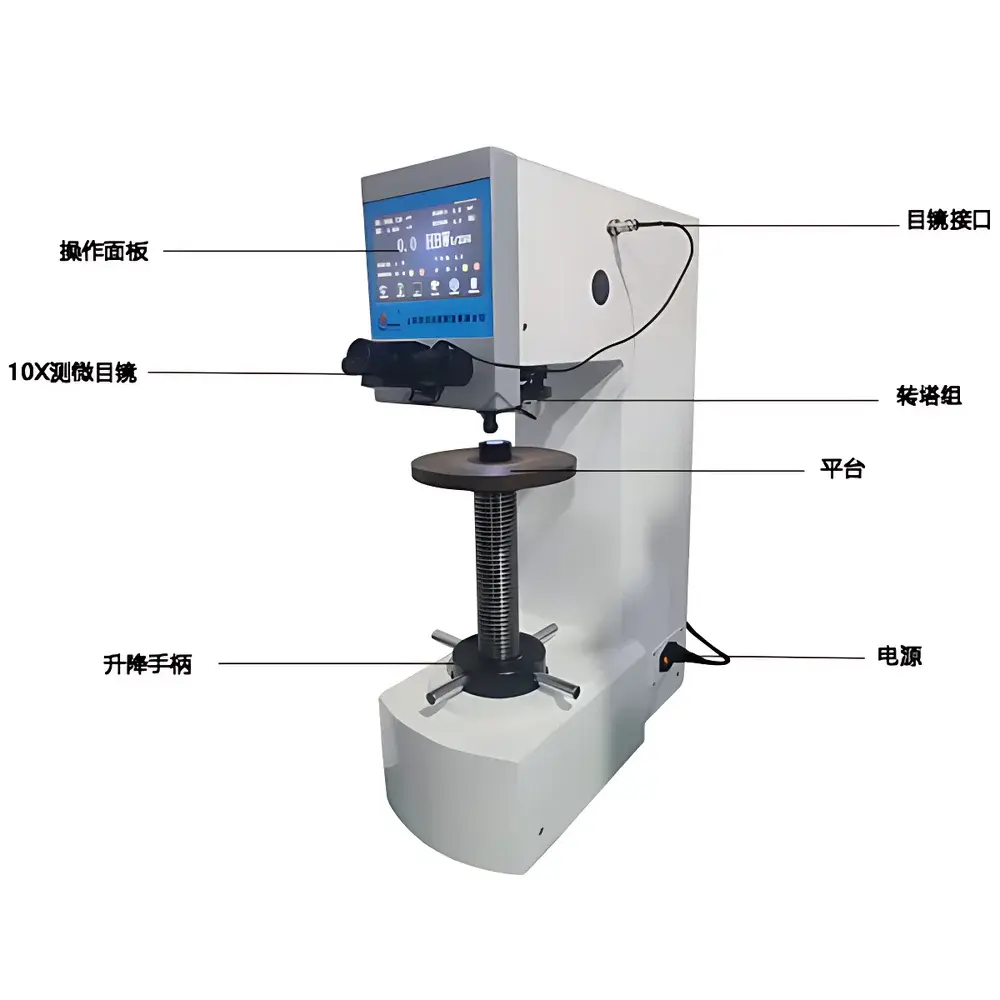
YANRUN HBS-3000L Touchscreen Digital Brinell Hardness Tester
| Brand | YANRUN |
|---|---|
| Origin | Shanghai, China |
| Manufacturer Type | Direct Manufacturer |
| Region of Origin | Domestic (China) |
| Model | HBS-3000L |
| Instrument Type | Brinell Hardness Tester |
| Hardness Range | 8–650 HBW |
| Total Test Forces | 62.5 kgf, 100 kgf, 125 kgf, 187.5 kgf, 250 kgf, 500 kgf, 750 kgf, 1000 kgf, 1500 kgf, 3000 kgf |
| Maximum Specimen Height | 235 mm |
| Depth from Indenter Center to Column | 155 mm |
Overview
The YANRUN HBS-3000L Touchscreen Digital Brinell Hardness Tester is a fully automated, microprocessor-controlled hardness testing system engineered for precision, repeatability, and compliance with international Brinell hardness standards—including ISO 6506-1, ASTM E10, and GB/T 231.1. It implements the classical Brinell indentation method: a hardened tungsten carbide ball indenter is applied under a precisely controlled static load for a defined dwell time (0–60 s), and the resulting permanent impression diameter is measured optically to calculate HBW (Hardness Brinell, tungsten carbide ball). Due to its large indentation area, the Brinell method provides high statistical representativeness—averaging over multiple microstructural constituents—and is especially suited for coarse-grained, inhomogeneous, or cast materials where localized variations (e.g., dendritic segregation or phase dispersion) would compromise smaller-scale tests such as Vickers or Rockwell.
Key Features
- Electronically closed-loop force control system eliminates mechanical deadweight loading—ensuring traceable, drift-free application of all 10 standard test forces (62.5–3000 kgf) with <±0.5% force accuracy per ISO 6506-2 calibration requirements.
- Integrated 20× digital eyepiece with 0.5 µm resolution (0.0005 mm) and automatic indentation diameter detection—reducing operator dependency and measurement uncertainty associated with manual micrometer reading.
- Multi-scale hardness conversion engine compliant with ASTM E140 and ISO 18265: real-time calculation and display of equivalent values for HRB, HRC, HV, HK, HR15/30/45N/T, and HBW across all valid load–diameter combinations.
- Touchscreen HMI (Human-Machine Interface) running proprietary Hardness Control Software V2.0 (registered software copyright)—supporting intuitive test setup, parameter logging, on-screen result review, and GLP-compliant audit trail generation (user ID, timestamp, force/dwell/time settings, raw pixel measurements).
- Onboard thermal-printer output for immediate hardcopy reporting; data export via USB to CSV-compatible spreadsheets for QA/QC documentation and SPC analysis.
- Robust mechanical architecture: cast-iron base, hardened column, and precision-ground specimen stage—designed to minimize vibration-induced error and maintain long-term geometric stability under industrial laboratory conditions.
Sample Compatibility & Compliance
The HBS-3000L accommodates specimens up to 235 mm in height and 155 mm in depth from the column centerline—compatible with standard flat, cylindrical (via V-block), and irregularly shaped metallic samples. Its standardized test force range (62.5–3000 kgf) and interchangeable tungsten carbide indenters (Ø2.5 mm, Ø5 mm, Ø10 mm) support all major Brinell test scales (e.g., HBW 10/1000, HBW 5/250, HBW 2.5/62.5), enabling full alignment with material-specific testing protocols in metallurgy, foundry quality control, and non-ferrous alloy certification. The instrument meets JJG 150 national verification regulation for hardness testers in China and conforms to metrological traceability requirements under ISO/IEC 17025-accredited calibration practices. All hardness value outputs are referenced to certified reference blocks (low/medium/high HBW ranges) and validated against GB/T 231.2–2012 accuracy tolerances: ±3% (HBW ≤125), ±2.5% (125<HBW≤225), ±2% (HBW >225), with repeatability limits of 0.03d, 0.025d, and 0.02d respectively (where d = mean indentation diameter in mm).
Software & Data Management
Hardness Control Software V2.0 provides full test lifecycle management: user-defined test sequences, configurable dwell time (1–60 s increments), auto-save of up to 30 test records per session, and password-protected administrator mode for method validation and calibration lockout. Raw image capture of indentations is stored with metadata (load, time, scale, operator ID), supporting retrospective review during internal audits or regulatory inspections (e.g., ISO 9001, IATF 16949, or FDA 21 CFR Part 11–compliant environments when deployed with electronic signature add-ons). Export formats include .csv and .pdf—structured for integration into LIMS or ERP systems without proprietary middleware.
Applications
- Quality assurance of as-cast iron, aluminum-silicon alloys, copper-brass forgings, and annealed steels prior to heat treatment.
- Verification of homogeneity in large-section billets, ingots, and weldments where microhardness methods lack representative sampling volume.
- Routine hardness monitoring in foundries, rolling mills, and OEM supplier labs operating under ASTM A48, EN 1561, or GB/T 9441 specifications.
- Research-grade mechanical property correlation studies—linking Brinell hardness to tensile strength (σUTS ≈ c × HBW, per ISO 6506-4 empirical models) or wear resistance in tribological investigations.
- Educational use in university materials science laboratories for teaching fundamental principles of plastic deformation, indentation mechanics, and standardization in mechanical testing.
FAQ
What Brinell standards does the HBS-3000L comply with?
It adheres to ISO 6506-1 (test method), ISO 6506-2 (verification), ASTM E10, GB/T 231.1, and JJG 150 for metrological verification.
Can the instrument perform automatic hardness conversions?
Yes—it computes and displays equivalent values for HRB, HRC, HV, HK, and all Rockwell superficial and normal scales per ASTM E140 and ISO 18265 algorithms.
Is calibration traceable to national standards?
All factory calibrations are performed using NIST-traceable or CNAS-accredited reference blocks; users receive a calibration certificate with uncertainty budget.
What maintenance is required for long-term accuracy?
Annual verification of force application, indenter geometry (via SEM or optical profilometry), and eyepiece calibration using certified step gauges is recommended per ISO 6506-2 Annex B.
Does the system support network connectivity or remote operation?
The base configuration includes USB data export only; Ethernet or RS-232 interfaces are available as optional hardware modules for integration into automated test cells.



