
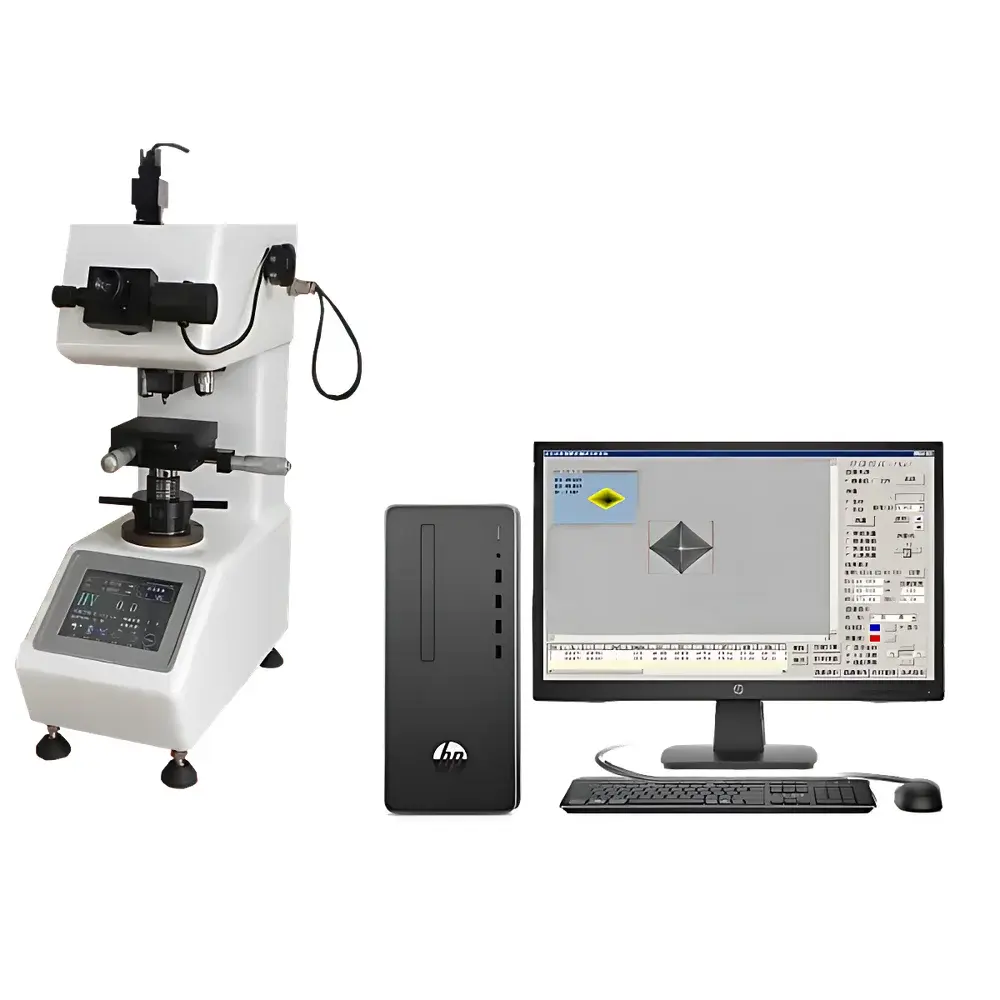
YANRUN HMAS-D1000Z Automated Digital Microhardness Testing System
| Brand | YANRUN |
|---|---|
| Origin | Shanghai, China |
| Manufacturer Type | Direct Manufacturer |
| Product Category | Domestic (China-made) |
| Model | HMAS-D1000Z |
| Instrument Type | Automatic Digital Microhardness Tester |
| Measurement Range | 0.001–6000 HV |
| Test Forces | 10, 25, 50, 100, 200, 300, 500, 1000 gf (0.098–9.807 N) |
| Turret | Motorized Auto-Turret |
| Loading Mechanism | Gear-Driven Force Application |
| Load Duration | 0–99 s (1 s increments) |
| X-Y Stage Travel | 25 × 25 mm |
| Minimum Detectable Indentation | 0.25 µm |
| Optical Magnification | 100× (observation), 400× (measurement), ~1600× on PC display |
| Compliant Standard | GB/T 4340 (equivalent to ISO 6507 and ASTM E384) |
Overview
The YANRUN HMAS-D1000Z Automated Digital Microhardness Testing System is a fully integrated, computer-controlled microindentation hardness tester engineered for precision measurement of Vickers hardness (HV) at low test forces—down to 10 gf (0.098 N). Based on the principle of optical indentation metrology, the system applies a precisely calibrated diamond pyramid indenter to the specimen surface under controlled static load, holds the force for a user-defined dwell time (1–99 s), and then measures the diagonals of the resulting square-shaped impression using high-resolution digital imaging. The instrument employs a motorized auto-turret with dual objective lenses (10× for observation, 40× for measurement), enabling seamless transition between sample positioning and quantitative analysis. Its rigid aluminum-cast frame, gear-driven loading mechanism, and precision-ground mechanical stage ensure long-term dimensional stability and repeatability across thousands of cycles—critical for quality control in heat-treated steels, thin films, coatings, ceramics, and metallurgical research.
Key Features
- Fully automated operation: motorized turret, auto-focus-assisted image acquisition, and programmable load application (8 selectable test forces from 10–1000 gf)
- Dual-view capability: simultaneous real-time viewing via eyepiece and high-definition CCD camera feed to PC monitor
- Proprietary HMAS software suite with AI-enhanced image processing—including simulated focus correction, sub-pixel indentation edge detection, and dynamic contrast optimization for low-contrast or reflective surfaces
- True 3D indentation modeling: reconstructs depth profiles and volumetric geometry from 2D diagonal measurements and material-specific elastic recovery models
- SPC-ready data pipeline: real-time statistical process control with Cp/Cpk calculation, histogram generation, trend charts, and outlier identification per ASTM E2921
- Multi-standard hardness conversion: supports direct output in HV, HK, HRA/B/C/D, HR15/30/45N/T, HBW, and HEF per ISO 18265 and ASTM E140
- Twelve customizable background color modes optimized for diverse material classes—including anodized aluminum, nitrided steel, copper alloys, and sintered carbides
Sample Compatibility & Compliance
The HMAS-D1000Z accommodates specimens up to 65 mm in height and 110 mm from indenter center to chamber wall—suitable for cross-sectioned gears, turbine blades, weld joints, and coated substrates. Its 25 × 25 mm motorized X-Y stage allows precise raster scanning for case-depth profiling (e.g., carburized or nitrided layers), gradient hardness mapping, and multi-point hardness arrays. All measurement protocols comply with GB/T 4340.1–2012 (identical to ISO 6507-1:2018 and ASTM E384–22), ensuring traceability to national metrological standards. Data audit trails—including operator ID, timestamp, environmental metadata, and raw image archives—are structured to support GLP/GMP environments and FDA 21 CFR Part 11 compliance when deployed with validated network configurations and electronic signature modules.
Software & Data Management
The HMAS software platform operates as a standalone Windows-based application with no external dependencies. It captures live video streams at ≥30 fps, performs real-time centroid-based indentation tracking, and computes hardness values using ISO 6507-1’s standard formula: HV = 0.1891·F/d² (where F is load in kgf and d is mean diagonal in mm). Image processing includes noise suppression, adaptive thresholding, and sub-pixel interpolation for measurements below 1 µm resolution. Reporting functions export fully formatted documents in PDF (ISO-compliant), Word (.docx), and Excel (.xlsx) formats—including embedded calibration certificates, uncertainty budgets (per GUM), and annotated indentation overlays. SPC dashboards generate control charts per ISO 7870-2, while batch history logs retain full image sets, measurement coordinates, and operator annotations for retrospective root-cause analysis.
Applications
This system serves laboratories engaged in metallurgical failure analysis, thermal processing validation, thin-film adhesion assessment, and advanced materials development. Typical use cases include: quantifying case depth and hardness gradients in induction-hardened crankshafts; evaluating decarburization in forged bearing steels; measuring residual stress effects in laser-clad Ni-based superalloys; characterizing nanostructured coatings on biomedical implants; and verifying hardness uniformity across wafer-scale PVD-deposited TiN layers. Its sub-micron detection limit (0.25 µm) and dual-magnification optics make it especially suitable for intermetallic phases, grain boundary hardening, and brittle fracture zone analysis in cast irons and tool steels.
FAQ
Does the HMAS-D1000Z support ISO/IEC 17025-compliant calibration documentation?
Yes—calibration certificates traceable to CNAS-accredited reference standards are provided with each unit, including uncertainty budgets for force application (±0.8% F.S.) and optical measurement (±0.5% of reading).
Can the system perform sequential multi-load testing on a single indentation site?
No—the instrument follows standard Vickers protocol requiring separate indentations per load level; however, the auto-stage enables rapid repositioning within ±0.5 µm accuracy for comparative load-series studies.
Is third-party LIMS integration supported?
Yes—HMAS exports ASCII-delimited data files (CSV/TSV) with configurable field headers and supports ODBC connectivity for direct ingestion into laboratory information management systems.
What maintenance is required for long-term accuracy?
Annual verification of force transducer linearity and optical magnification calibration is recommended; all consumables—including diamond indenter, objective lenses, and calibration blocks—are available directly from YANRUN’s Shanghai service center.
Does the software meet FDA 21 CFR Part 11 requirements out-of-the-box?
The base software provides audit trail logging and electronic signature placeholders; full Part 11 compliance requires on-site validation, role-based access configuration, and network-level encryption—services available through YANRUN’s international validation support team.



