
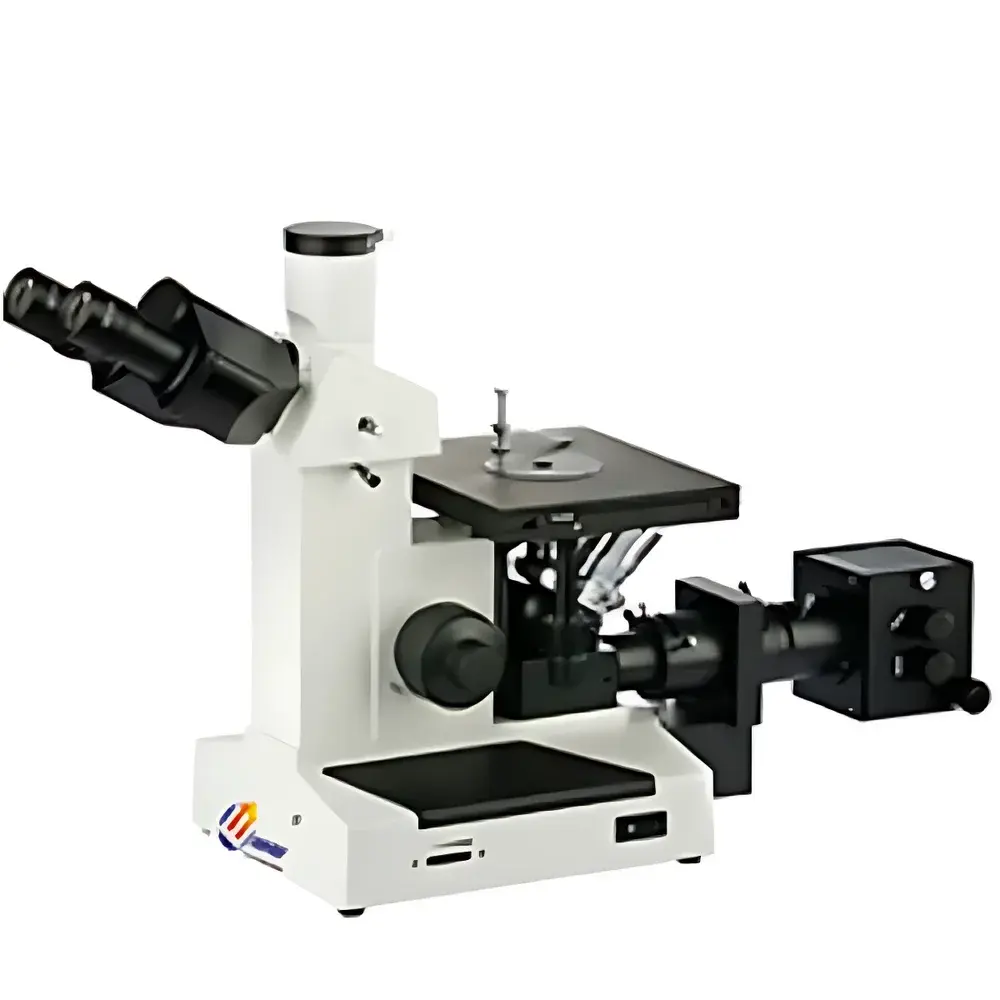
YANRUN 4XC Inverted Metallurgical Microscope
| Brand | YANRUN |
|---|---|
| Origin | Shanghai, China |
| Manufacturer Type | Direct Manufacturer |
| Product Type | Inverted |
| Total Optical Magnification | 100×–1000× (up to 1600× with optional eyepieces) |
| Eyepieces | 10× wide-field (18 mm field number), adjustable diopter |
| Objective Lenses | 10×/0.25, 20×/0.40, 40×/0.60, 100×/1.25 (oil immersion), working distances: 8.8 mm, 8.6 mm, 3.7 mm, 0.44 mm |
| Mechanical Tube Length | 160 mm |
| Coaxial Coarse/Fine Focus | 30 mm travel, fine focus graduation 2 µm |
| Stage | Dual-layer mechanical stage (180 × 150 mm), 15 × 15 mm travel range, aperture options: Ø10 mm / Ø20 mm |
| Illumination | Köhler illumination with 6 V / 20 W halogen lamp, continuously variable brightness |
| Power Input | 220 V / 50 Hz (optional 110 V / 60 Hz) |
| Compliance | Designed for ISO 9001-manufactured quality control environments |
Overview
The YANRUN 4XC Inverted Metallurgical Microscope is a precision-engineered optical instrument designed for routine and advanced microstructural analysis of opaque, polished metallographic specimens. Its inverted configuration places the objective lenses beneath the specimen stage—enabling stable, vibration-resistant observation of large, heavy, or irregularly shaped samples (e.g., castings, welds, heat-treated components) without requiring complex mounting fixtures. Built around a rigid 160 mm mechanical tube length optical system, the microscope adheres to classical finite-conjugate optics principles, ensuring compatibility with standardized metallurgical objectives and facilitating reproducible magnification calibration across laboratories. The system delivers diffraction-limited resolution at all standard magnifications (100×–1000×), with optional configurations extending usable magnification to 1600× while maintaining adequate depth-of-field and contrast for phase identification, grain size measurement, inclusion analysis, and defect characterization in ferrous and non-ferrous alloys.
Key Features
- Inverted trinocular head with 30° inclined viewing angle and interpupillary adjustment (53–75 mm), supporting ergonomic long-duration inspection and simultaneous visual observation plus camera coupling.
- Wide-field 10× eyepieces (18 mm field number) with individual diopter correction—ensuring consistent focus alignment across users and reducing observer fatigue during QC shift work.
- Four-parfocal, spring-loaded achromatic objectives (10×/0.25, 20×/0.40, 40×/0.60, 100×/1.25 oil) optimized for high-contrast brightfield imaging of etched and unetched metallic surfaces; numerical apertures and working distances are precisely matched to metallurgical sample thickness and cover-slip requirements.
- Coaxial coarse/fine focusing mechanism with 30 mm vertical travel and 2 µm fine-focus graduation—providing precise Z-axis positioning essential for serial sectioning, depth profiling, and focused ion beam (FIB) target verification.
- Dual-layer mechanical stage (180 × 150 mm footprint) with 15 × 15 mm translation range and interchangeable centering apertures (Ø10 mm and Ø20 mm)—accommodating standard 25 mm and 30 mm diameter metallographic mounts as well as custom-sized specimens.
- Köhler illumination system with 6 V / 20 W halogen source and continuous intensity control—delivering uniform, glare-free illumination critical for quantitative image analysis and compliance with ASTM E883 Annex A1 guidelines on illumination uniformity.
Sample Compatibility & Compliance
The 4XC is engineered for use with conventionally prepared metallurgical specimens: hot-pressed or cold-mounted samples ground, polished, and chemically or electrolytically etched per ASTM E407 or ISO 11272 standards. Its inverted geometry eliminates interference from mounting resins or clamping hardware during high-magnification examination. The microscope supports routine conformance testing under ISO 643 (steel grain size), ASTM E112 (grain size by planimetric method), and GB/T 6394 (Chinese national standard for metal grain size). While the base configuration does not include digital image capture hardware, its trinocular port meets DIN 58887 mechanical interface specifications, enabling seamless integration with third-party CCD/CMOS cameras certified for GLP-compliant documentation workflows.
Software & Data Management
As a hardware-only platform, the 4XC operates independently of proprietary software. Its optical design conforms to industry-standard C-mount (1″, 1.25× reduction) and F-mount adapter interfaces, allowing connection to validated imaging systems compliant with FDA 21 CFR Part 11 (electronic records/signatures) when deployed in regulated manufacturing environments. Users may integrate the microscope with commercial metrology software packages (e.g., Olympus Stream, Zeiss ZEN Core, or open-source Fiji/ImageJ) for grain size distribution histograms, phase fraction quantification, and automated inclusion counting—provided calibration is performed using NIST-traceable stage micrometers and verified per ISO/IEC 17025 procedures.
Applications
- Quality assurance of castings, forgings, and additive-manufactured metal parts—evaluating porosity, shrinkage cavities, and interdendritic segregation.
- Failure analysis of fractured components—identifying cleavage, ductile dimples, fatigue striations, and secondary cracking mechanisms.
- Heat treatment verification—assessing martensite/bainite/ferrite phase ratios, carbide morphology, and decarburization depth in tool steels and case-hardened alloys.
- Weld metal and HAZ (heat-affected zone) microstructure mapping—quantifying grain coarsening, precipitate distribution, and delta-ferrite content in stainless steel welds.
- Routine laboratory instruction and accreditation training—supporting ISO/IEC 17025 internal audits through traceable magnification verification and documented focus repeatability tests.
FAQ
Is the 4XC compatible with oil immersion objectives?
Yes—the 100× objective (NA 1.25) is specifically designed for use with immersion oil (Type A, n = 1.515) and includes a spring-loaded mechanism to prevent lens damage during contact with the specimen surface.
Can the microscope be adapted for polarized light observation?
The optical path supports retrofitting with a rotating polarizer/analyzer set (sold separately); however, no built-in polarization components are included in the standard configuration.
What electrical safety certifications does the unit meet?
The power supply complies with IEC 61010-1:2010 for laboratory electrical equipment, including overvoltage category II and pollution degree 2 ratings; CE marking applies to the EU market upon local importer declaration.
Does the stage support motorized XY control?
No—the stage is manually operated; motorized translation requires external OEM integration via standard M4 threaded mounting points and TTL-compatible step-motor drivers.
Is the 160 mm tube length compatible with modern infinity-corrected objectives?
No—the 4XC is a finite-conjugate system; infinity-corrected objectives will not achieve proper focus or aberration correction and are not recommended.




