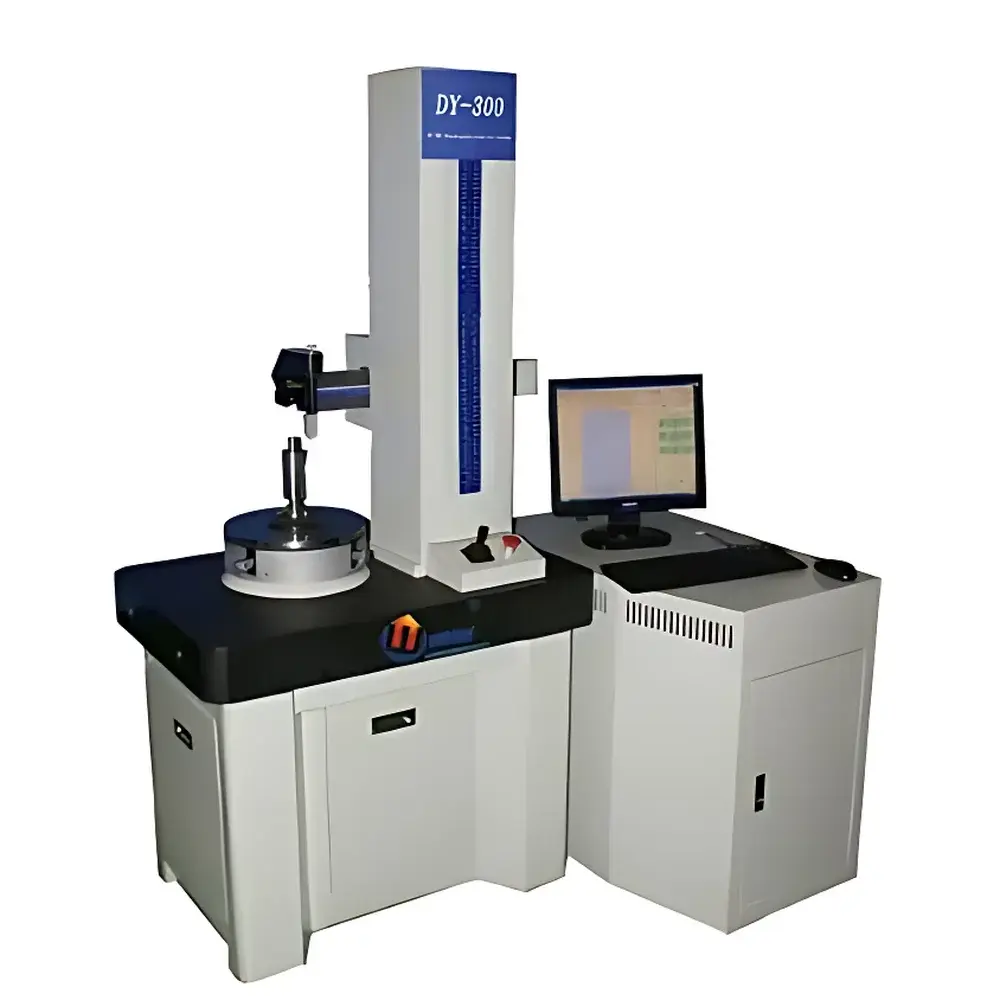
YANRUN DY-300 Cylindricity Measuring Instrument
| Brand | YANRUN |
|---|---|
| Origin | China |
| Manufacturer Type | Manufacturer |
| Model | DY-300 |
| Measurement Projects | Roundness, Cylindricity, Straightness (axis & end face), Parallelism, Perpendicularity, Coaxiality, Concentricity, Taper, Diameter, Radial Runout (single & total), Linearity of Cylindrical Generatrix, Flatness, Wall Thickness Variation, Angular Deviation, Short Arc Radius, Piston Profile |
| Spindle Rotational Accuracy | (0.03 + 0.0004H) µm |
| Bearing System | Air-bearing Vertical Column & Transverse Measurement System |
| Max. External Diameter | Φ300 mm |
| Column Height | 500 mm |
| Spindle Speed | 5 rpm |
| Radial Resolution | 0.01 µm |
| Radial Error | (0.03 + 0.0004H) µm |
| Axial Error | 0.06 µm |
| Z-Axis Straightness | 0.30 µm / 100 mm |
| Spindle–Z-Axis Parallelism | 0.45 µm / 100 mm |
| R-Axis Straightness | 0.5 µm / 100 mm |
| Min. Internal Diameter | Φ2.5 mm (Φ1.5 mm with optional micro-probe) |
| Max. Height | 500 mm |
| Load Capacity | 70 kg |
| Table Diameter | 300 mm |
| Horizontal Probe Travel (R-axis) | 220 mm |
Overview
The YANRUN DY-300 Cylindricity Measuring Instrument is a high-precision, air-bearing-based geometric metrology system engineered for comprehensive form and position error evaluation of rotational and quasi-rotational components. Operating on the principle of ultra-stable rotational scanning combined with high-resolution radial displacement sensing, the instrument captures point-cloud data along cylindrical surfaces, end faces, and discrete axial sections to compute ISO 1101-compliant geometric tolerances—including cylindricity, roundness, straightness, coaxiality, and total runout. Its core measurement architecture integrates a vertically aligned air-bearing spindle with sub-micron rotational fidelity and a motorized Z-axis column enabling synchronized vertical traversal. The system is designed for laboratory-grade calibration environments and production-integrated quality control labs where traceable, repeatable assessment of critical rotating parts—such as hydraulic pistons, bearing races, turbine shafts, valve bodies, and precision bushings—is required under controlled thermal and vibration conditions.
Key Features
- Air-bearing vertical column and transverse measurement carriage ensure frictionless, non-contact motion with exceptional long-term stability and zero mechanical wear—critical for maintaining metrological integrity over thousands of measurement cycles.
- High-accuracy rotary axis with specified rotational error of (0.03 + 0.0004H) µm (where H = height in mm above base) enables reliable separation of part geometry from machine-induced harmonic errors via multi-step reversal or multi-position averaging techniques.
- German HEIDENHAIN angular encoders integrated into the spindle drive deliver absolute angular positioning resolution better than 0.001°, supporting precise sector-based analysis and harmonics decomposition up to 50th order.
- Modular probe configuration supports interchangeable ruby-tipped styli ranging from standard 2 mm diameter down to 0.5 mm for internal diameters as small as Φ1.5 mm (with optional micro-probe kit), accommodating both macro- and micro-geometric features.
- Windows-based proprietary metrology software provides real-time graphical rendering of measured profiles, automatic tolerance zone evaluation per ASME Y14.5 and ISO GPS standards, and configurable report templates compliant with internal audit and external accreditation requirements.
- Full kinematic decoupling between Z-axis translation and R-axis radial movement minimizes Abbe error contributions, while linear scale feedback ensures traceable positioning accuracy across the full 220 mm horizontal probe travel range.
Sample Compatibility & Compliance
The DY-300 accommodates workpieces with external diameters up to Φ300 mm and heights up to 500 mm, supporting weights up to 70 kg. It accepts both continuous and interrupted cylindrical geometries—including stepped shafts, flanged housings, and segmented rings—with dedicated algorithms for gap interpolation and discontinuity masking. Measurement protocols align with ISO 12181 (roundness), ISO 12180 (cylindricity), ISO 1101 (geometrical tolerancing), and ASTM E1155 (flatness). The system’s error budget, documented per ISO 10360-3, supports uncertainty statements suitable for ISO/IEC 17025-accredited laboratories. All measurement data include embedded timestamps, operator IDs, environmental condition tags (optional temperature/humidity input), and full audit trails—enabling compliance with GLP and GMP documentation practices.
Software & Data Management
The instrument operates under a Windows 10/11-compatible metrology suite featuring dual-mode operation: guided wizard-driven workflows for routine inspection and advanced scriptable mode for custom GD&T evaluation sequences. Raw point data are stored in vendor-neutral ASCII CSV format with metadata headers, ensuring interoperability with third-party statistical process control (SPC) platforms and enterprise MES systems. Harmonic analysis includes amplitude spectrum, phase angle mapping, and waveband filtering (e.g., roughness vs. waviness separation per ISO 16610-21). All reports generate PDF outputs with embedded digital signatures, revision-controlled templates, and configurable pass/fail thresholds. Software validation documentation—including IQ/OQ protocols and 21 CFR Part 11 readiness assessment—is available upon request for regulated industries.
Applications
- Automotive: Cylinder bore distortion analysis, piston ring groove roundness verification, crankshaft journal cylindricity certification.
- Aerospace: Turbine blade root profile conformity, actuator housing coaxiality, landing gear pin straightness assessment.
- Hydraulics & Pneumatics: Valve spool taper uniformity, sleeve bore concentricity, port plate flatness and surface discontinuity detection.
- Medical Devices: Orthopedic implant stem geometry, dental abutment taper consistency, syringe barrel cylindricity for leak testing correlation.
- Tooling & Molds: Injection mold cavity roundness, extrusion die land geometry, thread plug gauge calibration support.
FAQ
What standards does the DY-300 comply with for geometric tolerance evaluation?
The system implements algorithms conforming to ISO 1101, ISO 12180-1/-2, ISO 12181-1/-2, and ASME Y14.5–2018 for form and orientation tolerances, with traceability verified against NIST-traceable step gauges and master cylinders.
Can the DY-300 measure internal diameters less than Φ2.5 mm?
Yes—using the optional micro-probe kit with 0.5 mm ruby stylus, the instrument achieves reliable measurement down to Φ1.5 mm internal diameter, subject to part accessibility and surface finish constraints.
Is the software validated for use in FDA-regulated environments?
The platform supports 21 CFR Part 11 compliance through user authentication, electronic signature capture, and immutable audit logs; formal validation packages (IQ/OQ/PQ) are available for deployment in pharmaceutical and medical device manufacturing settings.
How is thermal drift compensated during extended measurements?
The system incorporates ambient temperature monitoring inputs; users may apply ISO 230-3–based thermal error correction coefficients to Z- and R-axis positional data during post-processing.
Does the DY-300 support automated batch reporting for production line integration?
Yes—the software includes COM/ActiveX interfaces and configurable OPC UA connectivity for seamless integration with factory automation systems and SPC dashboards.