
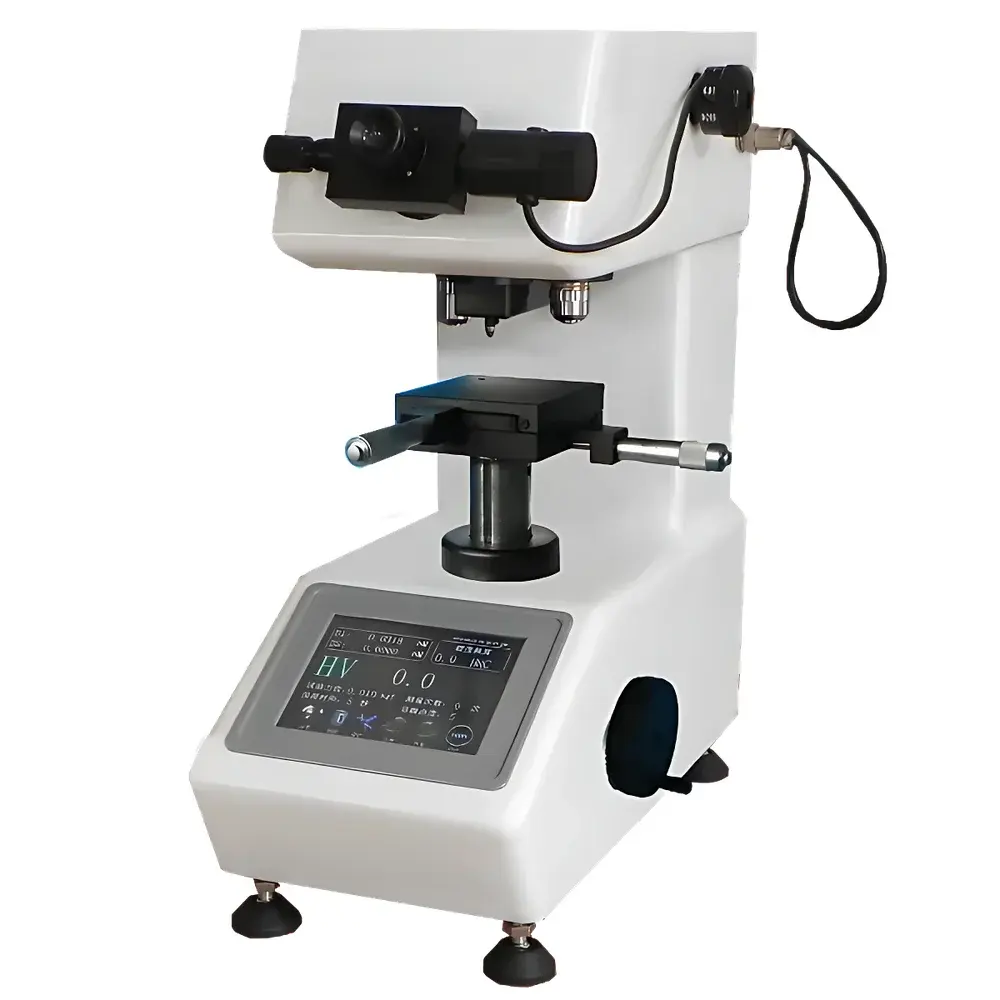
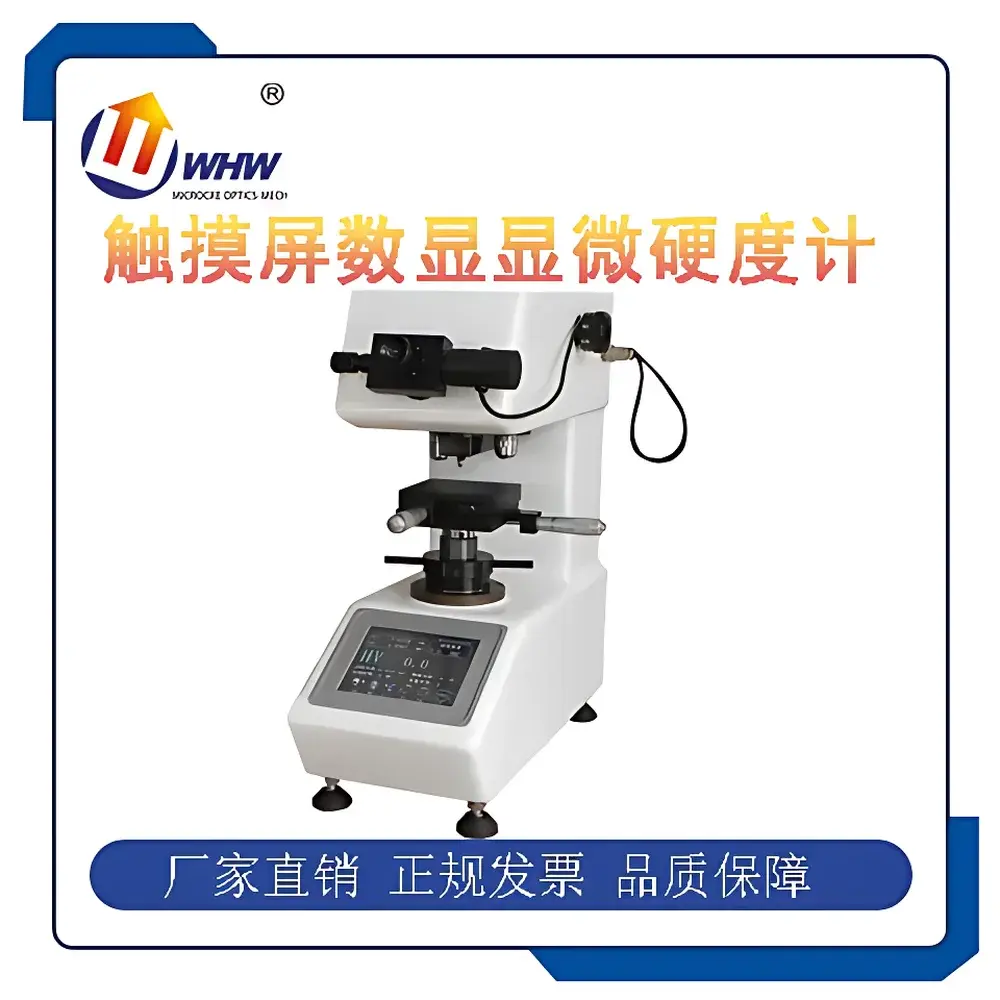
YANRUN HVS-1000M Touchscreen Digital Microhardness Tester
| Brand | YANRUN |
|---|---|
| Origin | Shanghai, China |
| Manufacturer Type | Direct Manufacturer |
| Instrument Type | Microhardness Tester |
| Model | HVS-1000M |
| Measurement Range | 0.001–6000 HV |
| Test Forces | 10, 25, 50, 100, 200, 300, 500, 1000 gf |
| Standards Compliance | GB/T 4340 |
| Optical Magnifications | 100× and 400× (dual-scale measurement) |
| Minimum Detectable Indentation Resolution | ~0.013 µm at 400× |
| X-Y Stage Travel | 25 × 25 mm |
| Max Specimen Height | 65 mm |
| Data Storage | Up to 60 test records onboard |
| Integrated Thermal Printer | Yes |
| Power Supply | AC 220 V / 50 Hz |
Overview
The YANRUN HVS-1000M Touchscreen Digital Microhardness Tester is a precision-engineered instrument designed for quantitative micro-scale hardness evaluation of metallic, ceramic, thin-film, and brittle materials using the Vickers and Knoop indentation methods. It operates on the principle of static indentation under controlled load application, where a diamond pyramid indenter (Vickers) or rhombic-based pyramidal indenter (Knoop) is pressed into the specimen surface for a defined dwell time. The resulting diagonal lengths of the residual impression are optically measured and converted into hardness values (HV or HK) via standardized geometric algorithms per ISO 6507-1, ASTM E384, and GB/T 4340.1. Its dual-magnification optical system (100× and 400×), coupled with a high-resolution digital encoder-based measurement path, ensures traceable, repeatable, and operator-independent results—critical for quality control in metallurgy, thin-film R&D, coating validation, and failure analysis laboratories.
Key Features
- 5.6-inch true-color resistive touchscreen interface with intuitive, menu-driven navigation inspired by industrial human-machine interaction paradigms—enabling rapid parameter setup, real-time test progress visualization, and direct on-device result review.
- Dual-scale optical measurement system: 100× (for coarse positioning and large-area screening) and 400× (for high-precision indentation metrology), both fully integrated into a rigid, monolithic optical train incorporating objective lens, indenter turret, illumination path, and CCD coupling.
- Automated force application cycle: fully programmable loading, dwell (0–60 s, 1-s increments), and unloading—eliminating manual timing variability and ensuring compliance with ISO/ASTM dwell-time requirements.
- Digital encoder-based XY stage with mechanical resolution of 0.01 mm and 25 × 25 mm travel range; cross-table design supports precise repositioning for multi-point hardness mapping across heterogeneous microstructures.
- Modular turret configuration accommodating Vickers and optional Knoop indenters—enabling low-load (<100 gf) testing of thin coatings, nitrided layers, semiconductor wafers, and brittle ceramics without cracking or pile-up artifacts.
- Onboard data management: stores up to 60 complete test records—including load, dwell time, diagonal measurements, calculated HV/HK, conversion values, and timestamp—with integrated thermal printer for immediate hard-copy reporting.
Sample Compatibility & Compliance
The HVS-1000M is optimized for specimens with thicknesses ≥0.5 mm and surface roughness Ra ≤0.8 µm (per ASTM E384 recommendations). Its 110 mm indenter-to-chamber distance and 65 mm maximum specimen height accommodate standard metallographic mounts, wafer fragments, wire cross-sections (with optional fine-wire clamps), and miniature components. The instrument conforms to national and international standards including GB/T 4340.1–2012 (equivalent to ISO 6507-1), ASTM E384–22, and JIS Z 2244. All hardness conversions (HV ↔ HRC, HBW, HRN, etc.) follow ASTM E140–22 Annex A1 algorithms and are traceable to NIST-certified reference blocks supplied with the system. For regulated environments, raw measurement data—including encoder pulses, load profile logs, and image metadata—can be exported via USB for integration into GLP/GMP-compliant documentation workflows.
Software & Data Management
When paired with the optional HMAS (Hardness Measurement Analysis System) software suite, the HVS-1000M transforms into a semi-automated microhardness mapping platform. HMAS supports live camera feed synchronization, automated indentation detection via edge-enhanced image processing, statistical analysis (mean, SD, min/max, histogram), spatial hardness profiling (X-Y heatmaps), and export to CSV, PDF, or XML formats compatible with LIMS and ELN systems. Audit trail functionality—including user login, parameter change history, and result modification logs—meets FDA 21 CFR Part 11 requirements when deployed with electronic signature modules. All firmware updates and calibration routines are performed via secure USB interface without third-party service intervention.
Applications
- Case depth verification of carburized, nitrided, or induction-hardened steel components.
- Hardness gradient analysis across weld zones, clad layers, and diffusion-bonded interfaces.
- Mechanical property validation of PVD/CVD coatings (TiN, DLC, Al₂O₃) on substrates ranging from silicon to tool steel.
- Quality assurance of sintered tungsten carbide, silicon carbide, and other advanced ceramics.
- Microstructural characterization of grain boundary hardening in aluminum alloys and nickel-based superalloys.
- Routine QC in aerospace fastener manufacturing, medical implant production, and semiconductor packaging R&D.
FAQ
Does the HVS-1000M support Knoop hardness testing?
Yes—the instrument accepts optional Knoop indenters and calculates HK values using the same optical measurement engine and ASTM E384-compliant algorithms.
Is calibration traceable to national standards?
Each unit ships with two certified reference hardness blocks (low- and high-range), calibrated per ISO/IEC 17025-accredited procedures; certificate includes uncertainty budgets and expiration dates.
Can test data be exported for regulatory submission?
Raw encoder data, image thumbnails, and full test reports can be exported via USB in ASCII-delimited format; HMAS adds electronic signature and audit trail capabilities for 21 CFR Part 11 compliance.
What maintenance is required for long-term accuracy?
Annual verification of force transducer linearity, indenter geometry (via SEM inspection), and optical magnification fidelity is recommended; all adjustments are accessible via factory-mode diagnostics.
Is remote operation supported?
The HVS-1000M does not include Ethernet or Wi-Fi connectivity; however, HMAS software enables PC-based control and monitoring over USB 2.0, supporting centralized lab instrument management.



