
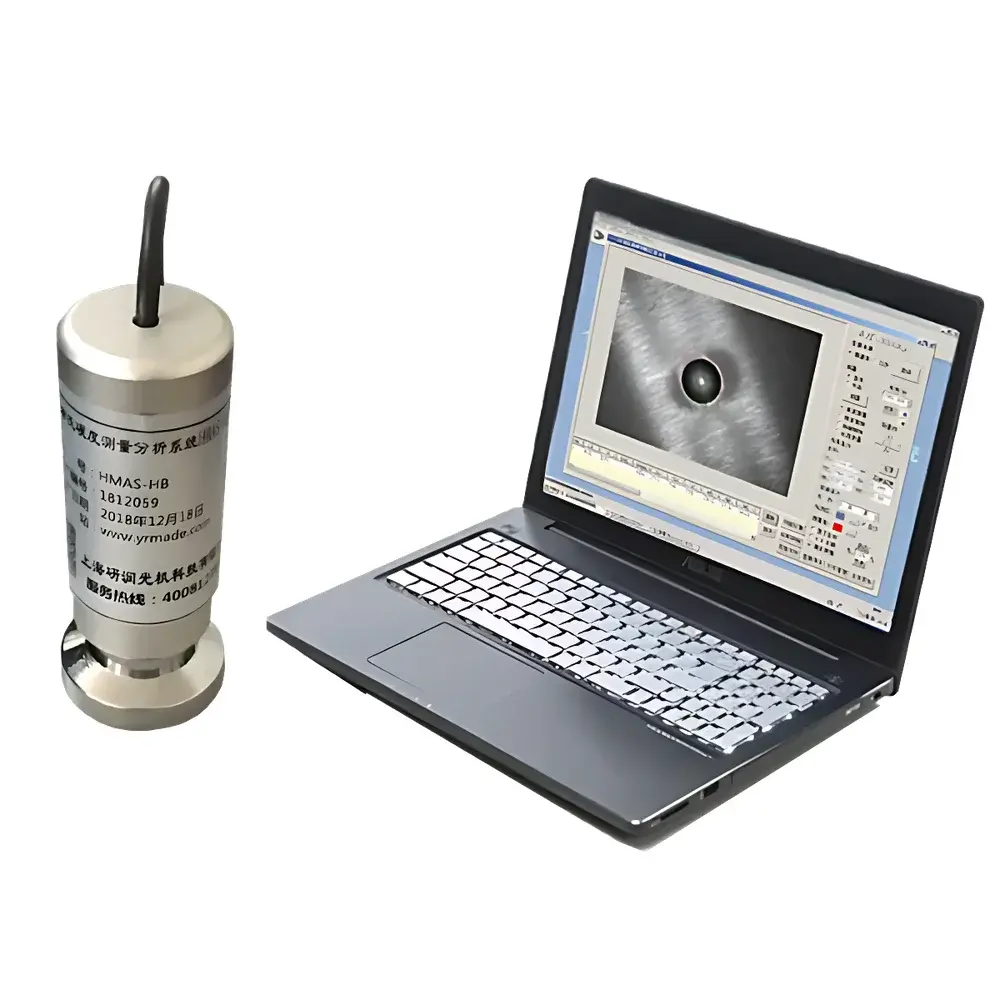
YANRUN HMAS-HB Portable Brinell Hardness Measurement and Analysis System
| Brand | YANRUN |
|---|---|
| Origin | Shanghai, China |
| Manufacturer Type | Manufacturer |
| Product Category | Domestic |
| Model | HMAS-HB |
| Instrument Type | Brinell Hardness Tester |
| Total Test Forces | 62.5, 100, 125, 187.5, 250, 500, 750, 1000, 1500, 3000 kgf |
| Measurement Resolution | 0.3 µm |
Overview
The YANRUN HMAS-HB is a portable, vision-based Brinell hardness measurement and analysis system engineered for field-deployable, high-reproducibility hardness evaluation of metallic and alloyed materials. Unlike conventional Brinell testers relying on manual optical microscope reading and empirical lookup tables, the HMAS-HB integrates digital image acquisition, automated indentation detection, and algorithm-driven hardness computation—operating on the fundamental Brinell principle: indentation diameter measurement under standardized static load (per ISO 6506-1 and ASTM E10). The system applies a hardened steel or tungsten carbide ball indenter to the test surface under precisely controlled test forces ranging from 62.5 to 3000 kgf, then captures the resulting spherical impression via an integrated coaxial optical path. Real-time image processing eliminates parallax error, operator fatigue, and subjective interpretation—enabling traceable, repeatable Brinell number (HBW) determination compliant with international metrological requirements.
Key Features
- Integrated optomechanical architecture: coaxial LED illumination, precision optical magnification lens, and high-resolution CMOS imaging sensor housed in a rigid aluminum-magnesium alloy chassis—optimized for shock resistance and thermal stability during on-site use.
- USB 2.0 high-speed interface: delivers both power and uncompressed image data over a single cable—no external power supply or battery required; fully compatible with Windows-based laptops and industrial tablets.
- Multi-level force compatibility: supports ten standard Brinell test loads (62.5–3000 kgf), enabling compliance with material-specific testing protocols across ferrous/non-ferrous alloys, castings, forgings, and heat-treated components.
- Sub-micron measurement resolution: 0.3 µm pixel-level calibration ensures accurate indentation diameter quantification—even on coarse-grained or lightly polished surfaces.
- Automated hardness conversion: real-time calculation of equivalent Rockwell (HRC/HRB), superficial Rockwell (HR15N/HR30T), Vickers (HV), Knoop (HK), and tensile strength (Rm) values per ISO 18265 and ASTM E140—without user interpolation or reference chart lookup.
Sample Compatibility & Compliance
The HMAS-HB is validated for flat, convex, or slightly curved metallic specimens ≥10 mm thick and ≥20 mm in diameter. Surface preparation must conform to ISO 6506-1: ground or fine-turned finishes with Ra ≤3.2 µm; no polishing required. The system meets mechanical and metrological requirements of GB/T 231.2 (Chinese national standard equivalent to ISO 6506-2), and its software architecture supports audit-ready documentation aligned with GLP and GMP environments. While the HMAS-HB itself is not a standalone hardness tester, it functions as a certified measurement module—its calibration traceability is maintained through NIST-traceable reference blocks (HBW 10/3000, HBW 5/750, etc.) and periodic verification per ISO/IEC 17025 procedures.
Software & Data Management
The proprietary HMAS software suite (v4.2+) operates under Windows 10/11 (64-bit) and provides full lifecycle data governance. It includes SPC-compliant statistical process control tools—X̄-R charts, Cp/Cpk indices, histogram distribution modeling, and outlier detection based on Grubbs’ test. All measurements are timestamped, user-ID logged, and stored with full metadata (load, dwell time, indenter type, specimen ID, environmental temperature). Reports export natively to PDF (ISO-compliant layout), Excel (.xlsx with raw pixel coordinates and calculated HBW), and Word (.docx with embedded annotated images). Audit trail functionality satisfies FDA 21 CFR Part 11 requirements when deployed with Windows domain authentication and electronic signature modules.
Applications
The HMAS-HB serves critical roles in quality assurance workflows where lab-bound benchtop hardness testers are impractical: incoming material inspection at foundry gates; in-process verification during heat treatment lines; post-weld hardness mapping on pipeline girth welds; failure analysis of turbine blades or rail components; and maintenance-level assessment of structural steel in offshore platforms or power generation facilities. Its portability and rapid setup (<90 seconds per measurement) make it especially suited for ISO 15630-3-compliant rebar hardness screening and ASTM A370 tensile-to-hardness correlation studies in fabrication yards.
FAQ
Is the HMAS-HB a standalone hardness tester?
No—it is a measurement and analysis module designed to interface with existing Brinell hardness testers (e.g., electronic or digital Brinell machines) that produce visible indentations meeting ISO 6506-1 geometry requirements.
Does the system require annual recalibration?
Yes—optical calibration using certified reference standards must be performed at least annually or after any mechanical impact; software validation should accompany each major OS or firmware update.
Can it measure curved surfaces?
Yes—within curvature radii ≥150 mm; concave surfaces require optional adapter fixtures to maintain perpendicular optical axis alignment.
What file formats does the software support for data exchange?
Raw image data (.tiff), measurement logs (.csv), and structured reports (.pdf, .xlsx, .docx) with embedded EXIF metadata and digital signatures.
Is remote support available for software troubleshooting?
Yes—via secure TLS-encrypted TeamViewer sessions with YANRUN’s application engineering team; firmware updates and patch releases are distributed through authenticated customer portal access.



