
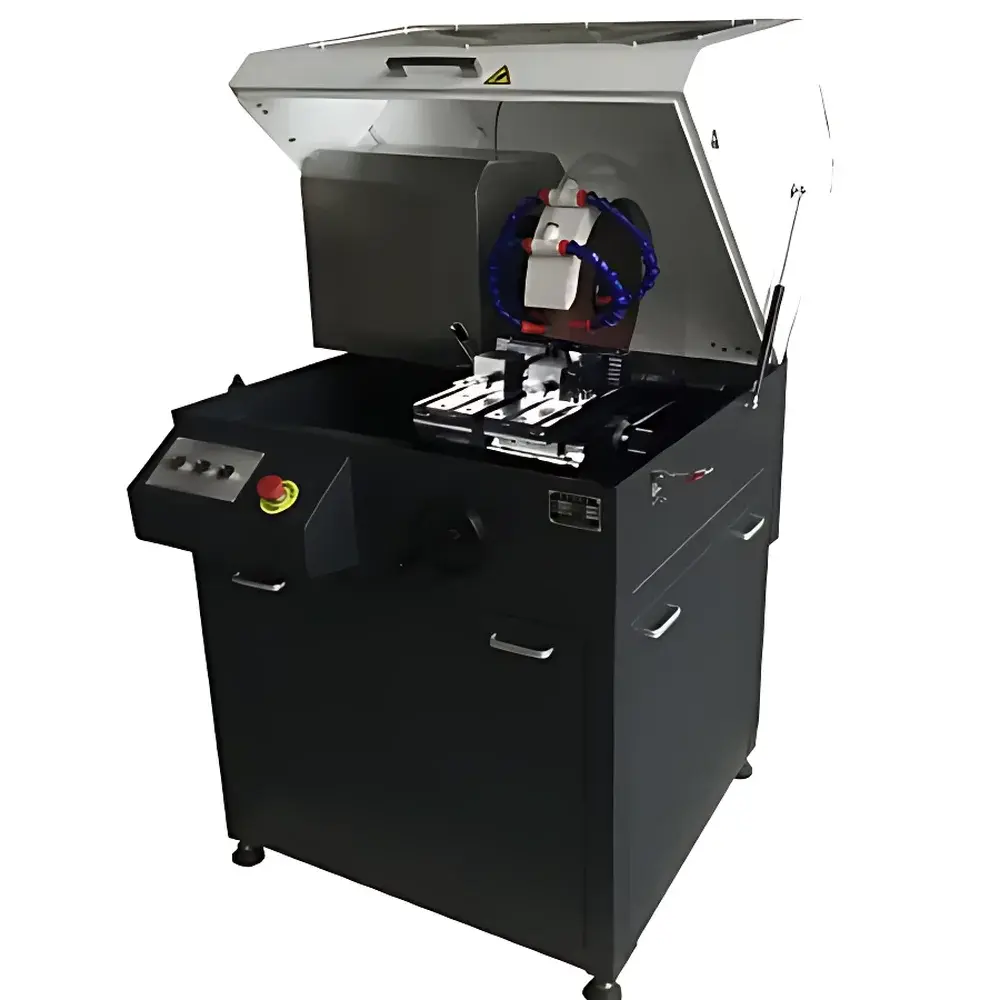
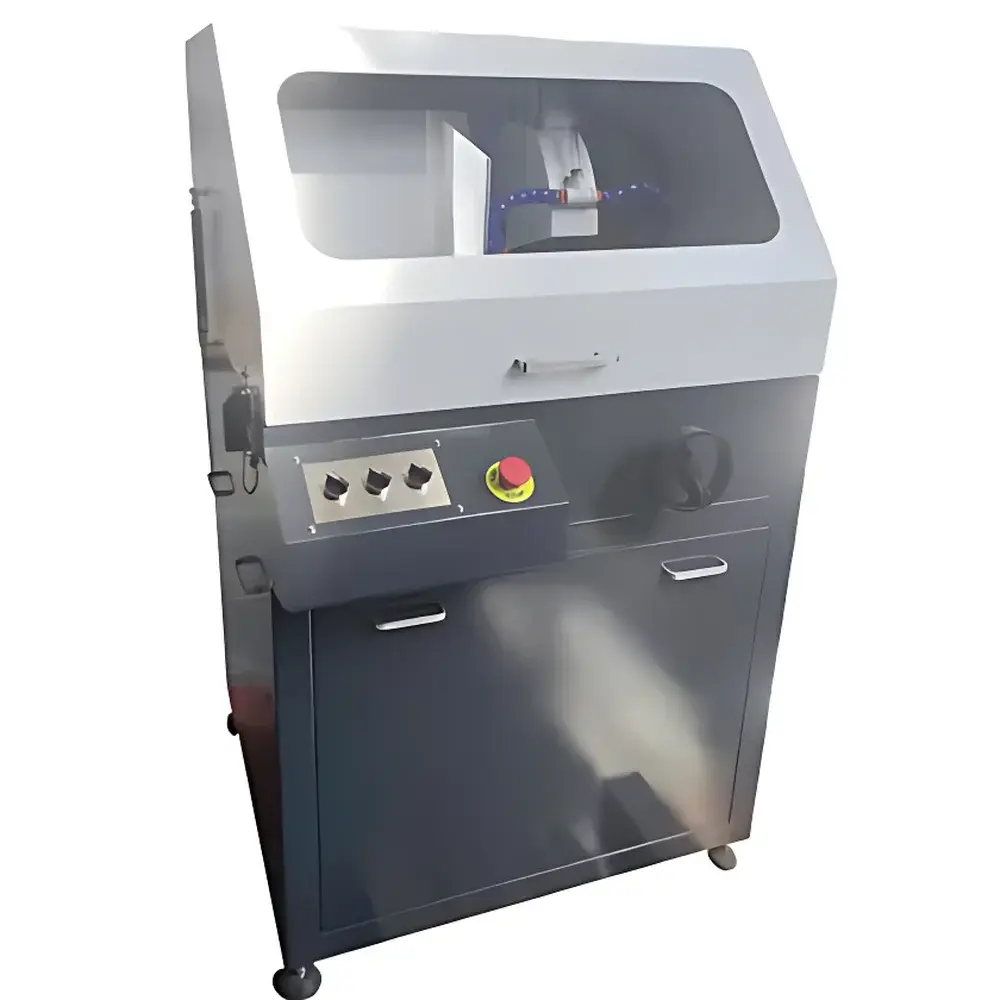
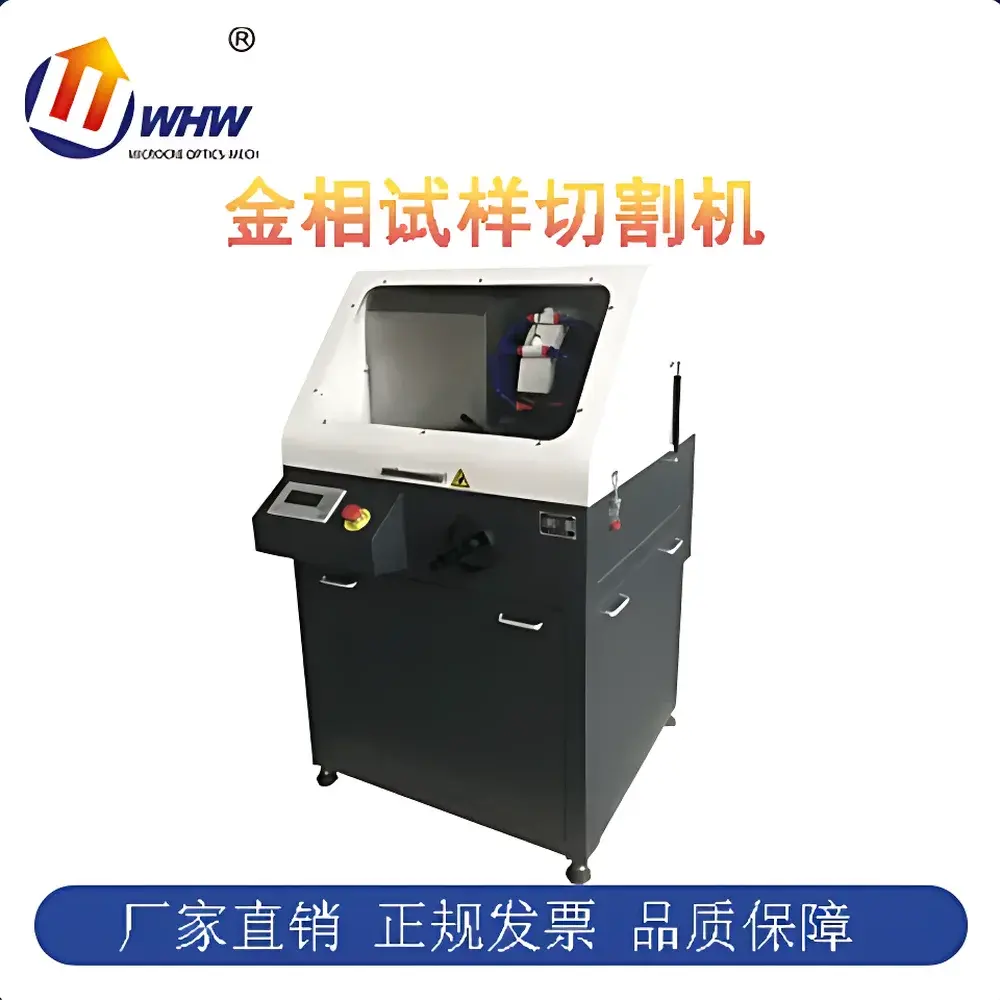
YANRUN QG-100 Manual Metallographic Cutting Machine
| Brand | YANRUN |
|---|---|
| Origin | Shanghai, China |
| Manufacturer Type | Direct Manufacturer |
| Country of Origin | China |
| Model | QG-100 |
| Instrument Type | Metallographic Cutting Machine |
| Spindle Speed | 2840 rpm |
| X-Axis Platform Travel | 50 mm |
| Y-Axis Platform Travel | 280 mm |
| Cutting Chamber | Enclosed |
| Max. Specimen Dimensions | 380 × 130 × 100 mm |
| Cutting Method | Manual |
| Effective Feed Distance | 250 mm |
| Cutting Table Size | 310 × 310 mm |
| Blade Specifications | (300–350) × 2.0–2.5 × 32 mm |
| Clamping System | Split-type Dual-layer Movable Precision Positioning Platform |
| Cooling System | Automated Three-channel Water Cooling |
| Water Tank Capacity | 120 L |
| Motor Power | 4.0 kW |
| Configuration | Floor-standing Integrated Design |
| Power Supply | 380 V AC |
| Net Weight | 300 kg |
Overview
The YANRUN QG-100 Manual Metallographic Cutting Machine is an engineered solution for precise, repeatable specimen sectioning in metallurgical, materials science, and quality control laboratories. Designed around the fundamental principle of controlled abrasive cutting under continuous coolant flow, the QG-100 employs a high-torque 4.0 kW motor driving a spindle at 2840 rpm to deliver consistent rotational energy to standard metallographic blades (300–350 mm diameter, 2.0–2.5 mm thickness, 32 mm arbor). Its enclosed cutting chamber ensures operator safety, minimizes aerosol dispersion, and maintains stable thermal conditions during extended operation—critical for preserving microstructural integrity in heat-sensitive alloys or coated specimens. The machine’s floor-standing integrated architecture provides mechanical stability essential for dimensional accuracy, while its rigid cast-iron base dampens vibration transmission that could otherwise compromise cut edge perpendicularity or surface finish.
Key Features
- Enclosed cutting chamber with interlocked safety door and transparent polycarbonate viewport for real-time process monitoring without exposure to rotating blade or coolant mist.
- Split-type dual-layer movable precision positioning platform enabling independent X-axis (50 mm travel) and Y-axis (280 mm travel) adjustment—facilitating both single-point sample placement and sequential multi-location sectioning on large or irregularly shaped specimens.
- Automated three-channel water cooling system with 120 L reservoir capacity, delivering regulated coolant flow directly to the blade–specimen interface to suppress localized heating, reduce thermal distortion, and extend abrasive wheel life.
- Manual feed mechanism with calibrated depth-stop and vernier-scale feed handle (250 mm effective feed distance), allowing tactile control over cutting rate and enabling fine-tuning for brittle ceramics, soft polymers, or layered composites.
- Standardized 310 × 310 mm cutting table compatible with ISO/ASTM-compliant clamping fixtures—including optional gear-rack, universal, longitudinal-section, and custom-engineered holders—to accommodate diverse specimen geometries from cylindrical rods to thin-sheet laminates.
Sample Compatibility & Compliance
The QG-100 supports preparation of specimens compliant with ASTM E3, ISO 14487, and GB/T 13298 for metallographic analysis. It accommodates metallic samples (ferrous/non-ferrous alloys, sintered powders), cemented carbides, ceramics, and composite materials within the maximum envelope of 380 × 130 × 100 mm. Its precision platform allows alignment to ±0.1 mm positional repeatability—sufficient for orientation-specific sectioning per ASTM E112 (grain size) or ASTM E1245 (inclusion rating). The enclosed design meets CE machinery directive requirements (2006/42/EC) for protection against mechanical hazards and fluid egress. While not inherently GLP/GMP-certified, the system’s mechanical traceability (calibrated feed scale, fixed spindle speed, documented coolant flow path) supports audit-ready documentation when integrated into validated laboratory workflows.
Software & Data Management
As a manually operated instrument, the QG-100 does not incorporate embedded software or digital control interfaces. All operational parameters—including feed position, blade rotation status, and coolant activation—are monitored and adjusted via analog indicators and mechanical controls. However, its design facilitates integration into broader laboratory data ecosystems: operators may log cutting parameters (specimen ID, blade type, feed rate, coolant temperature, cut duration) in LIMS-compatible spreadsheets or ELN platforms. Optional accessories such as digital micrometer stages or external thermal imaging probes can be deployed to augment metrological traceability where required by internal SOPs or regulatory review.
Applications
- Preparation of cross-sectional specimens for optical microscopy, SEM-EDS, and microhardness testing in R&D and production QA environments.
- Sectioning of failure analysis samples—including fracture surfaces, weld zones, and corrosion-affected regions—while minimizing artifact introduction.
- Serial sectioning of multi-layer coatings or brazed joints for interface characterization under ASTM F1160.
- High-volume batch cutting of standardized test coupons per ASTM A370 or ISO 6892-1 tensile bar preparation protocols.
- Custom specimen extraction from large castings or forged components where CNC-based sectioning is impractical due to size or geometry constraints.
FAQ
Is the QG-100 suitable for automated or programmable cutting sequences?
No—the QG-100 is a manually operated system. Feed advancement, specimen repositioning, and blade engagement are performed via handwheel and mechanical stops. For automated sequencing, consider YANRUN’s QG-100A semi-automatic variant with stepper-motor-assisted feed control.
Can the machine accommodate diamond-impregnated blades for ceramic or concrete samples?
Yes—blade mounting conforms to ISO 5211 flange standards. Users may install resin-bonded or metal-bonded diamond blades within the specified 300–350 mm diameter and 32 mm arbor range, provided coolant flow is optimized for abrasive wear mitigation.
What maintenance intervals are recommended for the three-channel cooling system?
Coolant level and clarity should be verified before each shift; the 120 L reservoir requires full replacement every 120 operating hours or quarterly—whichever occurs first—to prevent microbial growth and mineral scaling in recirculated lines.
Does the split-platform design support angular or angled cuts?
No—the X/Y axes provide orthogonal translation only. Angular sectioning requires pre-mounting specimens in custom jigs or using supplementary tilting fixtures (available as optional accessories).
Is electrical certification documentation available for international installation?
Yes—CE Declaration of Conformity, RoHS compliance statement, and IEC 60204-1 electrical safety certification are included in the technical documentation package shipped with each unit.



