
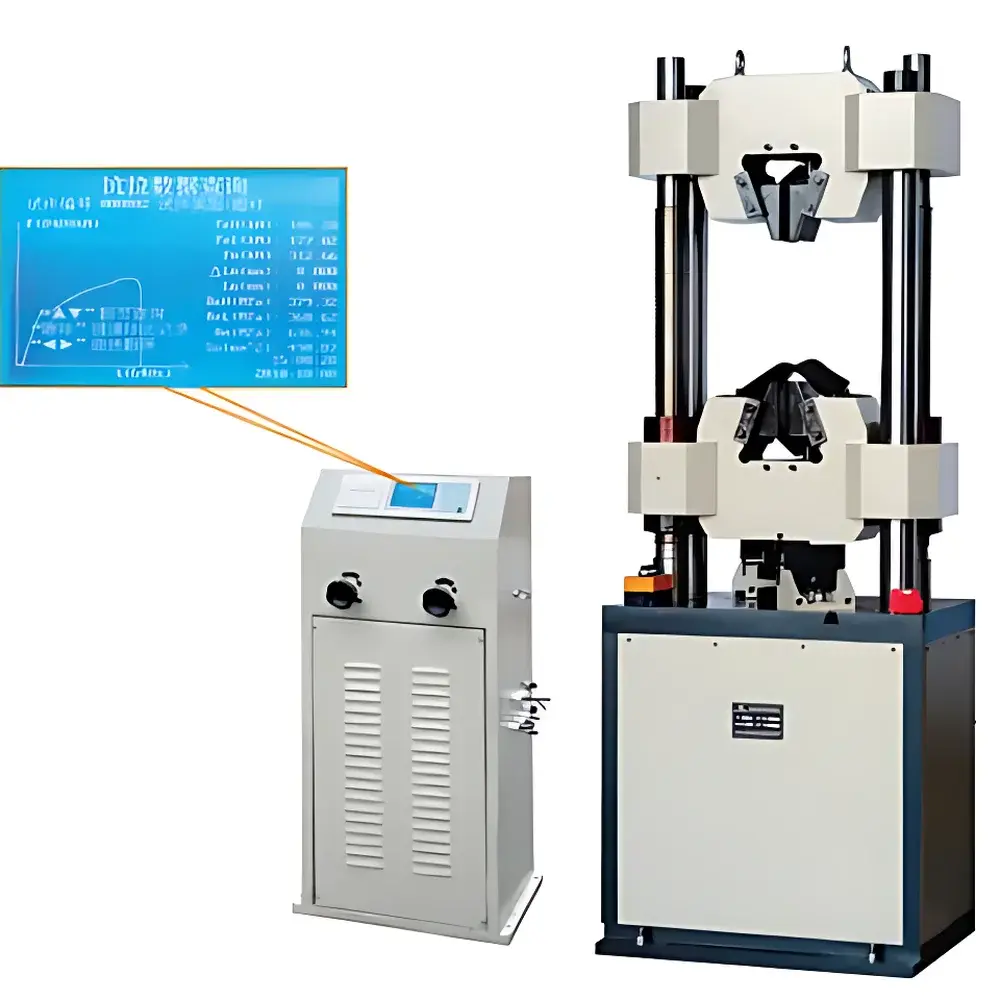
YANRUN WES100B/300B/600B Hydraulic Universal Testing Machine
| Brand | YANRUN |
|---|---|
| Origin | Shanghai, China |
| Manufacturer Type | Direct Manufacturer |
| Product Type | Hydraulic Universal Testing Machine |
| Model | WES100B / WES300B / WES600B |
| Max Test Force | 100 kN / 300 kN / 600 kN |
| Force Resolution | 0.01 kN |
| Force Accuracy | ≤ ±1% FS |
| Measuring Range | 4–100% FS (full-scale, 3-equivalent ranges) |
| Tensile Space | 550 mm / 550 mm / 650 mm |
| Compression Space | 380 mm / 380 mm / 380 mm |
| Specimen Gripping | Manual / Manual / Manual-Automatic Hybrid |
| Round Specimen Diameter Range | Φ6–26 mm / Φ6–26 mm / Φ13–40 mm |
| Flat Specimen Thickness Range | 0–15 mm / 0–15 mm (15–30 mm optional) / 0–15 mm |
| Flat Specimen Max Width | 70 mm / 70 mm / 75 mm |
Overview
The YANRUN WES100B/300B/600B Hydraulic Universal Testing Machine is a precision-engineered mechanical testing system designed for static tensile, compression, bending, and shear evaluation of metallic and non-metallic materials in accordance with international standards including ASTM E4, ASTM E8/E8M, ISO 6892-1, ISO 37, and GB/T 228.1. Its robust lower-platen hydraulic architecture features a bottom-mounted actuator cylinder, delivering high-stiffness load frame geometry optimized for structural stability during high-force testing. The machine operates on a closed-loop hydraulic principle: oil is drawn from the reservoir through a filtration mesh, pressurized by a fixed-displacement gear pump, and directed via a manually operated servo-valve into the main test cylinder—enabling precise control of loading rate and force hold. Load application is mechanically transmitted through a chain-and-screw-driven crosshead positioning system, ensuring repeatable alignment and minimal parasitic moments during specimen deformation.
Key Features
- Lower-actuator frame design minimizes overall height and footprint—ideal for constrained laboratory or field-based construction QA/QC environments.
- High-resolution electronic load measurement with 0.01 kN digital resolution and ≤ ±1% full-scale accuracy across 4–100% FS range—calibration traceable to national metrology institutes.
- Dual-stage safety protection: hardware-based overload cutoff (triggered at >103% FS) and mechanical upper-limit travel stop—both directly interrupting pump motor power supply.
- Integrated LCD controller displays real-time load–time curves, peak load, yield point detection (for materials exhibiting distinct yield plateaus), and calculated mechanical properties including ultimate tensile strength (UTS), yield strength (Rp0.2 or ReH/ReL), and modulus of elasticity.
- Modular gripping configuration: manual wedge-action grips for round and flat specimens; optional automatic hydraulic clamping available on WES600B for enhanced repeatability in high-volume production testing.
- Customizable frame color and optional accessories—including shear fixtures, concrete compression platens (150 × 150 mm or 200 × 200 mm), and weldment testing adapters—support multi-standard compliance workflows.
Sample Compatibility & Compliance
The WES-B series accommodates a broad spectrum of standardized and non-standard specimens per ISO 6892-1 Annex A, ASTM E8 Annex A1, and GB/T 228.1 Clause 6. Round specimens up to Φ40 mm (WES600B) and flat specimens up to 75 mm wide × 15 mm thick (standard) or 30 mm thick (optional) are supported. With appropriate fixtures, the system performs compression tests on concrete cylinders (150 × 300 mm), cement mortar prisms, plastic injection-molded bars, and composite laminates. All configurations comply with GLP documentation requirements when paired with optional audit-trail-enabled data export protocols. While the base system does not include FDA 21 CFR Part 11-compliant software, third-party validated data acquisition modules can be integrated to meet regulated pharmaceutical or medical device material qualification needs.
Software & Data Management
The embedded microcontroller supports direct input of specimen geometry (cross-sectional area, gauge length), automatic calculation of engineering stress–strain curves, and storage of up to 500 test records internally. Data export is enabled via RS232 serial interface to external PCs running Windows-compatible spreadsheet or LIMS software. Optional USB data logger modules provide timestamped CSV output compatible with Excel, MATLAB, and statistical process control (SPC) platforms. All displayed parameters—including load, displacement, time, and derived metrics—are stored with 10 Hz sampling resolution. System firmware supports user-defined test sequences (e.g., preload → ramp → hold → unload) and permits manual override at any stage for method development or failure analysis.
Applications
- Mechanical property verification of structural steel, rebar, and welded joints in civil engineering projects.
- Quality assurance of fasteners, chains, cables, and anchor systems per ISO 898-1 and ASTM F568M.
- Compression testing of concrete, asphalt, and geopolymer composites per ASTM C39/C39M and EN 12390-3.
- Validation of polymer tensile behavior—including thermoplastics, elastomers, and fiber-reinforced composites—under controlled strain rates.
- Educational use in university materials science labs for hands-on instruction in stress–strain fundamentals, ductile/brittle transition analysis, and fracture mechanics principles.
FAQ
What standards does the WES-B series comply with for tensile testing?
The system meets core requirements of ASTM E8/E8M (metals), ISO 6892-1 (metallic materials), and GB/T 228.1 (Chinese national standard), supporting both proportional and non-proportional specimen geometries.
Is hydraulic oil maintenance required, and what grade is recommended?
Yes—regular inspection and annual replacement of ISO VG 46 anti-wear hydraulic oil (e.g., Shell Tellus S2 MX 46 or equivalent) are essential for long-term valve and pump integrity.
Can the machine perform cyclic or fatigue testing?
No—the WES-B series is configured exclusively for quasi-static monotonic loading. For dynamic or low-cycle fatigue applications, a dedicated electro-hydraulic servo system (e.g., MTS or Instron 8800 series) is required.
What is the typical calibration interval and traceability path?
Annual calibration is recommended, using certified deadweight standards traceable to NIM (China National Institute of Metrology) or NIST-equivalent bodies. Calibration certificates include uncertainty budgets per ISO/IEC 17025.
Is remote diagnostics or service support available internationally?
YANRUN provides remote firmware updates and troubleshooting via secure VPN-assisted desktop sharing; on-site technical support is coordinated through authorized regional partners in Southeast Asia, the Middle East, and Latin America.



