
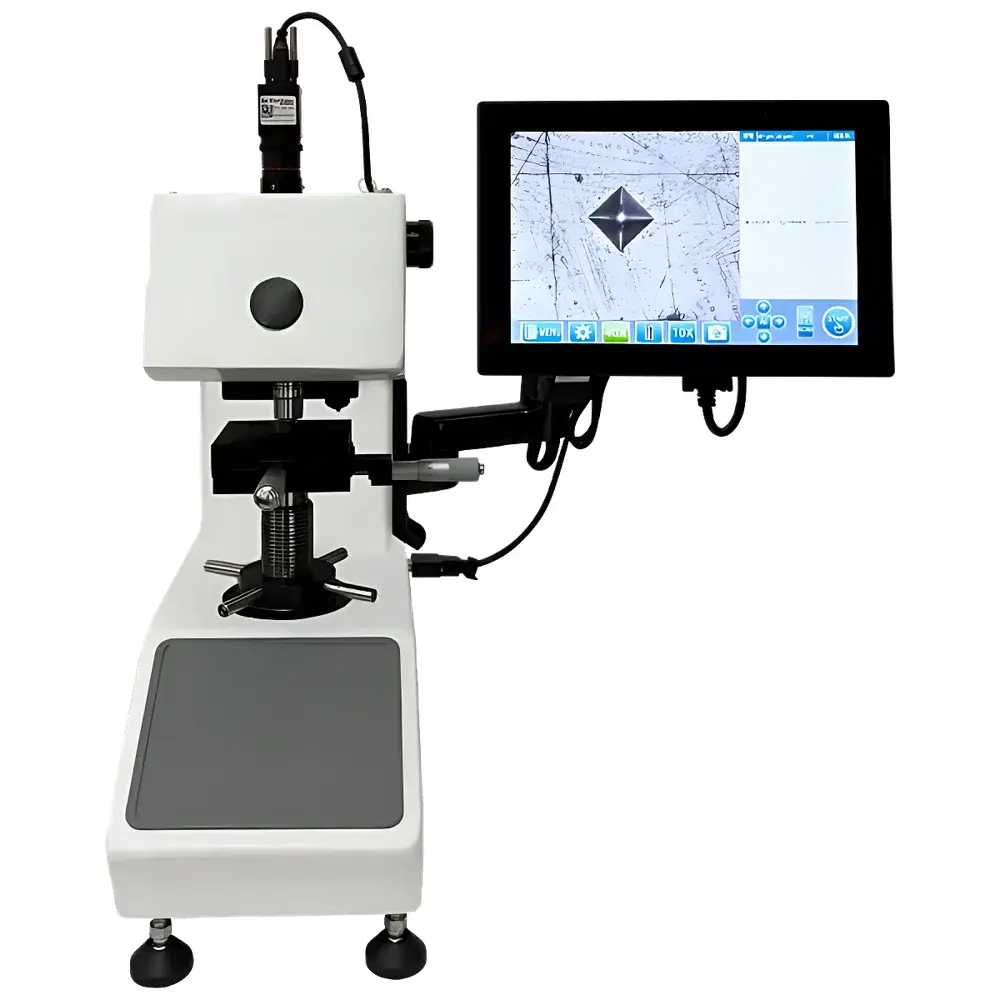
YANRUN HV-C5/10/30/50VE10Z Automated Vision-Based Vickers Hardness Tester
| Brand | YANRUN |
|---|---|
| Origin | Shanghai, China |
| Manufacturer Type | Manufacturer |
| Model | HV-C5/10/30/50VE10Z |
| Hardness Tester Type | Vickers Hardness Tester |
| Measuring Range | 8–3000 HV |
| Test Forces | 0.2–50 kgf (selectable in six steps per load range) |
| Objective Lenses | 10× (observation), 20× (measurement) for 5/10 kgf models |
| Total Magnification | 100× (observation), 200× (measurement) for 5/10 kgf |
| Minimum Detectable Indentation Resolution | 0.16 µm (10×), 0.08 µm (20×) |
| Indentation Dwell Time | 0–60 s (1 s increments) |
| Max Specimen Height | 230 mm |
| Distance from Indenter Center to Chamber Wall | 130 mm |
| Power Supply | AC 220 V / 50 Hz |
| Dimensions (L×W×H) | 580 × 375 × 800 mm |
| Net Weight | 47.0 kg |
| Compliance | GB/T 4340, ISO 6507 |
Overview
The YANRUN HV-C5/10/30/50VE10Z is an automated vision-based Vickers hardness tester engineered for precision metallurgical and materials science laboratories requiring traceable, repeatable micro- and macro-hardness measurements. It operates on the fundamental principle of Vickers indentation—applying a precisely controlled diamond pyramid indenter (136° apex angle) under defined test forces (0.2–50 kgf), followed by optical measurement of the resulting diagonal impressions on polished specimen surfaces. The system integrates a high-stability mechanical frame with a motorized turret, dual-magnification optical path, and embedded tablet-based control interface to deliver full automation of loading, dwell, unloading, and digital image capture—all compliant with ISO 6507-1 and GB/T 4340.1 standards for Vickers hardness testing.
Key Features
- Motorized triple-objective turret: Supports up to three objectives simultaneously (standard configuration includes 10× observation and 20× measurement lenses for 5/10 kgf models; 10× lens only for 30/50 kgf models), enabling rapid switching between observation and measurement modes without manual alignment.
- Fully automated test cycle: Integrated load-cell feedback and closed-loop force control ensure accurate application, dwell (0–60 s adjustable in 1 s increments), and unloading across six selectable test forces within each load range (e.g., 0.2, 0.3, 0.5, 1, 3, 5 kgf for the 5 kgf model).
- Optimized optical architecture: Large-diameter trinocular optical path achieves near 100% light transmission efficiency; LED illumination remains active only during imaging to extend service life while maintaining consistent color temperature and intensity.
- High-resolution digital indentation analysis: Tablet-integrated software performs sub-pixel edge detection using floating-point arithmetic algorithms, reducing systematic deviation between measured diagonals and theoretical values—critical for calibration verification and inter-laboratory comparison.
- Modular expandability: Optional motorized XY stage (custom-engineered per application), PC-based advanced analysis software (supporting statistical process control, report generation, and database export), and GLP-compliant audit trail modules enable progressive upgrade to semi-automated or fully integrated QA/QC workflows.
Sample Compatibility & Compliance
The HV-C5/10/30/50VE10Z accommodates specimens up to 230 mm in height and 130 mm from indenter center to chamber interior wall—suitable for heat-treated steels, carbide tooling, thin coatings (with appropriate support), sintered ceramics, and welded joints. All hardness values are calculated and reported in accordance with ISO 6507-1:2018 and GB/T 4340.1–2012, including mandatory corrections for surface curvature, elastic recovery, and non-perpendicular loading. The instrument supports traceable calibration via certified reference blocks (e.g., NIST SRM 1901b, BCR-434) and meets requirements for internal audit documentation under ISO/IEC 17025-accredited testing laboratories.
Software & Data Management
The embedded Android-based tablet interface provides real-time display of load curve, indentation image, diagonal measurements, and final HV value with uncertainty estimation. Raw image files (TIFF, 12-bit depth), metadata (test force, dwell time, operator ID, timestamp), and calculation logs are stored locally and exportable via USB or network share. Optional PC software adds features including multi-sample batch reporting (PDF/Excel), statistical trend analysis (X-bar R charts), SPC alert thresholds, and 21 CFR Part 11-compliant electronic signatures and audit trails—enabling deployment in regulated environments such as medical device manufacturing or aerospace component QA.
Applications
This system is routinely deployed in metallurgical R&D labs for phase hardness mapping of duplex stainless steels; in automotive powertrain facilities for case-depth verification of nitrided crankshafts; in academic materials science programs for correlating heat treatment parameters with nanoindentation-derived yield strength; and in third-party certification labs performing hardness validation per ASTM E384 (microhardness) and ISO 6507-2 (verification of hardness testers). Its dual-magnification capability ensures reliable measurement of both coarse-grained cast irons (at 100×) and fine precipitates in aluminum alloys (at 200×), while the 0.08 µm resolution at 20× enables detection of sub-5 µm indentations—essential for thin-film and coating characterization.
FAQ
What standards does this instrument comply with?
It conforms to ISO 6507-1:2018, GB/T 4340.1–2012, and supports verification procedures outlined in ISO 6507-2.
Can the system be integrated into a laboratory information management system (LIMS)?
Yes—via optional PC software with configurable CSV/XML export and REST API support for bidirectional data exchange.
Is calibration traceability provided?
Factory calibration uses NIST-traceable reference blocks; users may perform periodic verification using certified hardness standards (e.g., BCR-434 series).
What maintenance is required for long-term accuracy?
Annual verification of load cell linearity, indenter geometry (via SEM), and optical magnification factor is recommended per ISO 6507-3 guidelines.
Does the instrument support automatic focus or Z-height compensation?
No—focus is manually adjusted via coaxial coarse/fine knobs; however, the rigid mechanical design and stable base minimize drift during extended test sequences.



