
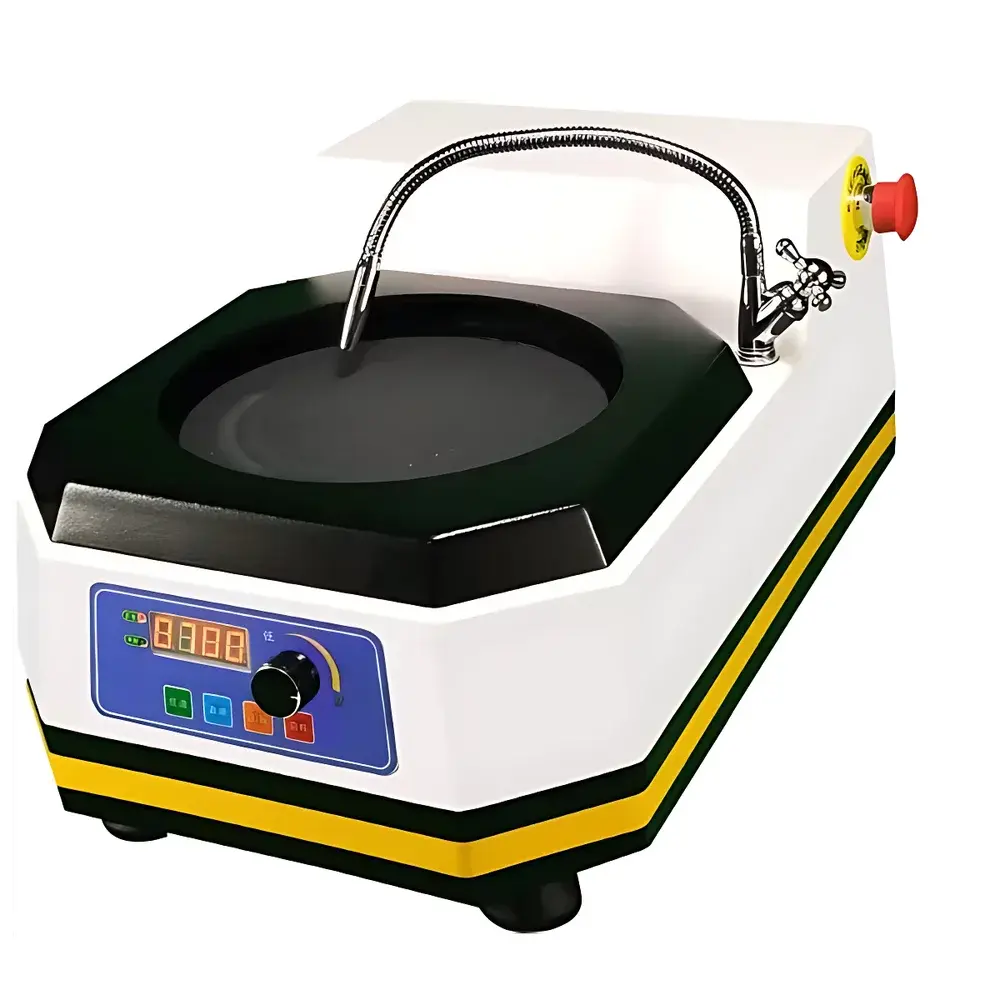
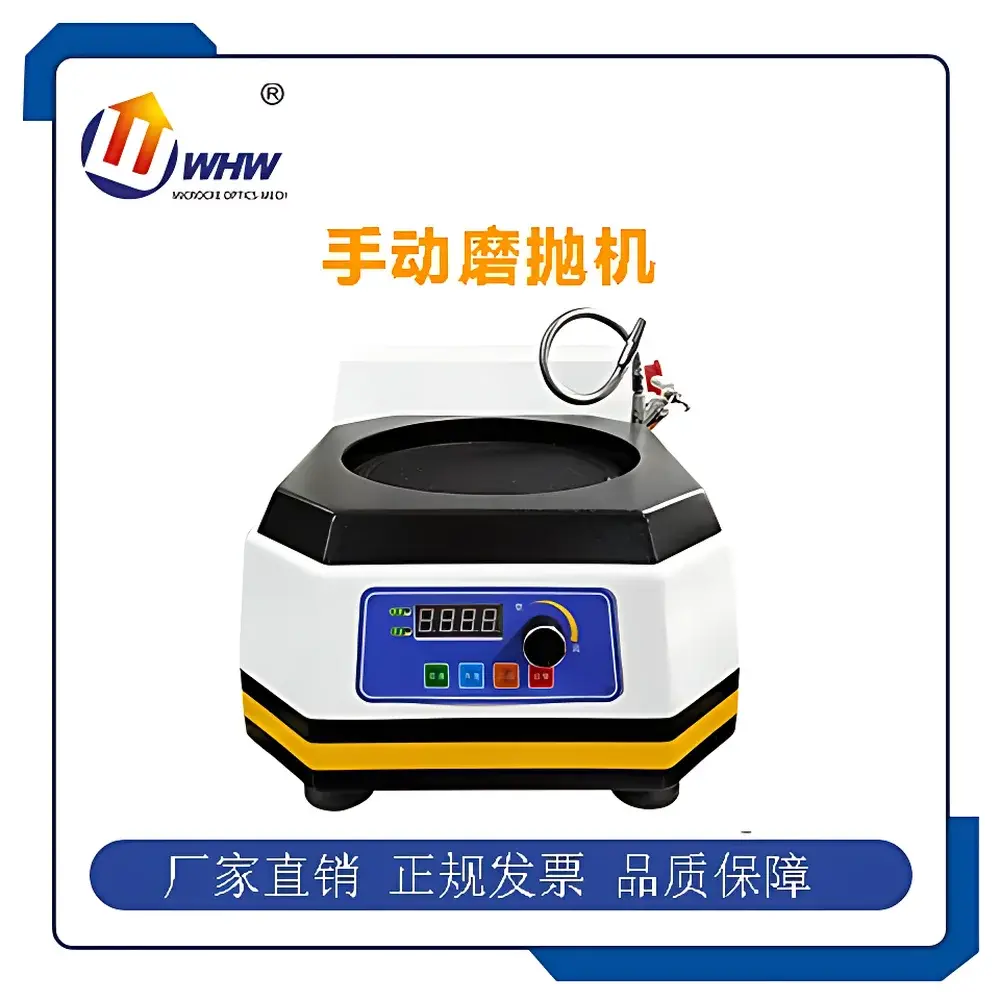
YANRUN MPD-1S Single-Disc Metallographic Grinding and Polishing Machine
| Brand | YANRUN |
|---|---|
| Origin | Shanghai, China |
| Manufacturer Type | Direct Manufacturer |
| Region of Origin | Domestic (China) |
| Model | MPD-1S |
| Speed Range | 50–1500 rpm (Infinitely Variable + Dual Fixed Speeds: 700 rpm Low / 1400 rpm High) |
| Platen Diameter | φ230 mm |
| Number of Platens | 1 |
| Motor Power | 750 W (Servo Motor, Torque: 2.39 N·m) |
| Dimensions (W×D×H) | 340 × 500 × 250 mm |
| Voltage | 220 V AC |
| Water Control | 360° Rotatable Faucet with Sealed Inlet/Outlet System |
| Housing Material | ABS Injection-Molded Enclosure |
| Control Mode | Independent Single-Platen Control |
| Rotation Direction | Bidirectional (Clockwise/Counterclockwise Selectable) |
Overview
The YANRUN MPD-1S is a benchtop single-disc metallographic grinding and polishing machine engineered for precision sample preparation in metallurgical, materials science, and failure analysis laboratories. It operates on the principle of controlled mechanical abrasion—applying consistent rotational torque and adjustable peripheral velocity to progressively reduce surface topography via sequential abrasive media (e.g., silicon carbide papers, diamond suspensions, and woven or non-woven polishing cloths). Designed for reproducible planarization of cross-sectional specimens—including metals, alloys, ceramics, geological samples, and electronic packaging substrates—the MPD-1S integrates coarse grinding, fine grinding, and final polishing into a single platform. Its sealed water management architecture isolates fluid pathways from electrical components, meeting fundamental safety requirements for wet-processing instrumentation under IEC 61000-6-3 (EMC) and IPX1-rated operational environments.
Key Features
- ABS injection-molded housing: Provides impact resistance, chemical inertness against common grinding fluids (e.g., water-based coolants, ethanol, mild surfactants), and ergonomic form factor compliant with ISO 7010 safety signage integration.
- Sealed inlet/outlet water system: Fully isolates hydraulic circuits from motor windings and control PCBs, minimizing risk of short-circuiting and supporting long-term reliability in high-humidity lab settings.
- Single-platen, single-station configuration: Optimized for operator ergonomics and procedural consistency; eliminates inter-platen calibration drift inherent in dual-disc systems.
- Dual-mode speed control: Combines two fixed speeds (700 rpm for coarse grinding; 1400 rpm for polishing) with infinitely variable adjustment across 50–1500 rpm—enabling precise adaptation to abrasive grit size, specimen hardness, and material removal rate requirements per ASTM E3-22 Section 7.2.
- Bidirectional rotation: Clockwise and counterclockwise platen rotation selectable via front-panel switch—critical for mitigating directional scratch artifacts and improving surface uniformity during final polishing stages.
- 360° rotatable faucet: Facilitates targeted coolant delivery across full platen radius without repositioning specimens; supports ASTM E3-22-compliant “continuous flow” cooling protocols.
- High-torque servo drive: 750 W motor delivers 2.39 N·m stall torque at low speeds, ensuring stable rotational velocity under load—essential for maintaining consistent material removal rates during heavy-duty grinding of hardened steels or sintered carbides.
Sample Compatibility & Compliance
The MPD-1S accommodates specimens up to 40 mm in height within its deep-draft grinding chamber, supporting standard metallographic mounts (e.g., 25 mm and 30 mm diameter phenolic, acrylic, or epoxy resins) as well as unmounted bulk samples (≤230 mm diameter footprint). It is compatible with all conventional abrasive consumables—including SiC papers (P80–P2500), diamond-impregnated discs (15–0.25 µm), alumina suspensions (0.3–0.05 µm), and synthetic polishing cloths (e.g., napped polyester, microfiber, and velvet). The unit complies with general laboratory safety standards including CE marking prerequisites (2014/30/EU EMC Directive, 2014/35/EU LVD Directive) and supports GLP-aligned documentation practices through traceable speed logging (via optional external data logger interface) and repeatable parameter recall.
Software & Data Management
While the MPD-1S operates via analog/digital hybrid front-panel controls (no embedded touchscreen or firmware), it features standardized 0–10 V analog output terminals for integration with external programmable logic controllers (PLCs) or PC-based data acquisition systems. Users may log speed setpoints, runtime duration, and direction status using third-party software (e.g., LabVIEW, MATLAB Data Acquisition Toolbox) to generate audit-ready preparation records. This capability aligns with internal quality system requirements for traceability in ISO/IEC 17025-accredited labs and supports retrospective validation of grinding/polishing protocols per ASTM E3-22 Annex A1.
Applications
- Preparation of ferrous and non-ferrous metallographic sections for optical microscopy (OM) and scanning electron microscopy (SEM) imaging.
- Surface planarization of ceramic matrix composites (CMCs) and refractory oxides prior to Vickers/Knoop microhardness testing (ASTM E384).
- Grinding of geological thin sections (e.g., basalt, granite, shale) for petrographic analysis under polarized light.
- Polishing of semiconductor packaging substrates (e.g., AlN, SiC, DBC ceramics) to achieve sub-5 nm Ra roughness prior to solder joint inspection.
- Routine QC/QA preparation of weld cross-sections in pressure vessel and pipeline integrity programs per ASME BPVC Section IX.
FAQ
Is the MPD-1S suitable for automated protocol execution?
No—it is manually operated with real-time speed/direction adjustment. However, its analog output interface enables semi-automated integration with external timing and logging hardware.
What is the maximum specimen weight supported on the φ230 mm platen?
The platen is rated for static loads ≤5 kg; dynamic loading during grinding should remain below 3 kg to maintain rotational stability and bearing service life.
Can the machine be used with oil-based lubricants or corrosive etchants?
Only water-miscible coolants and neutral pH polishing suspensions are recommended. Oil-based media may compromise ABS housing integrity and void warranty coverage.
Does the unit include compliance documentation for FDA-regulated environments?
It does not carry FDA 21 CFR Part 11 certification; however, raw speed/time logs generated via external DAQ systems may be incorporated into Part 11–compliant electronic records when paired with validated software.
Is technical support available outside mainland China?
Yes—YANRUN provides remote diagnostic assistance and English-language documentation; spare parts distribution is coordinated through authorized regional partners in ASEAN, EMEA, and North America.
Related Products



