
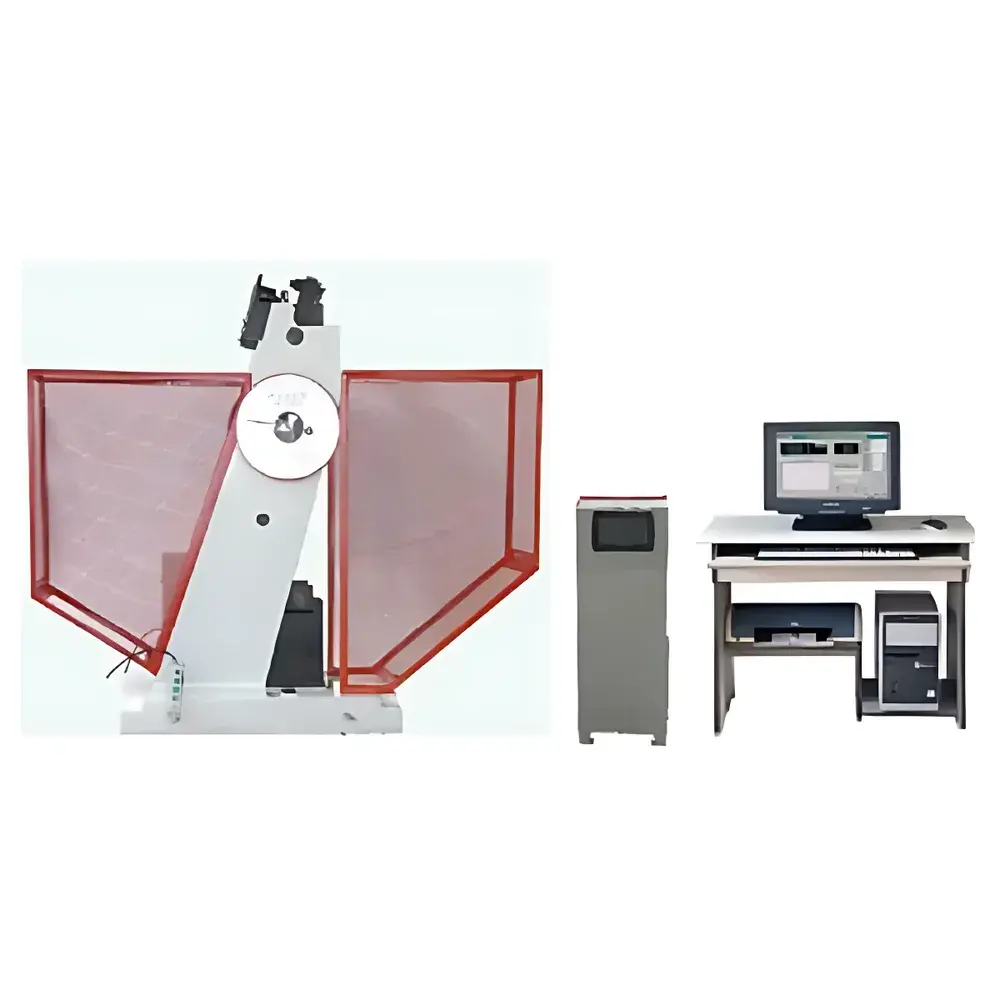
YANRUN JBWS-300C Semi-Automatic Pendulum Impact Testing Machine with Triple Digital Display
| Brand | YANRUN |
|---|---|
| Model | JBWS-300C |
| Type | Pendulum Impact Tester |
| Impact Energy | 150 J / 300 J (achieved via adjustable counterweight assembly) |
| Impact Velocity | 5.2 m/s |
| Pendulum Lift Angle | 150° |
| Support Span | 40 mm |
| Anvil Radius (support) | R1.0–R1.5 mm |
| Striking Edge Radius | R2.0–R2.5 mm and R8 mm |
| Distance from Pendulum Axis to Impact Point | 750 mm |
| Standard Specimen Dimensions | 10 × 10 × 55 mm |
| Power Supply | 3-phase, 4-wire, 380 V, 50 Hz, 180 W |
| Angular Accuracy | ±0.1° |
| Axial Positioning Accuracy | ±0.05 mm |
| Machine Weight | 450 kg |
| Overall Dimensions (L×W×H) | 2124 × 600 × 1340 mm |
Overview
The YANRUN JBWS-300C is a semi-automatic pendulum impact testing machine engineered for high-reproducibility Charpy and Izod impact measurements in quality control, materials R&D, and metallurgical laboratories. Based on the classical principle of conservation of mechanical energy, the system measures the energy absorbed by a notched or unnotched specimen during fracture under a single-axis dynamic load. The pendulum arm—rigidly mounted on a precision-ground bearing shaft—swings from a fixed initial angle (150°), delivering a calibrated impact at precisely 5.2 m/s. Energy absorption is determined by comparing pre- and post-impact angular displacement, captured via high-resolution optical encoder and verified against dual analog dial and digital display outputs. Designed in accordance with ISO 148-1, ASTM E23, and GB/T 229 standards, the JBWS-300C supports both 150 J and 300 J test configurations through interchangeable pendulum assemblies with certified counterweight calibration—ensuring traceable, repeatable results across material classes including carbon steels, stainless alloys, polymers, and composites.
Key Features
- Triple-display readout system: integrated analog scale, high-contrast LCD panel, and real-time touch-screen interface for simultaneous visual verification and operational control.
- Automated pendulum positioning: motor-driven lifting and release mechanism ensures consistent 150° pre-lift angle and eliminates manual handling errors.
- Dual-pendulum configuration: includes dedicated 150 J pendulum and field-configurable 300 J pendulum with NIST-traceable mass distribution and certified center-of-percussion alignment.
- High-precision kinematic geometry: 750 mm effective pendulum length and ±0.05 mm axial positioning accuracy minimize torsional deviation and ensure compliant specimen alignment per ISO 148-1 Annex A.
- Comprehensive safety architecture: interlocked full-enclosure protective net, emergency stop circuitry, and opto-electronic beam interruption detection (photoelectric sensor) meet CE machinery directive requirements.
- Modular support system: includes calibrated anvil set (40 mm span), standardized specimen centering tool, anvil radius adjustment gauge (R1.0–R1.5 mm), and striking edge verification fixtures (R2.0–R2.5 mm and R8 mm).
Sample Compatibility & Compliance
The JBWS-300C accommodates standard Charpy V-notch (10 × 10 × 55 mm) and Izod specimens, with optional adapters for sub-size geometries (e.g., 5 × 5 × 55 mm, 7.5 × 7.5 × 55 mm) in accordance with ASTM E23 Annex A. All mechanical components—including anvils, clamps, and striking edges—are manufactured to dimensional tolerances specified in ISO 148-2 and verified using coordinate measuring machine (CMM) traceable to national metrology institutes. The system complies with ISO/IEC 17025 requirements for testing laboratory competence and supports audit-ready documentation for GLP and GMP environments. Calibration certificates for pendulum energy, angular encoder, and support geometry are provided with each unit and align with ISO 17025-accredited third-party verification protocols.
Software & Data Management
The bundled Windows-based impact analysis software (v3.2+) runs on the included Lenovo Qitian M4880 industrial PC and provides full test sequence automation, result logging, statistical analysis (mean, SD, CV%), and PDF report generation with embedded digital signatures. Data export supports CSV, XML, and ASTM E1447-compliant .IMP formats. Audit trail functionality records all user actions—including parameter changes, calibration events, and specimen ID entries—with timestamped, non-erasable logs compliant with FDA 21 CFR Part 11 requirements when deployed with validated electronic signature modules. Raw angular displacement waveforms and energy decay curves are stored with metadata (operator ID, environmental conditions, calibration status) for full traceability.
Applications
This instrument is routinely deployed in steel mills for ductile-to-brittle transition temperature (DBTT) profiling of structural plates; in automotive component suppliers for polymer blend toughness validation under low-temperature conditions; and in aerospace material qualification labs for assessing weld zone embrittlement after heat treatment. Its dual-energy capability enables comparative studies across thickness variants (e.g., 10 mm vs. 15 mm plate) without recalibration, while the R8 mm striker option satisfies ISO 148-1 requirements for high-toughness metallics. Universities utilize the system for teaching fracture mechanics fundamentals, supported by its transparent mechanical layout and real-time energy-loss visualization.
FAQ
What standards does the JBWS-300C comply with?
ISO 148-1 (Metallic materials — Charpy pendulum impact test), ASTM E23 (Standard Test Methods for Notched Bar Impact Testing of Metallic Materials), and GB/T 229 (Chinese national standard for impact testing).
Can the machine perform both Charpy and Izod tests?
Yes — with appropriate anvil and specimen holder configurations, it supports both test geometries per ASTM E23 and ISO 180.
Is the energy calibration traceable to international standards?
Yes — each pendulum assembly is supplied with a calibration certificate traceable to NIM (National Institute of Metrology, China) and cross-verified against ISO 17025-accredited reference laboratories.
Does the software support multi-user access with role-based permissions?
Yes — administrator, operator, and reviewer roles are configurable, with password protection and activity logging per user session.
What maintenance is required for long-term angular accuracy?
Annual verification of encoder linearity and pendulum axis concentricity is recommended; bearing lubrication and optical sensor cleaning should be performed quarterly per the maintenance logbook.



