
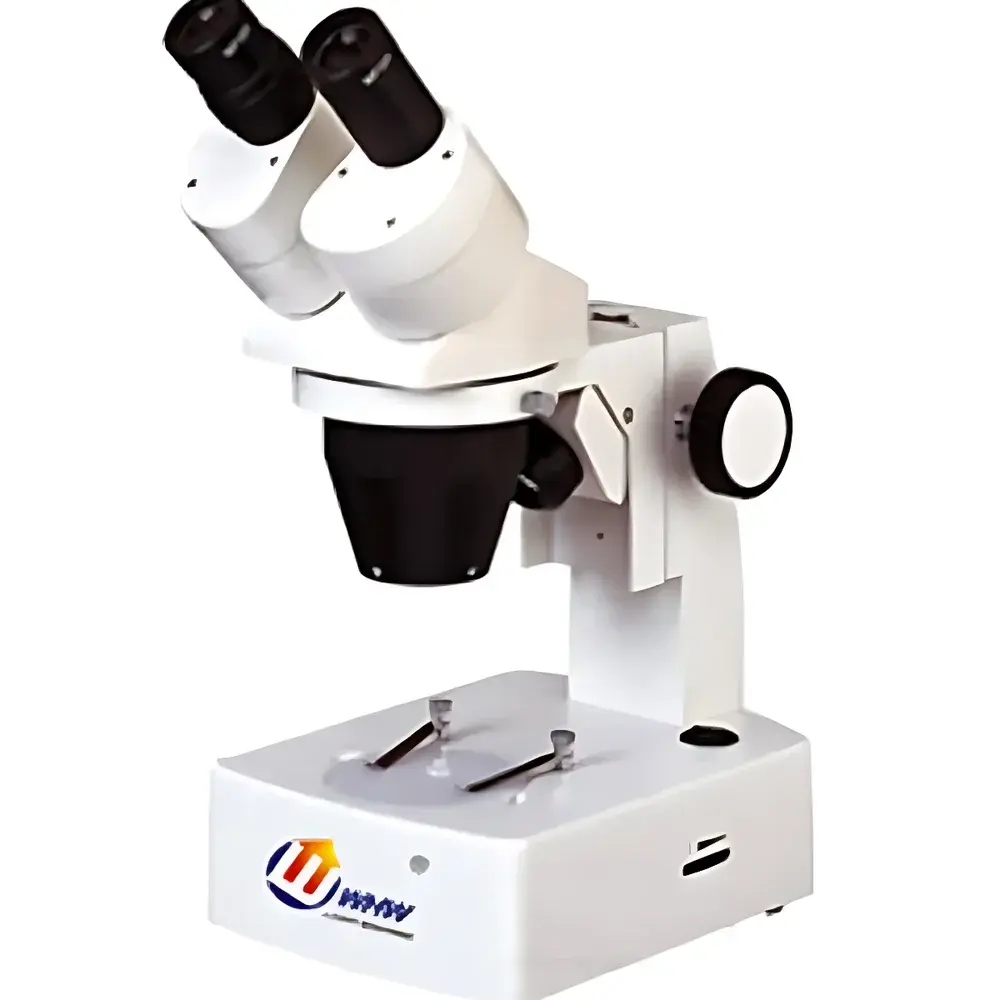
YANRUN SM-2C Fixed-Magnification Stereo Microscope
| Brand | YANRUN |
|---|---|
| Origin | Shanghai, China |
| Manufacturer Type | Direct Manufacturer |
| Product Category | Domestic (China-made) |
| Model | SM-2C Fixed-Magnification Stereo Microscope |
| Mounting Style | Upright |
| Image Analysis System | Not Integrated |
| Total Magnification | 20×, 40× |
| Eyepiece | Widefield 10× (Φ20 mm) |
| Objective Lenses | 2×, 4× |
| Working Distance | 88 mm |
| Vertical Travel Range | 88 mm ≤ H < 130 mm |
| Base Dimensions | 215 × 160 × 60 mm |
| Illumination | Top-mounted 12 V / 10 W halogen lamp with reflector cup, continuously adjustable brightness |
| Overall Dimensions | 230 × 160 × 380 mm |
| Optional Eyepiece | Graticule Widefield 10× (Φ20 mm), scale division 0.1 mm per division |
| Optional Objectives | 1×, 3× (yielding 10× and 30× total magnification) |
| Field of View | Φ10–Φ5 mm (at 20×/40×) |
Overview
The YANRUN SM-2C Fixed-Magnification Stereo Microscope is an upright, dual-optical-path stereoscopic instrument engineered for routine inspection, quality control, and manual assembly tasks in metallurgical, electronic component, precision mechanical, and educational laboratory environments. Unlike zoom-type stereo microscopes, the SM-2C employs a fixed-magnification optical architecture—comprising matched objective lenses (2× and 4×) and widefield 10× eyepieces—to deliver consistent, parfocal, and highly reproducible magnification states at 20× and 40×. This design eliminates magnification drift and focus shift associated with continuous zoom mechanisms, making it particularly suitable for standardized visual assessment protocols where measurement repeatability and inter-operator consistency are critical. The microscope utilizes Greenough-style optical geometry, ensuring natural depth perception, minimal chromatic aberration, and high-resolution edge definition across the entire field of view. Its 88 mm working distance accommodates bulky samples—including castings, PCBs, solder joints, and machined parts—without obstruction from the objective or illumination system.
Key Features
- Fixed-magnification dual-objective turret (2× and 4×) paired with widefield 10× eyepieces (Φ20 mm field number), yielding precise, repeatable magnifications of 20× and 40×
- Robust upright stand with 42 mm vertical travel range (88 mm ≤ H < 130 mm), enabling stable height adjustment while maintaining mechanical rigidity during extended use
- Top-illuminated optical path featuring a 12 V / 10 W halogen lamp with integrated reflector cup—providing uniform, shadow-minimized incident lighting with continuous intensity control
- Stable aluminum alloy base (215 × 160 × 60 mm) and compact overall footprint (230 × 160 × 380 mm), optimized for benchtop integration in QC labs and production line stations
- Optional calibrated graticule eyepiece (10×, 0.1 mm per division) supports basic dimensional estimation without external imaging hardware
- Modular compatibility with optional 1× and 3× objectives for extended low-magnification capability (10× and 30×), retaining identical mechanical tube length and parfocality
Sample Compatibility & Compliance
The SM-2C accommodates opaque, reflective, and moderately textured specimens typical of metallurgical analysis—including polished metallographic mounts, fracture surfaces, weld seams, and surface-coated components. Its long working distance and top-only illumination eliminate interference from sample holders or stage accessories, permitting direct observation of unmounted or oversized parts up to 85 mm in height. While not equipped with motorized stages or digital imaging interfaces, the microscope conforms to foundational optical safety standards (IEC 61010-1 for electrical safety) and supports GLP-aligned documentation when used with calibrated graticules and standardized observation SOPs. It serves as a compliant primary inspection tool in ISO 9001-certified manufacturing facilities where visual acceptance criteria are defined per ASTM E3, ISO 13007, or internal QA checklists.
Software & Data Management
The SM-2C operates as a standalone optical instrument without embedded firmware, network connectivity, or proprietary software. It does not include an integrated image capture module or analysis suite; however, its standard C-mount thread (optional adapter required) permits compatibility with third-party USB or HDMI cameras for documentation purposes. When paired with validated imaging systems, the microscope supports traceable image acquisition workflows compliant with FDA 21 CFR Part 11 requirements—provided audit trails, user authentication, and electronic signature controls are implemented at the camera/software layer. Raw visual assessments conducted using the graticule eyepiece may be recorded manually in paper-based or LIMS-integrated logbooks, satisfying basic GMP record-keeping expectations for non-critical inspections.
Applications
- Metallurgical sample screening: rapid identification of porosity, inclusions, grain boundary delineation, and surface defects on polished cross-sections
- Electronics manufacturing: solder joint integrity verification (IPC-A-610), component placement accuracy checks, and PCB trace continuity inspection
- Mechanical assembly: alignment verification of gears, bearings, and miniature actuators prior to functional testing
- Educational laboratories: hands-on demonstration of stereoscopic vision principles, optical parallax, and comparative morphology analysis
- Toolroom metrology: qualitative evaluation of surface finish, burr presence, and chamfer consistency on machined parts
FAQ
Is the SM-2C compatible with digital imaging systems?
Yes—via optional C-mount adapter, it supports integration with industry-standard USB or HDMI cameras for documentation. No native software or driver suite is provided.
Does the microscope meet ISO or ASTM standards for optical measurement?
It complies with general optical safety and electrical safety standards (IEC 61010-1). Magnification accuracy and field-of-view specifications align with ISO 8578 for stereo microscopes, though formal calibration certification requires third-party verification.
Can the working distance be extended beyond 88 mm?
No—the mechanical design fixes working distance at 88 mm for both 2× and 4× objectives. Optional 1× and 3× objectives retain the same working distance but reduce magnification.
Is the halogen illumination suitable for prolonged use?
The 12 V / 10 W lamp is rated for ≥2,000 hours under normal duty cycles. Heat dissipation is managed via passive aluminum housing; ambient temperature should remain below 35 °C for optimal lamp life.
What documentation is supplied with the instrument?
Each unit includes a printed user manual (English), factory test report confirming optical alignment and magnification verification, and CE/ROHS compliance declarations. Calibration certificates are available upon request at additional cost.





