
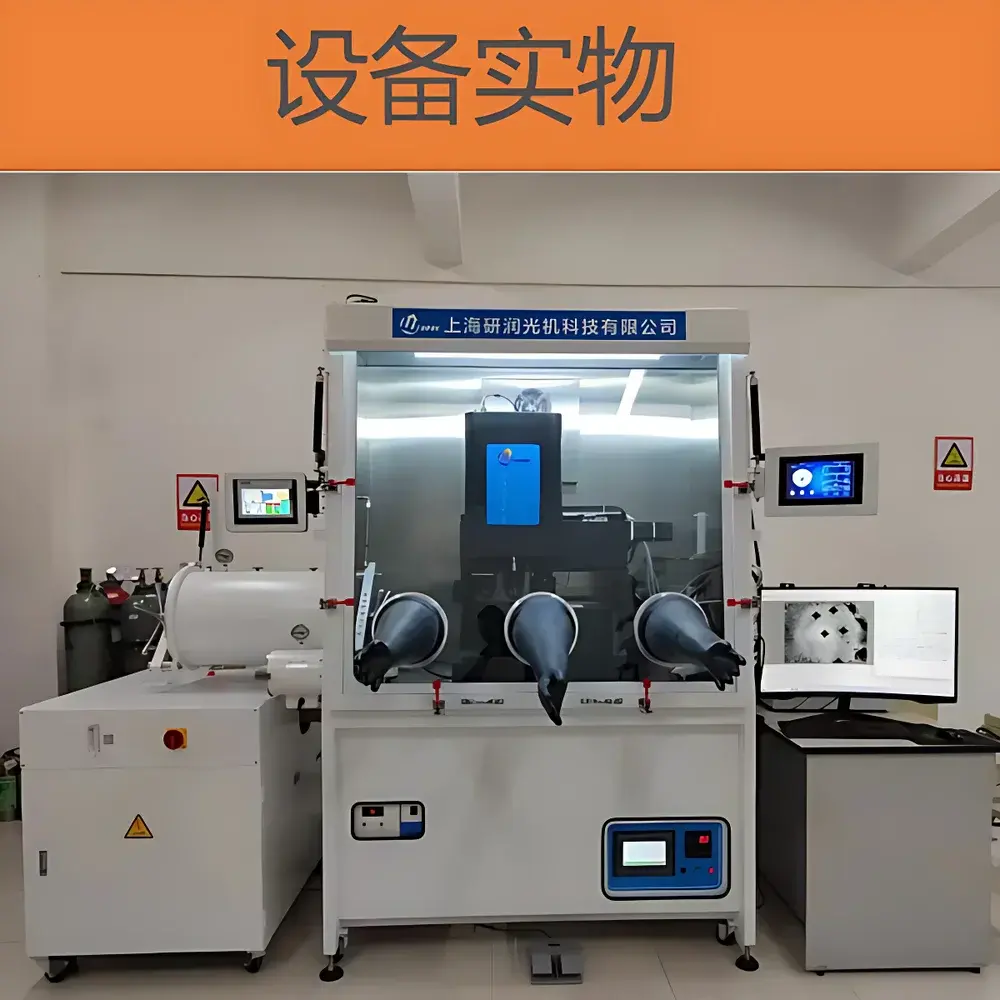
YANRUN HMAS-HT800 Full-Field High-Temperature Vickers Hardness Tester
| Brand | YANRUN |
|---|---|
| Origin | Shanghai, China |
| Manufacturer Type | Direct Manufacturer |
| Instrument Type | Vickers Hardness Tester |
| Measurement Range | 1–3000 HV |
| Operating Temperature Range | Ambient to 800 °C |
| Load Capacity | Standard 30 kgf, Optional 1–150 kgf |
| Optical System | 10× Objective (20× Optional), 1000× Display Magnification (2000× Optional) |
| Temperature Uniformity | ≤ ±5 °C Across 80 × 80 × 60 mm Furnace Chamber |
| Thermal Control Accuracy | ±1 °C |
| Heating Rate | 1–40 °C/min |
| Sample Size Limit | ≤ φ20 × 20 mm |
| Auto-Sample Exchange Time | ≤ 20 s Within Isothermal Field |
| Multi-Axis Motion Control | 4-Axis, Positioning Accuracy ≤ ±1.5 µm |
| Force Resolution | 0.01% FS |
| Load Application Precision | ±2% (≤1 kgf), ±0.5% (>1 kgf) |
| Indenter Material | Cubic Boron Nitride (CBN) Pyramid |
| Optional Indenters | Spherical, Conical, Cylindrical |
| Image Recognition & In-Situ Analysis | Integrated High-Temperature Imaging and Automated Indentation Evaluation |
Overview
The YANRUN HMAS-HT800 is a full-field, high-temperature Vickers hardness tester engineered for quantitative mechanical property evaluation of advanced materials under controlled thermal conditions up to 800 °C. Unlike conventional hardness testers that operate only at ambient temperature or employ localized heating, the HMAS-HT800 maintains a uniform, isothermal furnace environment across its entire measurement chamber—enabling true in-situ indentation testing with real-time optical observation and automated data acquisition. The system operates on the principle of standardized Vickers microhardness testing (ASTM E384, ISO 6507-1), where a diamond pyramid indenter is loaded onto the specimen surface under precisely regulated force and dwell time, and the resulting diagonal impression is measured optically to compute hardness (HV). At elevated temperatures, this methodology provides critical insight into thermally activated deformation mechanisms—including dislocation mobility, creep resistance, phase stability, and interfacial relaxation—essential for metallurgy, ceramic development, aerospace alloy qualification, and nuclear material research.
Key Features
- Full-field isothermal furnace with S-type thermocouple feedback and ±1 °C thermal control accuracy across an 80 × 80 × 60 mm working volume.
- High-temperature optical imaging module featuring a 10× objective (20× optional) capable of real-time observation and indentation measurement at 800 °C; system magnification up to 2000× with sub-micron resolution (1.19–1.44 µm).
- Multi-range load application system: standard 30 kgf capacity with optional extension to 150 kgf; fixed 16-step or configurable 32/61/127-step loading profiles; force resolution of 0.01% full scale.
- Automated 4-axis motion platform (X/Y/Z + Z-B for indenter positioning) with ≤ ±1.5 µm repeatability and ≤ 0.1 µm motion resolution—enabling precise multi-point mapping and gradient testing.
- In-situ rapid sample exchange mechanism completing full specimen replacement within ≤20 seconds without thermal interruption—critical for high-throughput comparative studies across composition or heat treatment variables.
- Integrated high-temperature indenter assembly using cubic boron nitride (CBN) pyramid geometry, rated for continuous operation at 800 °C; optional spherical, conical, and cylindrical indenters support fracture toughness (KIC) and plasticity analysis per ASTM E1820 and ISO 20501.
- Modular environmental integration: optional inert-atmosphere glovebox (H2O/O2 ≤ 1 ppm), water-cooling (±0.3 °C stability), gas-quenching (≤10 s cooldown), and chamber air-conditioning modules ensure compatibility with oxidation-sensitive or thermally fragile specimens.
Sample Compatibility & Compliance
The HMAS-HT800 accommodates cylindrical or disc-shaped specimens up to φ20 × 20 mm, compatible with metallic alloys (Ni-based superalloys, Ti-Al intermetallics), technical ceramics (SiC, Al2O3, ZrO2), refractory composites, and thin-film coated substrates. Its design supports compliance with multiple international standards including ASTM E384 (microindentation hardness), ASTM E1820 (fracture toughness), ISO 6507 (Vickers hardness), ISO 20501 (instrumented indentation), and USP (mechanical characterization of pharmaceutical excipients under thermal stress). When equipped with audit-trail-enabled software and electronic signature modules, the system meets GLP and GMP requirements for regulated R&D environments—including FDA 21 CFR Part 11 readiness upon configuration.
Software & Data Management
The HMAS-HT800 is operated via a wall-mounted industrial PC running proprietary YANRUN HT-Analysis Suite—a deterministic, real-time control platform supporting synchronized thermal ramping, load application, image capture, and geometric feature extraction. All test parameters—including temperature profile, load sequence, dwell time, XY position map, and indentation morphology—are timestamped and stored in structured HDF5 format. The software enables automated calculation of hardness gradients, crack length-to-indentation diagonal ratios (for KIC), and thermal softening curves. Export options include CSV, XML, and PDF reports compliant with laboratory information management systems (LIMS). Optional API integration allows direct data ingestion into MATLAB, Python (via PyHDF), or enterprise analytics platforms for statistical process control and machine learning–driven material property modeling.
Applications
- Thermal stability assessment of turbine blade coatings during simulated service cycling.
- Creep-hardness correlation studies in directionally solidified Ni–Cr–Al alloys above 0.5 Tm.
- Interfacial strength quantification in diffusion-bonded ceramic-metal joints subjected to thermal shock.
- Phase transformation kinetics in shape-memory alloys via in-situ hardness mapping across programmed cooling ramps.
- Fracture resistance evaluation of ultra-high-temperature ceramics (UHTCs) under combined thermal–mechanical loading.
- Quality assurance of additively manufactured components across post-processing heat treatments (HIP, solution annealing, aging).
FAQ
What is the maximum operating temperature of the HMAS-HT800, and how is temperature uniformity maintained?
The system operates continuously from ambient to 800 °C. Uniformity is achieved through a dual-zone HRE alloy heating element array, active thermal shielding, and closed-loop S-type thermocouple feedback with PID tuning—ensuring ≤ ±5 °C deviation across the full 80 × 80 × 60 mm furnace cavity.
Can the instrument perform hardness measurements during dynamic heating or cooling?
Yes. The system supports programmed thermal gradients (1–40 °C/min) with synchronized indentation at user-defined setpoints, enabling temperature-dependent hardness profiling and transient mechanical response capture.
Is the indenter replaceable, and what materials are used for high-temperature durability?
The standard indenter uses a CBN pyramid mounted on a nickel–chromium alloy shank (110 mm length). While non-repairable, optional full-size 1700-series replaceable indenters (φ6.35 or φ8 mm) are available for extended service life at extreme temperatures.
Does the system support automated hardness mapping across large-area samples?
Yes. The 4-axis motorized stage enables programmable grid-based indentation arrays (e.g., 10 × 10 points), with auto-focus and image-based diagonal measurement for spatial hardness distribution analysis.
What safety and environmental controls are integrated for reactive or oxygen-sensitive samples?
Optional glovebox integration provides inert-atmosphere handling (Ar/N2) with ≤1 ppm H2O/O2 levels; vacuum transition lock and modular gas-cooling allow safe transfer and rapid quenching without ambient exposure.



