
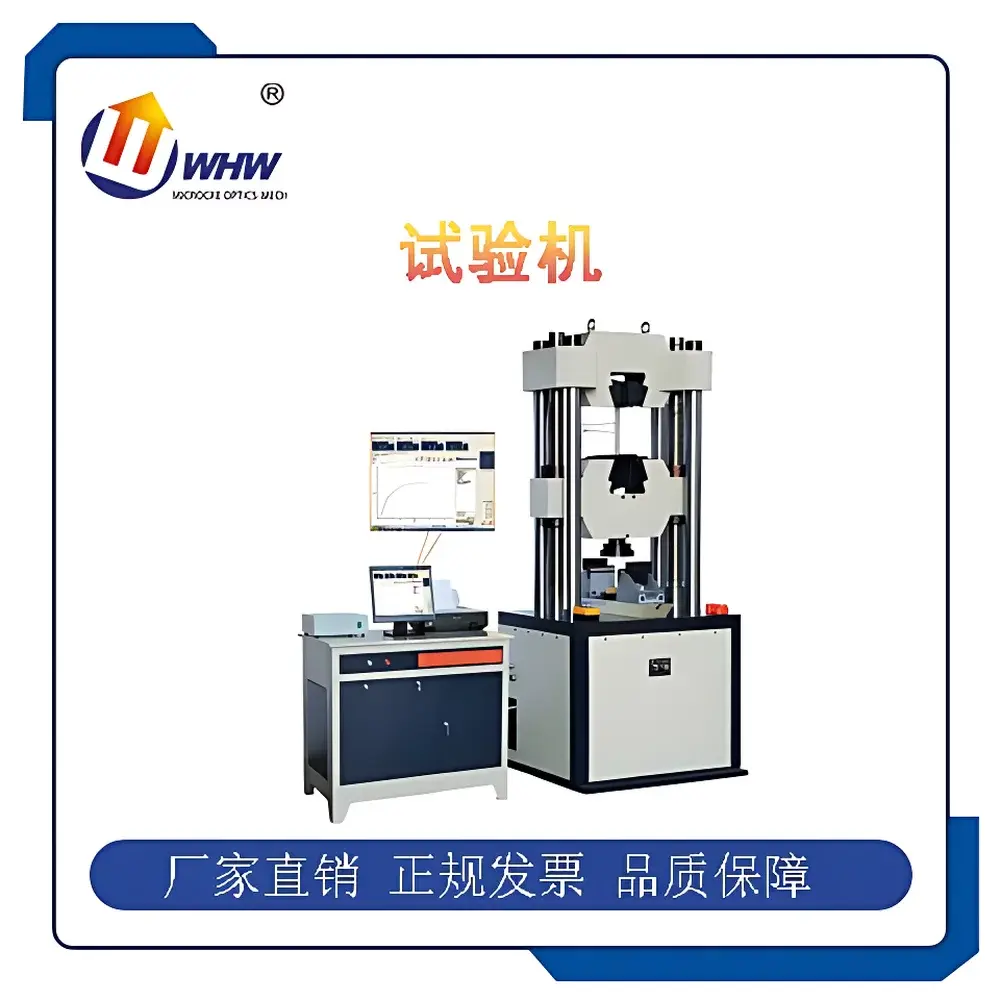
YANRUN MC009-WAW-300 Microcomputer-Controlled Electro-Hydraulic Servo Universal Testing Machine
| Brand | YANRUN |
|---|---|
| Origin | Shanghai, China |
| Manufacturer Type | Manufacturer |
| Origin Category | Domestic (China) |
| Model | MC009-WAW-300 |
| Instrument Type | Electro-Hydraulic Servo Testing Machine |
| Load Capacity | 6–300 kN |
| Load Accuracy | ±1% or ±0.5% FS |
Overview
The YANRUN MC009-WAW-300 is a high-stability, microcomputer-controlled electro-hydraulic servo universal testing machine engineered for precision mechanical property evaluation of metallic and non-metallic materials under tension, compression, bending, and shear loading conditions. Based on the classical Couette-type hydraulic actuation principle with closed-loop servo control, the system delivers reproducible force application across its full 6–300 kN operational range. Its lower-mounted cylinder architecture provides enhanced structural rigidity and thermal stability—critical for long-duration creep and relaxation tests—and positions the tensile test zone above the main frame while locating compression and flexural test zones between the movable crosshead and fixed base plate. The machine complies with international mechanical testing standards including ISO 6892-1 (tensile testing of metallic materials), ASTM E4 (load verification), ASTM E8/E8M (tension testing), and ISO 7500-1 (static calibration of force-proving instruments), supporting traceable, audit-ready test execution in GLP- and GMP-regulated environments.
Key Features
- Lower-cylinder, single-column frame design with optimized load path geometry for minimal deflection and high lateral stiffness.
- Four-channel closed-loop digital control system managing test force, specimen deformation, crosshead displacement, and real-time test progression—each independently configurable.
- High-resolution A/D conversion module delivering 1/500,000 internal resolution, enabling seamless full-scale measurement without range switching or manual gain adjustment.
- Electro-hydraulic servo actuation with proportional directional control valve, ensuring precise regulation of oil flow into the piston chamber for constant-rate force, displacement, or strain control.
- Dual-stage overload and stroke-limit protection: automatic pump shutdown triggered when applied load exceeds 103% of full scale or when piston reaches upper mechanical limit.
- Robust hydraulic power unit with high-pressure gear pump, differential pressure filter assembly, and thermally stabilized oil reservoir to maintain viscosity consistency during extended test cycles.
- Adjustable test space via motor-driven chain-and-screw crosshead positioning system, supporting rapid configuration for diverse specimen geometries and standard-compliant gauge lengths.
Sample Compatibility & Compliance
The MC009-WAW-300 accommodates cylindrical specimens ranging from Φ13 mm to Φ40 mm and flat specimens up to 15 mm thick, with standardized grips conforming to ISO 6892-1 Annex B and ASTM E8 Annex A1. Bending fixtures support two-point loading configurations per ISO 7438 and ASTM D790, with roller diameters of Φ30 mm and adjustable span lengths up to 350 mm. All force transducers are factory-calibrated against national metrological standards and certified to ISO/IEC 17025-accredited reference laboratories. The system meets Class 1 and optional Class 0.5 accuracy requirements per ISO 7500-1, with verified linearity, hysteresis, and repeatability performance documented in the supplied calibration certificate. Data acquisition and storage comply with FDA 21 CFR Part 11 requirements when used with validated software modules—including electronic signatures, audit trails, and user-access controls.
Software & Data Management
The integrated PC-based control and analysis software supports multi-step test programming, real-time curve overlay, and automated report generation in PDF, Excel, and XML formats. All raw data—including time-stamped force, displacement, and extensometer signals—are stored in a structured SQLite database with immutable records and versioned metadata. Software features include: programmable hold segments, conditional branching based on force/displacement thresholds, batch test sequencing, and customizable pass/fail criteria aligned with ISO 10360 or ASTM E2382. Exported datasets retain full traceability to instrument ID, operator credentials, environmental logs (optional temperature/humidity input), and calibration history. Optional add-ons enable direct integration with LIMS platforms via HL7 or RESTful API interfaces.
Applications
This testing platform serves as a primary mechanical characterization tool in R&D laboratories and quality assurance departments across metallurgy, aerospace component manufacturing, civil infrastructure materials certification, polymer composite development, and academic mechanics research. Typical use cases include: tensile property mapping of high-strength alloy sheets per ASTM B557; compressive strength validation of concrete cylinders under ISO 4108; fatigue pre-conditioning of orthopedic implant alloys prior to cyclic testing; and shear modulus determination of elastomeric bearing pads used in seismic isolation systems. Its wide dynamic range and dual-mode control fidelity make it suitable for both routine QC screening and advanced constitutive modeling studies requiring high-fidelity stress–strain histories.
FAQ
What standards does the MC009-WAW-300 comply with for force measurement accuracy?
It conforms to ISO 7500-1 Class 1 (±1% FS) and optional Class 0.5 (±0.5% FS), verified through third-party accredited calibration with NIST-traceable deadweight standards.
Can the system perform strain-controlled tests using an external extensometer?
Yes—the controller accepts analog inputs from clip-on or video extensometers, enabling closed-loop strain control with resolution down to 0.005 mm per ISO 9513.
Is the hydraulic oil system compatible with ISO VG 46 or equivalent mineral-based hydraulic fluids?
Yes—standard configuration uses ISO VG 46 anti-wear hydraulic oil; operating temperature range is maintained between 10 °C and 50 °C via optional thermostatic cooling.
Does the software support automated compliance with 21 CFR Part 11?
When deployed with the validated software package (v3.2+), it provides full electronic signature implementation, audit trail logging, and role-based access control required for regulated environments.
What is the maximum recommended piston velocity for high-precision quasi-static testing?
For optimal force resolution and system stability, velocities ≤5 mm/min are recommended for tests requiring <±0.5% accuracy; maximum rated speed is 50 mm/min for coarse positioning or preliminary alignment.



