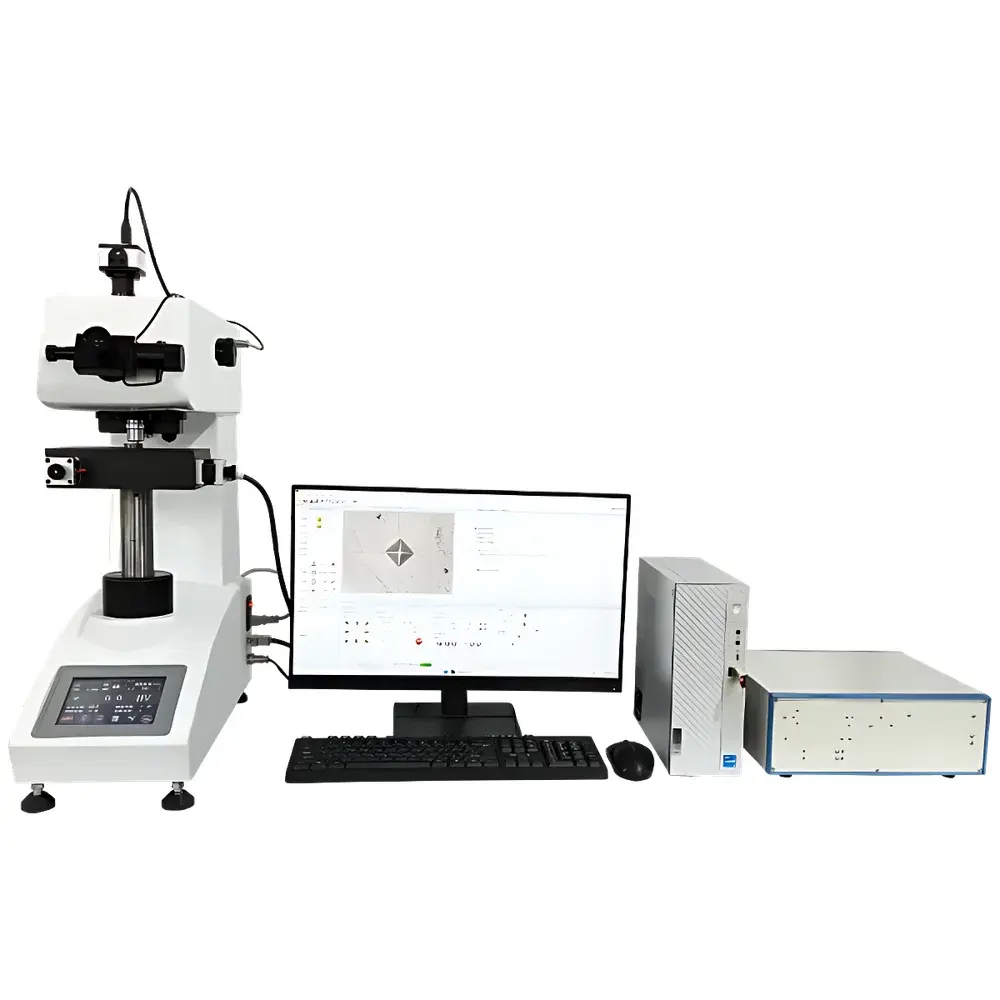
YANRUN HMAS-C1000SZA Automated Microhardness Testing System
| Brand | YANRUN |
|---|---|
| Origin | Shanghai, China |
| Manufacturer Type | Direct Manufacturer |
| Country of Origin | China |
| Model | HMAS-C1000SZA |
| Optical System | High-Precision Triple-Port Microscopy with Dual Measurement Pathways |
| Turret Mechanism | Motorized Turret with Precision Z-Axis Elevation |
| Test Forces | 8-step selectable (0.098–9.807 N / 10–1000 gf) |
| Hardness Scales | HV0.01 to HV1 |
| Compliance | GB/T 4340.1–2009 |
| X-Y Stage Travel | 25 × 25 mm (optional 50 × 50 mm), Repeatability: ±2 µm |
| Max Specimen Height | 130 mm |
| Depth from Indenter to Chamber Wall | 170 mm |
| Magnification | 100× (observation), 400× (optical measurement), ~1500× (digital image analysis) |
| Minimum Resolution | 0.025 µm |
| Dwell Time | 1–60 s (1 s increments) |
| Specimen Stage Size | 140 × 180 mm |
| Dimensions (L×W×H) | 570 × 220 × 680 mm |
| Net Weight | 46.0 kg |
| Gross Weight | 61.0 kg |
Overview
The YANRUN HMAS-C1000SZA Automated Microhardness Testing System is a fully integrated, computer-controlled instrument engineered for high-precision Vickers and Knoop microhardness measurements in metallurgical, materials science, and quality assurance laboratories. Based on the standardized indentation principle defined in ISO 6507 and ASTM E384, the system applies precisely calibrated loads to a diamond pyramid indenter, then measures the diagonal lengths of the resulting impression under high-magnification optical imaging. Its triple-port optical architecture enables simultaneous real-time viewing, manual measurement via eyepiece, and automated digital image capture—ensuring traceable, operator-independent results across multiple test points. Designed for compliance-critical environments, the HMAS-C1000SZA supports audit-ready workflows through deterministic motion control, calibrated force application, and software-logged metadata including load, dwell time, position coordinates, and environmental timestamps.
Key Features
- Motorized dual-axis (X-Y) stage with ±2 µm positional repeatability over 25 × 25 mm travel range (expandable to 50 × 50 mm), enabling precise grid-based hardness mapping and cross-sectional gradient profiling.
- Automated turret with synchronized indenter and objective lens switching—eliminating manual alignment errors and ensuring consistent optical path geometry across all test forces (0.098–9.807 N).
- Dual-path optical imaging system: 10× digital eyepiece for direct observation and 40× objective lens for measurement; total optical magnification up to 400×, enhanced to ~1500× via calibrated digital zoom and sub-pixel edge detection algorithms.
- Computer-integrated control interface supporting full remote operation—including load selection, dwell time setting, stage positioning, auto-focus initiation, and measurement execution—mirroring all hardware panel functions with identical functional fidelity.
- Hardness calculation engine compliant with GB/T 4340.1–2009 and aligned with ISO 6507-1:2018 methodology, automatically compensating for diagonal asymmetry and surface tilt using iterative centroid correction.
Sample Compatibility & Compliance
The HMAS-C1000SZA accommodates specimens up to 130 mm in height and 170 mm from indenter center to chamber interior wall—suitable for bulk metallographic mounts, coated substrates, thin-film cross-sections, and heat-treated components. Its mechanical design conforms to the dimensional and operational requirements of ISO 6507-2 for instrument verification and ASTM E10-22 for hardness tester calibration. All hardness values are reported in standard Vickers units (HV) with traceability to national standards through factory-certified force transducers and NIST-traceable reference blocks. The system supports GLP/GMP documentation protocols: each test record includes embedded metadata (operator ID, calibration status, environmental conditions, stage coordinates), and optional 21 CFR Part 11-compliant electronic signatures can be enabled via validated software modules.
Software & Data Management
The proprietary HMAS Analysis Suite provides a Windows-based platform for acquisition, quantification, statistical evaluation, and reporting. It captures raw grayscale images at 12-bit depth with hardware-triggered synchronization to load application and dwell cycle. Image processing includes adaptive thresholding, morphological filtering, and sub-pixel diagonal length interpolation (resolution limit: 0.025 µm). Data export options include CSV, Excel, and XML formats compatible with LIMS integration. Statistical modules compute mean hardness, standard deviation, confidence intervals (95%), and generate contour maps, line profiles, and histogram distributions. Audit trails log every user action—including parameter changes, result edits, and report generation—with immutable timestamps and user authentication.
Applications
- Depth-resolved hardness profiling of case-hardened steels, nitrided surfaces, and diffusion zones.
- Quantitative evaluation of coating adhesion integrity via microhardness gradients at substrate-coating interfaces.
- Quality control of sintered ceramics, carbide tools, and additive-manufactured alloys where localized property variation affects performance.
- Research-grade metallurgical analysis including grain boundary hardening, precipitate strengthening effects, and irradiation-induced embrittlement studies.
- Failure analysis investigations requiring correlation between microstructural features (e.g., inclusion distribution, phase morphology) and local mechanical response.
FAQ
Is the HMAS-C1000SZA compliant with international hardness testing standards?
Yes—the system implements test procedures and calculation algorithms fully aligned with ISO 6507-1:2018, ASTM E384-23, and GB/T 4340.1–2009. Force calibration certificates and verification reports are provided with each unit.
Can the system perform automatic hardness mapping across irregular or curved surfaces?
The motorized stage supports programmable coordinate sequences and Z-height compensation via optional tactile probe integration; however, full topographic adaptation requires external profilometry data import and custom script-based trajectory planning.
What software validation documentation is available for regulated industries?
IQ/OQ documentation packages, URS templates, and 21 CFR Part 11 readiness assessments are available upon request. Software version history, change logs, and patch validation records are maintained per GAMP 5 guidelines.
Does the system support Knoop hardness measurements?
Yes—Knoop scale calculations (HK) are enabled within the software using the same optical measurement engine, with appropriate load and scale selection per ASTM E384 Annex A2.
How is measurement uncertainty quantified and reported?
Uncertainty budgets follow ISO/IEC Guide 98-3 (GUM), incorporating contributions from force accuracy (±0.5% FS), optical resolution (±0.025 µm), diagonal measurement repeatability (typically <1.2% RSD), and environmental drift. Expanded uncertainty (k=2) is displayed alongside each hardness value in exported reports.